 Chuckanut Exterior
 Cedar Siding Has Real Appeal — We're Not Pretending Otherwise
Cedar siding shows up on a lot of beautiful homes around Whatcom County, and it's easy to see why. The grain is genuinely striking, it takes stain well, and there's a warmth to a cedar-clad house that manufactured products spend a lot of marketing money trying to imitate. If a homeowner asks us why we don't install it, we don't start with a list of complaints. We start by admitting cedar looks good and always has.
The problem isn't the wood itself. Western red cedar is naturally rot-resistant compared to most softwoods, thanks to oils in the heartwood that resist decay and insects. That's real, and it's why cedar has a long history as a siding and shingle material in the Pacific Northwest. Our decision to stop installing it as an exterior siding company isn't about the tree — it's about what happens to that wood once it's milled into thin siding boards and hung on a wall that faces Chuckanut's weather, year after year, decade after decade.
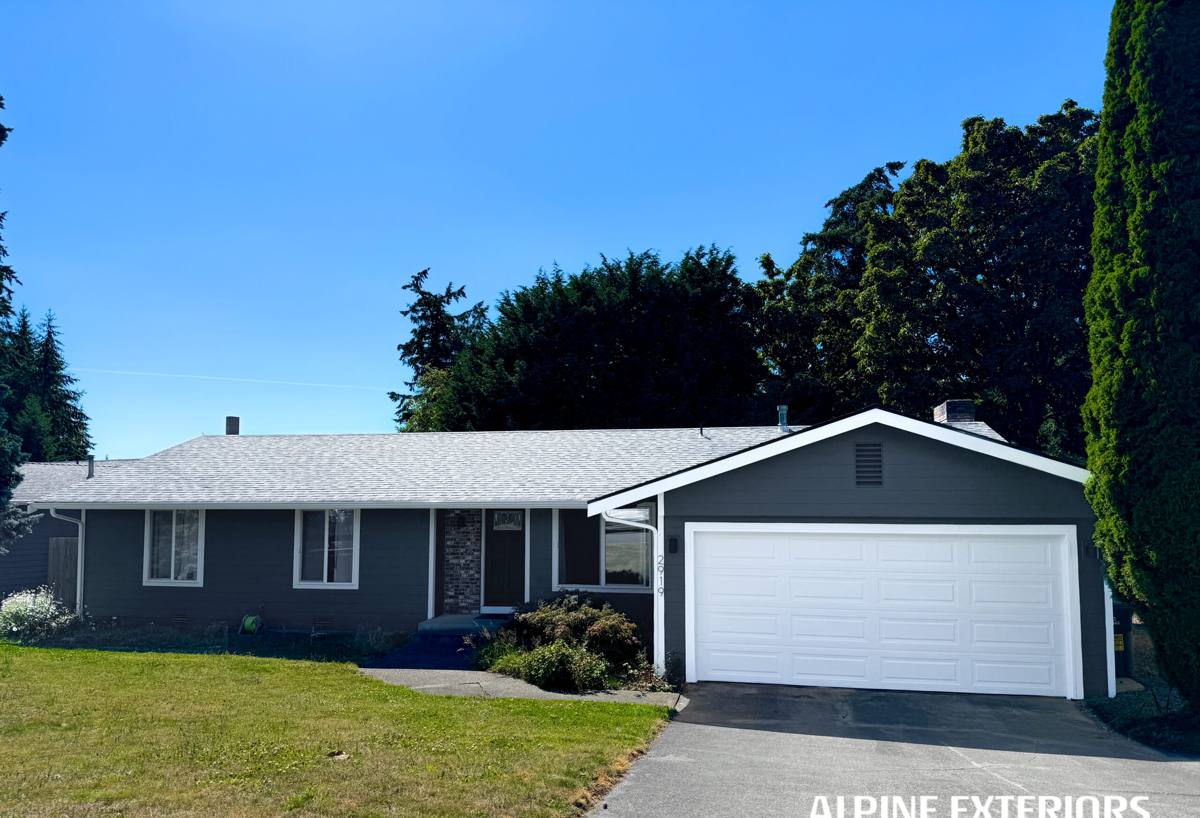
What Chuckanut's Climate Does to Wood Siding
Chuckanut sits in a spot where the marine air off Bellingham Bay meets the drainage off the ridge, and that combination produces a specific kind of punishment for exterior wood: salt-laden air, long stretches of driving rain, and a moss season that can run from October into May. None of these are exotic conditions — they're just constant, and constant is what wears wood siding down.
Salt air accelerates the breakdown of finishes and pulls moisture into end grain and fastener holes faster than drier inland climates. Driving rain — rain that comes in sideways off the water rather than falling straight down — gets forced under lap joints and around trim in ways that vertical rain doesn't. And moss doesn't just sit on top of siding; it holds moisture against the wood surface for months at a time, which is exactly the environment wood decay fungi need to get established. Put those three together on a house in Whatcom County and you have conditions that are, frankly, tougher on wood siding than what cedar was doing well in a century ago before homes were built this close together, with this much shade, and this little airflow along exterior walls.
Why This Matters More Today Than It Used To
Older cedar-sided homes in this region often had more roof overhang, more spacing from vegetation, and simpler wall assemblies that let wood dry out between rain events. Modern construction — tighter lots, more landscaping close to the foundation, energy-sealed wall assemblies — traps moisture against siding longer than it used to. Cedar can handle getting wet. What it struggles with is staying wet, and staying wet is increasingly the norm rather than the exception on shaded, north-facing, or heavily landscaped walls in this area.
The Maintenance Reality Homeowners Aren't Always Told
This is the heart of why we walked away from installing cedar siding: it is not a low-maintenance product, and a lot of homeowners find that out after they've already paid for it.
- Stain or sealer needs reapplication roughly every 2-5 years depending on sun and rain exposure — sooner on walls that face the weather directly
- Skipping a maintenance cycle doesn't just mean faded color; it means the wood's moisture protection is gone and decay can start underneath a finish that still looks intact
- Caulking at joints, trim, and penetrations needs regular inspection — cedar moves with humidity, and failed caulk lines are one of the most common entry points for water damage
- Moss and mildew need active removal, not just pressure washing, which itself can damage soft cedar grain if done incorrectly
- Board replacement is common on any 15-20 year old cedar installation, usually starting at the bottom courses, around windows, and on north-facing walls
None of that is a defect in the product. It's the honest cost of owning a wood exterior. We just don't think it's fair to sell a homeowner a siding job without being upfront that the real cost of cedar includes a recurring maintenance bill that many other materials don't carry.
Moisture, Rot, and the Repair Pattern We See
When cedar siding fails, it rarely fails all at once. It fails in patches — a section behind a downspout that was never quite draining right, a run of boards under an eave that doesn't quite clear the wall, a spot where two courses met and the caulk gave out three winters ago and nobody noticed. By the time it's visible from the ground, there's often hidden damage to the sheathing behind it.
That kind of localized, hidden-until-it's-bad failure pattern is exactly what makes wood siding repairs expensive relative to the size of the visible problem. A homeowner budgeting for "a little wood repair" is sometimes looking at opening up a wall section to find rot that's spread further than the siding alone suggested. We'd rather not put a product on a house that has that failure mode built into it, especially in a climate that gives wood so many chances to stay damp.
Fire Considerations Worth Knowing
Cedar is a combustible material — it's wood, and untreated or lightly treated wood siding burns. Whatcom County isn't the dry east-side wildfire corridor, but insurance underwriting increasingly looks at exterior material as part of a home's overall risk profile, and some carriers now factor siding combustibility into premiums or coverage terms. That's a conversation we think homeowners deserve to have before installation, not after a renewal notice arrives with a surprise.
How Cedar Compares to What We Actually Install
| Factor | Cedar Siding | James Hardie Fiber Cement |
|---|---|---|
| Combustibility | Combustible (wood) | Non-combustible core material |
| Moisture/rot risk | Vulnerable if finish fails or moisture is trapped | Engineered to resist moisture-driven decay |
| Refinishing cycle | Stain/seal every 2-5 years | ColorPlus factory finish rated for decades, no regular repainting |
| Pest vulnerability | Susceptible to insects if finish is compromised | Not a food source for insects |
| Product warranty | Typically installer/finish warranty only | Manufacturer-backed, transferable warranty on the siding itself |
| Upfront material cost | Moderate to high | Moderate, with lower lifetime cost from reduced maintenance |
We want to be fair here: cedar's upfront material cost is sometimes comparable to or even less than fiber cement, depending on grade and milling. The gap shows up over time, in maintenance dollars and hours, and in what the wall assembly is doing when nobody's watching it — which, on a Chuckanut property with moss season half the year, is most of the year.
Why We Standardized on James Hardie Instead
We install James Hardie fiber cement siding exclusively, and the reasoning is straightforward: it's a non-combustible material engineered specifically for climates like this one. Hardie's HZ10 product line is formulated for regions with the kind of moisture exposure Whatcom County sees — freeze-thaw cycling isn't the main event here, but sustained damp is, and that's what the HZ10 engineering targets.
The ColorPlus factory finish system is a big part of why we stopped worrying about the maintenance conversation that dominates cedar ownership. Instead of a field-applied stain that starts breaking down against sun and rain within a few years, the color is baked on at the factory under controlled conditions, with a warranty that follows the finish, not just the substrate. That doesn't mean zero maintenance forever — no exterior material is maintenance-free — but it changes the maintenance conversation from "recoat every few years" to periodic washing and inspection.
Hardie also backs the product with a manufacturer warranty that's transferable to a new owner, which matters if a homeowner ever sells. A wood siding job's remaining life is a much harder thing to warranty or transfer, because so much of its condition depends on how consistently it was maintained.
What We Tell Homeowners Who Still Want Cedar
Some homeowners hear all of this and still want the look of wood. That's a legitimate preference, and we don't try to talk anyone out of liking what they like. What we do is decline to install it ourselves, and we say why: we don't want to sell a product we know will need a maintenance commitment most homeowners underestimate, in a climate that's actively working against it every rainy month of the year. If cedar is the right call for a particular home and owner, there are contractors who specialize in it and can advise on species, finish systems, and detailing far better than we can, since it isn't our focus.
What we can speak to with confidence is what happens after installation when the material is engineered for this exact climate rather than adapted to it. That's the whole reason we narrowed our focus to one product line instead of offering everything.
Get an Honest Look at Your Options
If you're weighing cedar against fiber cement for a home in Chuckanut or anywhere else in Whatcom County, we're glad to walk the property with you, look at sun exposure, moss patterns, and drainage, and give you a straight answer about what we'd recommend and why. The estimate is free, there's no pressure, and if cedar genuinely makes sense for your situation we'll tell you that too.