 Chuckanut Exterior
 What Primed Spruce Siding Actually Is
Primed spruce siding is solid-sawn wood — usually clear or select-grade spruce, milled into lap boards or panels and coated with a factory or site-applied primer before installation. It's been a staple of Pacific Northwest construction for generations, and there's a reason for that: it's real wood, it takes paint well, and on a dry, well-detailed wall it can look genuinely beautiful. A lot of the older homes along Chuckanut Drive and through the surrounding Whatcom County hillsides still wear it.
We get asked about it often enough that it's worth laying out, plainly, why we don't install it anymore — not because it's a bad product in the abstract, but because of what happens to it here, in this specific climate, over the years we're actually responsible for standing behind our work.
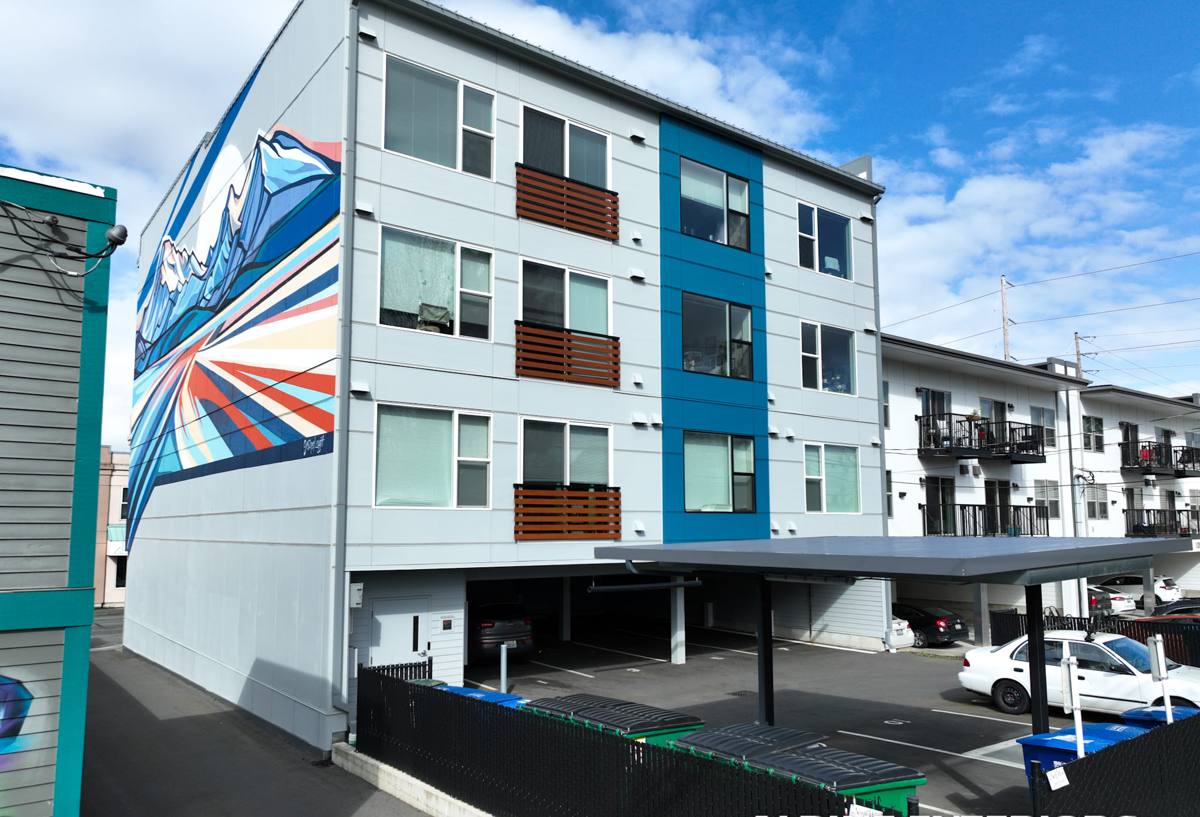
What Primed Spruce Gets Right
Before we get into why we walked away from it, it deserves a fair shake. Primed spruce has real strengths:
- It's a natural, renewable material with a warm, traditional look that vinyl and some engineered products struggle to replicate.
- It can be field-cut, shaped, and repaired with basic carpentry tools — no specialty fasteners or factory coordination required.
- Well-maintained wood siding on a protected elevation can genuinely last decades.
- It's readily available and familiar to most framing and trim crews, which keeps labor costs predictable on the front end.
If a homeowner lived somewhere arid, kept up an aggressive repaint schedule, and had wide roof overhangs shielding every wall, primed spruce could be a reasonable choice. That's just not the environment most of our customers live in.
Why Our Local Climate Changes the Equation
Chuckanut sits where the Chuckanut Mountains drop straight into Samish and Bellingham Bay, and that geography stacks three separate stresses on top of each other that most siding products never have to face all at once.
Salt Air
Homes along Chuckanut Drive and the surrounding shoreline take on airborne salt from the bay. Salt is hygroscopic — it pulls moisture out of the air and holds it against whatever surface it lands on. On painted wood, that means the paint film is under constant chemical and moisture stress, which is exactly the condition that causes premature peeling, checking, and the gray, chalky breakdown you see on older wood-sided homes near the water.
Driving Rain
Storms coming off the Salish Sea don't just fall straight down here — wind-driven rain hits walls at an angle, especially on west- and south-facing elevations with little overhang protection. Wood siding depends almost entirely on an intact paint film to keep water out of the fiber. Once wind-driven rain finds a hairline crack, a nail hole, or a butt joint where the primer didn't fully seal, water gets into the wood and doesn't dry out quickly in our humidity.
A Long Moss Season
Whatcom County's mild, wet stretch runs long — moss, algae, and lichen get a real foothold on north-facing and shaded walls for much of the year. Organic growth holds moisture against the siding surface even longer than rain alone, and it's abrasive and unsightly enough that most homeowners end up pressure washing to keep it in check — which is hard on a painted wood surface and easy to do wrong.
None of these three things alone would necessarily rule out wood siding. Together, stacked on top of each other for months at a time, every year, they're the reason primed spruce has a shorter, higher-maintenance service life here than it does in drier parts of the country.
The Maintenance Reality Nobody Loves to Talk About
Primed siding is not finished siding — the primer is a base coat, not a topcoat, and it's only rated to protect bare wood for a limited window before it needs a real paint job over it. After that, the maintenance clock doesn't stop:
| Maintenance Task | Typical Interval in This Climate | What Happens If Skipped |
|---|---|---|
| Repaint / recoat | Roughly every 5-8 years, often sooner on sun- and rain-exposed walls | Paint film fails, bare wood absorbs moisture, rot begins at seams and end grain |
| Caulk joints and butt seams | Annual inspection, resealed as needed | Water tracks behind boards, staining and swelling follow |
| Moss and algae removal | 1-2 times per year on shaded elevations | Organic growth holds surface moisture, accelerates paint breakdown |
| Spot repair of rot or splitting | As discovered, ideally before it spreads | Localized rot works into adjacent boards and sheathing |
That's not a knock on any particular homeowner's upkeep — it's just the honest workload that comes with a painted wood exterior in a coastal, high-rainfall county. A lot of people don't fully understand that commitment when they buy or build, and we'd rather tell them up front than sell them something we know will demand that much attention.
Where Installation Sensitivity Comes In
Even a well-maintained paint schedule can't fully protect wood siding if the install itself has gaps. Wood siding depends on details that are easy to shortcut and hard to inspect later:
- Every cut end needs to be primed or sealed on-site — factory priming only covers the face and back, not field-cut edges, and end grain is where wood absorbs water fastest.
- Butt joints need to be back-primed and properly flashed, not just butted and caulked.
- Nail holes need to be set and filled correctly, not just driven and left proud or overdriven.
- Adequate clearance from grade, decks, and roof lines has to be maintained so splashback and snow-load contact don't sit against the bottom course.
Any one of those steps done carelessly turns into a moisture entry point within a few seasons. We'd have to build in that level of field-priming and detailing discipline every time, on every job, in a climate that punishes shortcuts faster than most — and we decided our crews' time was better spent installing a system engineered to not need that margin for error.
Cost Over the Life of the Siding
Primed spruce is often cheaper to buy and install than fiber cement up front. Over the life of the siding, that gap narrows or reverses once you account for the ongoing work:
| Factor | Primed Spruce | James Hardie Fiber Cement |
|---|---|---|
| Upfront material and install cost | Generally lower | Generally higher |
| Repainting need | Recurring, every 5-8 years | ColorPlus factory finish typically holds far longer before repaint is needed |
| Moisture and rot risk | Higher, especially at joints and cut ends | Fiber cement does not rot; moisture behavior is engineered into the product |
| Combustibility | Combustible | Non-combustible fiber cement |
| Manufacturer warranty | Varies, often limited or none on the wood itself | Strong transferable limited warranty when installed to spec |
We're not going to invent numbers for you — real costs depend on your home's size, elevation exposure, and current condition. But when you weigh a lower purchase price against a decade of recurring paint jobs and moisture repairs, the total cost of ownership tells a different story than the estimate on day one.
Why We Standardized on James Hardie Instead
This is really the point of the page. We don't install LP SmartSide, vinyl, Cemplank, Allura, primed spruce, or cedar — not because every one of those products is without merit, but because we chose to build our whole operation, our crew training, and our warranty relationship around one system: James Hardie fiber cement.
Hardie's HZ5 product line is specifically engineered for climates like ours — wet, coastal, moss-prone. The fiber cement substrate doesn't rot, doesn't feed pests, and won't burn. The ColorPlus factory finish is baked on under controlled conditions, which gives it far more consistent, long-lasting protection than a field-primed and painted wood board can achieve, especially against the salt air and driving rain this stretch of coastline sees. When it's installed correctly — proper clearances, fastening, and joint treatment — it's a system that's proven itself over decades in exactly the conditions Chuckanut deals with.
Standardizing on one product also means our crews aren't relearning install details for five different siding systems. Every job gets the same trained eyes on the same details, which matters more here than almost anywhere.
Signs Your Current Wood Siding Needs a Closer Look
If you already have primed spruce or another painted wood siding on your home, here's what's worth checking before it turns into a bigger repair:
- Peeling, cracking, or chalky paint, especially on south- and west-facing walls
- Soft or spongy spots when you press on the siding, particularly near the bottom courses
- Dark staining or streaking around butt joints and nail heads
- Persistent moss or algae growth that returns quickly after cleaning
- Visible gaps or separation at seams and trim boards
- A repaint that's overdue by more than a year or two
Catching these early can mean spot repairs instead of a full re-side. Left alone through another wet Whatcom County winter, they usually don't get better on their own.
Let's Talk About Your Home
Every house and every wall is different, and we're happy to take a look at what you've got before recommending anything. If you're weighing a repaint against a full re-side, or just want an honest read on how your current siding is holding up against our coastal weather, reach out for a free, no-pressure estimate — no obligation, no pressure, just a straight answer.