 Chuckanut Exterior
 What LP SmartSide Actually Is
LP SmartSide is an engineered wood siding product. The core is strand board — wood strands bonded with resin under heat and pressure, similar in concept to OSB sheathing — then treated with a zinc borate preservative and coated with a resin-saturated overlay to resist moisture and insects. It comes prefinished or primed, in lap, panel, and trim profiles, and it installs faster and lighter than fiber cement in a lot of crews' hands. It's also generally less expensive up front than James Hardie, which is a real and honest advantage worth naming.
We're not going to pretend LP SmartSide is a bad product on paper. Engineered wood has come a long way since the OSB siding failures of the 1990s that gave the category a bad name. LP's current SmartSide line, with its treated strand technology, is a legitimate step up from that era. But "better than a 1990s product" and "what we're willing to warranty our workmanship over" are two different bars, and after years of installing siding in Whatcom County's weather, we've landed on fiber cement — specifically James Hardie — as the only product we put our name behind.
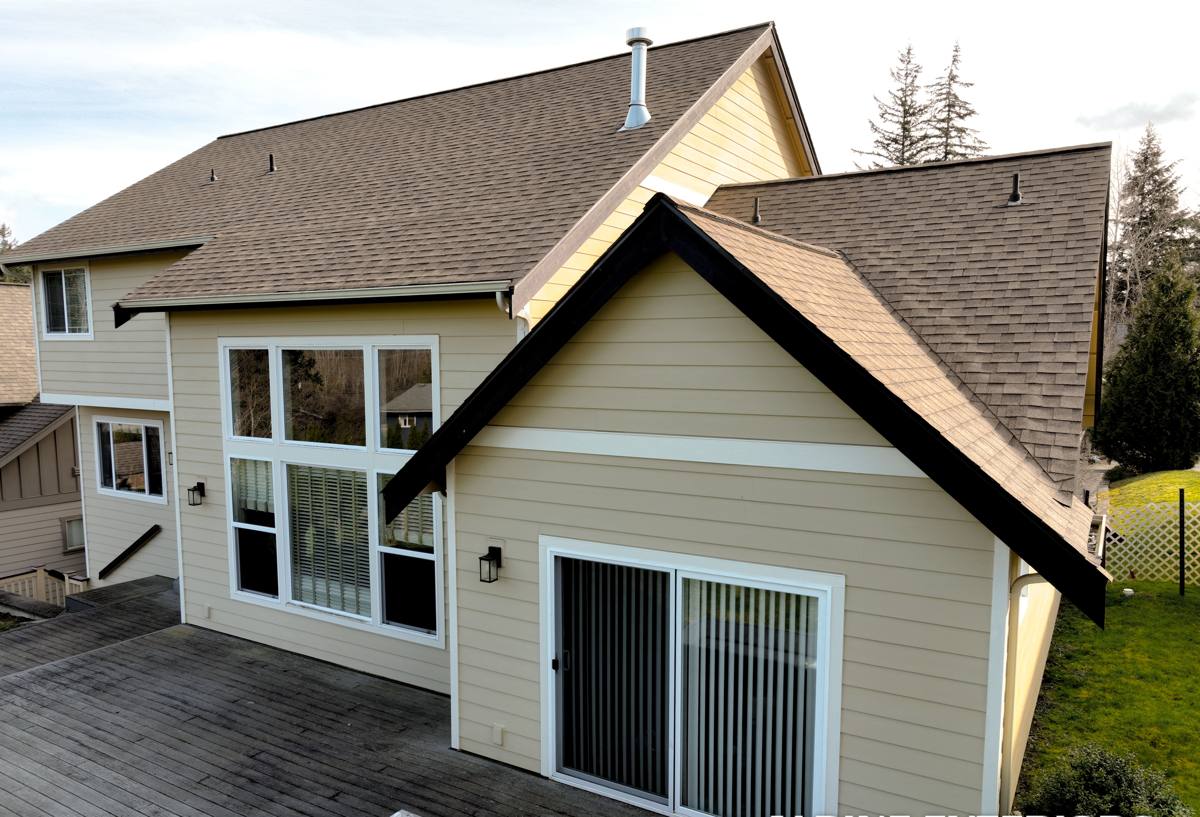
The Trade-Off We Can't Get Past: It's Still Wood
Strip away the resin coating and the borate treatment, and the core material is still wood fiber. Wood swells and shrinks with moisture, and it's a food source for the fungi and insects that cause rot — the treatments slow that process, they don't eliminate the underlying chemistry. Fiber cement, by contrast, is made from Portland cement, sand, and cellulose fibers. It doesn't feed rot, it doesn't swell with humidity the way wood does, and it's non-combustible rather than merely fire-treated.
The place this shows up first on an engineered wood product is at the cut edges — where a plank is trimmed on site, at butt joints, around windows, and at the bottom edge near grade. Factory coatings protect the face of the board well. Field cuts expose raw substrate, and if that edge isn't sealed correctly with the manufacturer's specified caulk or edge sealant every single time, it becomes the entry point for moisture. On a home with dozens of cuts, joints, and penetrations, that's a lot of places where one missed detail can start a slow problem you won't see for a few years.
Where This Plays Out on a House
- Butt joints between courses, especially on longer wall runs
- Corners and trim intersections where boards are mitered or butted
- Bottom edges near foundations, decks, and grade
- Around window and door penetrations
- Anywhere a fastener is driven slightly off and needs to be re-set
Why Chuckanut's Climate Raises the Stakes
Every siding product has weak points. What changes the calculus here is the environment we're actually installing into. Chuckanut sits right along the water on Chuckanut Drive south of Bellingham, in Whatcom County, which means homes here deal with a combination most inland markets don't see together: near-constant salt-laden air off Samish Bay and the Salish Sea, driving rain that comes in sideways off the water during winter storms, and a moss and algae season that runs long because the humidity rarely lets up. That combination is hard on any exterior material, but it's specifically hard on a wood-based one.
Driving rain forces water into laps, joints, and fastener holes under wind pressure rather than just running down the face of the wall — exactly the conditions where a compromised seal or an unsealed cut edge turns into a wicking point. Salt air accelerates the breakdown of coatings and finishes over time, meaning a factory coating that's rated for general exposure works harder here than it would forty miles inland. And moss and algae hold moisture against the wall surface for weeks at a stretch during the wet season, keeping any exposed wood substrate damp longer than a drier climate would. None of this means engineered wood siding fails on every Chuckanut home — plenty of installations hold up fine. It means the product has a smaller margin for error in exactly the conditions this area delivers every winter, and that margin gets smaller with every year the coating ages.
Installation Sensitivity Is the Real Issue
Most of the horror stories associated with engineered wood siding trace back to installation, not the product itself. LP is explicit in its own installation guidelines about required gaps, fastener placement, flashing details, and field-cut sealing — and when those specs are followed exactly, the product performs as designed. The problem is that those specs are numerous, easy to shortcut on a production schedule, and unforgiving of drift. A crew that's fast and careful with fiber cement can get sloppy with engineered wood without any visible sign of a problem for a year or two, because the failure mode is slow moisture intrusion, not an obvious construction defect.
We'd rather not run that risk on a house with our name on the estimate. Fiber cement is also installation-sensitive — it needs proper clearances, correct fastener patterns, and painted-not-caulked field cuts on unfinished edges — but the failure mode when something's slightly off is far more forgiving, because the substrate itself isn't feeding rot the way exposed wood fiber does.
Maintenance and Long-Term Cost
Lower material cost up front is real, but it's only half the cost picture. Engineered wood siding generally asks more of a homeowner over the life of the product: periodic re-caulking of joints and cut edges, repainting on a shorter cycle than a factory-baked finish, and closer attention to anything that looks like a soft spot or bubbling paint before it spreads. Fiber cement with a factory ColorPlus finish is built to go far longer between repaints and doesn't rely on the homeowner catching a caulk failure before it becomes a moisture problem.
| Factor | LP SmartSide (engineered wood) | James Hardie (fiber cement) |
|---|---|---|
| Core material | Resin-bonded wood strand board | Cement, sand, cellulose fiber |
| Combustibility | Treated, but wood-based | Non-combustible |
| Cut-edge moisture risk | Requires field sealing at every cut | Requires field priming/painting, more forgiving substrate |
| Finish life before repaint | Shorter cycle, primed or factory finish | Longer cycle with ColorPlus factory finish |
| Upfront material cost | Generally lower | Generally higher |
| Performance in driving rain / salt air | More dependent on installation and coating maintenance | Engineered HZ product lines built for exposure |
Warranty Structure Matters More Than the Number
Warranty length gets quoted like it's the whole story, but the structure underneath matters just as much. Read any manufacturer warranty closely and you'll find carve-outs around improper installation, failure to seal field cuts, inadequate maintenance, and prorated coverage that shrinks the payout the longer you've owned the product. That's not unique to any one brand — it's standard in the building products industry — but it matters more on a product where a missed maintenance step is what triggers the failure in the first place. James Hardie's warranty coverage on its fiber cement products, backed by a substrate that isn't chasing a maintenance clock the same way, is part of why we standardized on it. We want the warranty conversation with a homeowner to be short, not a document full of exceptions.
What We Install Instead, and Why
We install James Hardie fiber cement siding exclusively. It's non-combustible, it holds paint and factory ColorPlus finishes far longer than wood-based products, and Hardie's HZ5 product line is specifically engineered for climates with heavy moisture exposure — which describes Whatcom County's coastline well. It doesn't feed rot, it resists the moss and algae buildup that's a fact of life in a marine climate, and it stands up to salt air and driving rain without asking a homeowner to stay ahead of a caulking schedule. It costs more to buy and more to install correctly, and we think that's the honest trade a homeowner in this area should be making with their eyes open.
A Practical Checklist If You're Comparing Siding Options
- Ask what the core substrate actually is, not just the brand name on the box
- Ask how field-cut edges are sealed and how often that seal needs attention
- Ask for the manufacturer's installation spec sheet, not just the marketing brochure
- Ask what voids the warranty, specifically — not just how many years it runs
- Ask how the product performs in the local wind-driven rain and marine humidity, not just a generic climate zone
- Get the repaint or refinish cycle in writing, so you know the real cost over 15-20 years
The Bottom Line
LP SmartSide isn't a scam product and we're not claiming otherwise — it's a legitimate engineered wood siding that performs reasonably well when installed exactly to spec and maintained on schedule. Our decision not to install it is a professional standard, not an attack on the product: after years of siding work in a marine climate with long moss seasons and hard winter rain off the water, we decided we'd rather build our business around a material with a wider margin for error and a shorter maintenance list. That's James Hardie fiber cement, and it's the only siding system we put on Chuckanut homes.
If you're weighing your siding options and want a straight answer about what will actually hold up on your specific home, we're happy to take a look and give you a free, no-pressure estimate — no obligation, just an honest read on what your house needs.