 Chuckanut Exterior
 Composite Decking Built for Sehome's Weather, Not Just Its Looks
Sehome sits close enough to the water and under enough tree cover that a deck here works harder than a deck in a drier inland town. Salt-tinged air off the bay accelerates corrosion on fasteners and hardware. Driving rain off the water finds every gap in flashing and framing. And the shaded, damp stretch that runs from fall through spring gives moss and algae months to take hold on any surface that doesn't drain and dry properly. Composite decking handles that combination better than most materials on the market, but only when it's installed with those specific conditions in mind. A composite deck built the same way you'd build one in Spokane or Sacramento will disappoint a Sehome homeowner within a few wet seasons — the boards themselves may be fine, but the framing, fasteners, and drainage underneath won't be.
This page is about that distinction: what composite decking actually needs to perform well on a Sehome property, and what our crew does differently because we already know the neighborhood's conditions rather than guessing at them from a spec sheet.
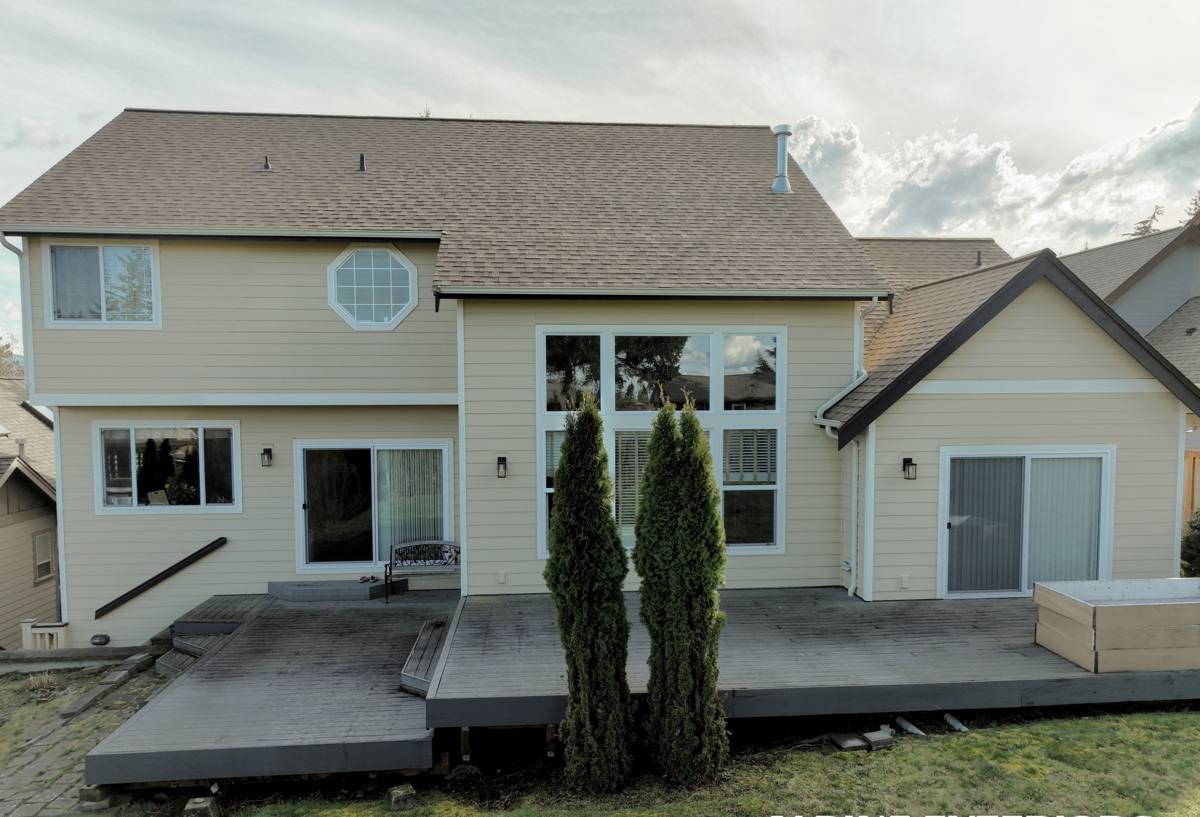
What a Correctly Built Composite Deck Involves
Composite boards themselves are largely maintenance-free, but they sit on top of a wood or engineered substructure, and that substructure is where most premature deck failures in Whatcom County actually start. A correct installation treats the frame as the part that has to survive the climate, since the decking surface is doing that job for itself.
Framing and Ledger Attachment
Where a deck attaches to the house, the ledger board needs proper flashing that sheds water away from the rim joist and siding, not just a bead of caulk. On homes in wetter Western Washington neighborhoods, we see ledger rot far more often than we see problems with the decking above it, because that connection point traps moisture against the house for months at a time if it isn't flashed correctly. We also use joist tape or an equivalent moisture barrier across the tops of the joists themselves, since composite decking traps some condensation underneath, and untreated joists sitting under that moisture for years will eventually fail even if the boards on top look brand new.
Fastening, Spacing, and Drainage
Hidden fastener systems are standard on most composite decks now, and they matter for more than appearance — a clean board surface with no screw heads has fewer places for water to pool and fewer points where a fastener can corrode and stain the board around it. Board spacing has to account for composite's expansion and contraction with temperature swings, and the whole deck needs a slight slope away from the house so water actually runs off instead of sitting on the surface. On a shaded lot, standing water is exactly what feeds moss and mildew growth, so getting that slope right at framing time saves years of cleaning headaches later.
Railings, Stairs, and Trim
Railings and stair systems take the brunt of salt air exposure since they're vertical, exposed on all sides, and handled constantly. We spec hardware — screws, brackets, post connectors — rated for coastal or high-moisture exposure rather than standard interior-grade fasteners, because the cost difference is small relative to what it costs to replace corroded hardware embedded in composite trim a few years down the road. Fascia boards and skirting also need ventilation gaps so the space under the deck can dry out between rain events instead of staying damp and dark, which is exactly the environment moss and mold prefer.
Composite vs. Wood vs. PVC: Which Makes Sense in This Climate
All three materials can work in Whatcom County. The right choice depends on how much upkeep you want to do, your budget, and how exposed the deck is to sun, shade, and salt air. Here's how they actually compare for a Sehome property rather than in general terms.
| Material | Maintenance in this climate | Moss/mildew resistance | Typical lifespan |
|---|---|---|---|
| Pressure-treated wood | Annual cleaning, periodic sealing or staining | Low — porous surface holds moisture and organic growth | 10-15 years before major repair or replacement |
| Capped composite | Occasional soft washing, no sealing or staining | High — capped shell resists staining and surface growth | 25-30+ years, backed by manufacturer warranty |
| PVC decking | Occasional cleaning, no sealing | High — fully synthetic, no wood content to feed growth | 25-30+ years, though it can flex more in temperature swings |
We install capped composite most often for Sehome homeowners because it strikes the best balance between low upkeep and a natural wood-grain look, but PVC is a reasonable choice for a full-sun deck with no tree canopy overhead. Uncapped or older-generation composite products are more prone to moisture absorption at the board edges, which matters more here than in a dry climate, so we steer clients toward capped or fully synthetic products for anything staying outside year-round in this weather.
Moss, Mildew, and Salt Residue: What Ongoing Care Actually Looks Like
One of the real advantages of composite decking here is how little it asks of you compared to wood, but "low maintenance" doesn't mean "no maintenance." A shaded deck under tree cover will still develop a thin film of algae or moss on the surface over a wet winter, especially on the north side of a house or under overhanging branches. The fix is a soft wash with a composite-safe cleaner — never a pressure washer on high pressure, which can etch or fray the surface texture of most composite boards and void the manufacturer warranty. For homes closer to the water, an occasional rinse of railings and hardware helps clear salt residue before it can accelerate corrosion on screws, brackets, and fasteners. None of this is difficult work, but skipping it entirely for several years is how a deck that should look new at year ten starts looking tired instead.
Cost Factors for a Sehome Composite Deck Project
Composite decking projects vary enough in scope that a flat price-per-square-foot number rarely tells you much on its own. Broadly, most composite deck projects in this area run somewhere in the range of $35 to $70 per square foot installed, with the final number driven by the factors below rather than the decking material alone.
| Factor | Why it moves the price |
|---|---|
| Existing substructure condition | Sound framing can sometimes be reused; rotted or undersized framing needs rebuilding before decking goes on |
| Decking tier | Entry-level capped composite costs less than premium multi-tone or PVC boards |
| Railing system | Composite or aluminum railing costs more than basic pressure-treated rail, cable rail more still |
| Footings and site slope | Sloped or hillside lots may need engineered or helical footings instead of standard concrete piers |
| Tear-off of an old deck | Demolition and disposal of an existing structure adds labor before the new build starts |
| Permit and inspection requirements | Elevated decks, stairs, and structural attachment to the house typically require a permit and inspection |
Our Process, Start to Finish
- Site visit and assessment: we look at the existing structure (if there is one), the slope of the lot, sun and shade exposure, and how the deck ties into the house before recommending anything.
- Design and material selection: we walk through composite board options, colors, and railing systems based on your budget and how much sun or shade the deck actually gets.
- Permitting: we handle the permit application and coordinate required inspections so you're not the one tracking down paperwork.
- Demolition, if needed: old decking and any compromised framing is removed and hauled off.
- Framing and structural work: ledger flashing, joist protection, footings, and blocking are addressed before a single composite board is installed.
- Decking, railing, and stair installation: boards go down with hidden fasteners and correct spacing, followed by railing, stairs, and trim.
- Final inspection and walkthrough: we confirm the deck passes inspection where required and walk you through basic care before we consider the job finished.
Signs Your Current Deck Should Be Replaced Rather Than Repaired
Not every deck problem calls for a full rebuild, but in a climate that's hard on framing and fasteners, some issues are worth taking seriously before they become safety concerns.
- Soft, spongy, or visibly darkened decking boards, especially near the house or in shaded areas
- Rust streaks running down from fasteners or brackets, which usually means the hardware underneath is corroding
- Persistent moss or algae growth that returns within weeks of cleaning
- Any wobble or movement in railings or stair stringers when weight is applied
- Visible gaps or separation where the ledger board meets the house
- A deck more than 15-20 years old built with older, uncapped composite or standard pressure-treated lumber
Why Local Experience in Sehome Matters
Building codes, frost depth, and drainage requirements in Whatcom County aren't identical to a coastal town two states south, and a crew that hasn't worked here regularly can miss details that only show up after a full winter of rain. We already know how shaded, tree-covered lots in this area behave over a wet season, which sides of a house tend to hold moisture longest, and how much extra attention hardware needs given the salt air coming off the water. That's not a sales pitch — it's the difference between a deck that's designed for the conditions it will actually sit in versus one that's designed for a national average climate that doesn't exist in Sehome.
Permits and Site Considerations
Most elevated decks, and any deck involving structural attachment to the house or new footings, require a building permit in this area, along with inspections at the framing stage and again once the project is complete. Hillside and sloped lots, which are common in and around Sehome, sometimes need engineered footing plans rather than standard concrete piers, particularly where drainage or soil stability is a factor. We handle the permit application and inspection scheduling as part of the project so you aren't left navigating that process on your own, and we'll flag early if your lot's slope or drainage pattern is likely to affect the footing design or timeline.
Ready to Talk About Your Deck?
If you're weighing a new composite deck, a rebuild of an aging one, or just want an honest read on whether your current deck has a few good years left in it, we're happy to take a look. Use the form below to request a free, no-pressure estimate, and we'll walk the site with you before recommending anything.