 Chuckanut Exterior
 Why Decks in the Mount Vernon Area Wear Out Faster Than You'd Expect
A deck in Mount Vernon lives a harder life than most homeowners assume. The combination of salt-tinged marine air drifting in off the Sound, long stretches of driving rain through fall and winter, and a moss season that can run five or six months out of the year means wood and fasteners are under near-constant moisture pressure. Add in the shade from mature trees common on lots throughout the area, and you get decks that stay damp long after the rain stops. That's the environment we build our repair process around, not a generic checklist pulled from a drier climate.
Most deck problems we find in this region aren't dramatic. They're slow: a ledger board that's been wicking moisture for years, fasteners that have corroded quietly under decking boards, or a drainage path that was never designed to handle the volume of water this area actually gets. By the time a deck feels "off" underfoot, the damage is usually well past the surface.
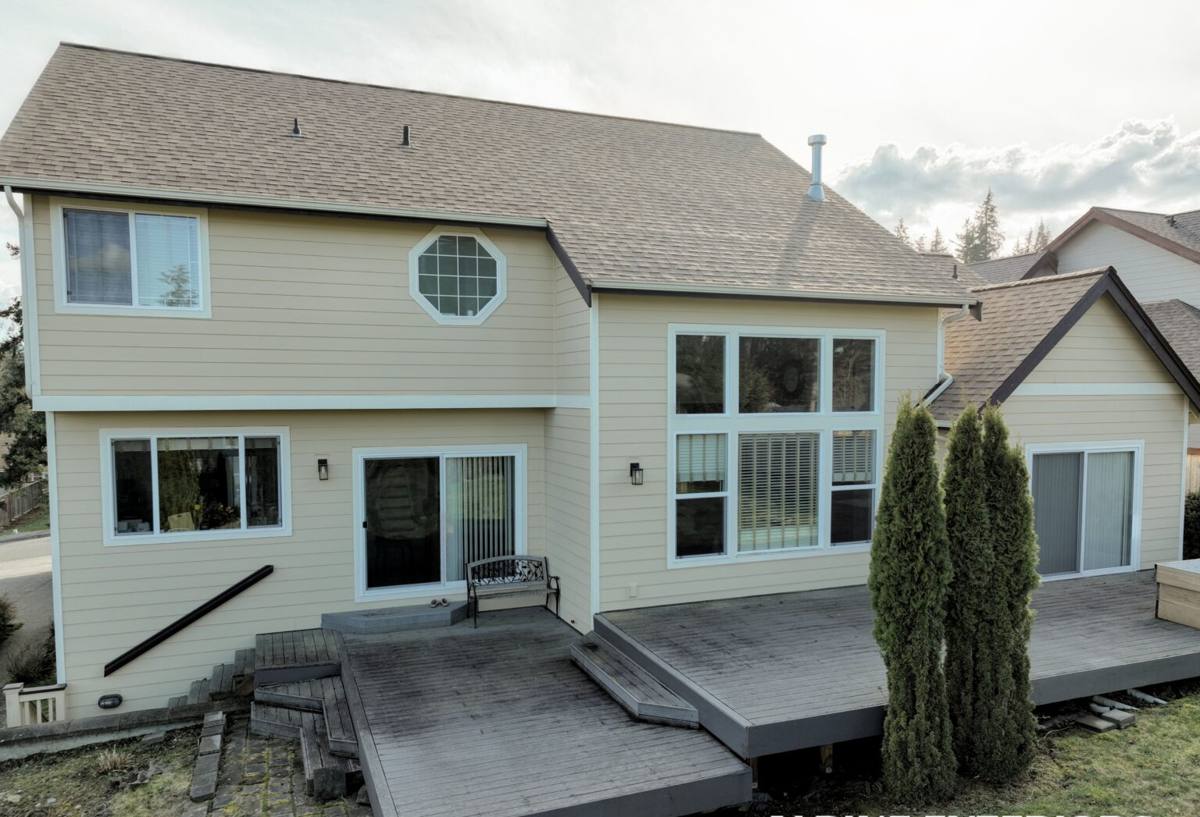
Signs Your Deck Needs Attention
Homeowners often wait for a deck to look bad before calling anyone, but the visible signs are usually the last thing to show up. Here's what we tell people to actually watch for:
- Boards that feel spongy, bouncy, or slightly soft when you walk across them, especially near the house or in shaded corners
- Green or black staining that keeps coming back within weeks of cleaning, particularly on north-facing sections
- Gaps opening up between decking boards and the ledger board where it meets the house
- Railings or posts that wiggle more than they used to, even slightly
- Rust streaks running down from screw heads or joist hangers
- Standing water that takes more than a day to drain after a normal rain
- A musty smell coming from underneath the deck, which usually points to trapped moisture in the framing
Any one of these on its own might be minor. Two or three together usually means the moisture problem has moved from the surface into the structure, which changes the scope of the repair.
What a Correct Deck Repair Actually Involves
A repair that only replaces the boards you can see is a cosmetic fix, not a structural one. Here's what we actually check and address on a deck repair, in the order it matters.
Ledger Board and Flashing
The ledger board — where the deck attaches to the house — is the single most common source of hidden rot we find in this region. If the flashing behind it was installed wrong, missing entirely, or has failed over time, water gets channeled directly into the rim joist and wall framing behind it. This is a slow leak, not an obvious one, which is why it's so often missed until the deck is already sagging near the house. Any legitimate repair includes pulling back decking near the ledger to inspect flashing condition, not just caulking over a gap and calling it done.
Framing, Joists, and Fasteners
Joists, beams, and posts take the real structural load, and they're also the components most exposed to prolonged dampness because airflow underneath a deck is usually limited. We check for soft spots with a probe, not just a visual look, since surface wood can look intact while the core is compromised. Fasteners matter just as much as the wood itself — galvanized hardware that's been in place for 15-plus years in a humid coastal climate is a common failure point even when the surrounding lumber still looks fine.
Decking Boards and Surface
Once structure is confirmed sound, board-level repair is straightforward: replacing cupped, cracked, or rotted boards, resetting fasteners, and correcting board spacing where gaps have closed up and stopped water from draining through properly.
Railings, Stairs, and Guardrails
Railing posts anchor into the framing below, so a wobbly rail is often a symptom of a framing issue rather than a standalone problem. We treat railing repair as connected to the structural inspection, not a separate line item, and we check stair stringers the same way — they're low to the ground, closer to splash-back moisture, and often the last thing homeowners think to have inspected.
Repair or Replace: How We Help You Decide
Not every deck with problems needs to be torn out, and not every deck is worth patching. The honest answer depends on where the damage is concentrated and how old the structure is relative to how it was built.
| Factor | Leans Toward Repair | Leans Toward Replacement |
|---|---|---|
| Ledger board condition | Solid, flashing intact or easily corrected | Rot at the house connection point |
| Framing/joists | Isolated soft spots, majority sound | Widespread softness or sagging across multiple joists |
| Age of structure | Under 15-20 years, built to a reasonable standard | Original build has known design or code gaps |
| Fastener corrosion | Localized to a few connections | Corrosion is widespread throughout hardware |
| Decking material | Boards failing individually | Entire surface cupping, splitting, or delaminating uniformly |
We walk homeowners through this in plain terms during the inspection. If a deck can be repaired honestly and hold up for years, we say so. If the structure has moved past that point, we say that too, rather than layering a repair on top of a problem that will just resurface.
Our Deck Repair Process
- On-site inspection. We walk the deck top to bottom, probe suspect boards and framing, and check the ledger connection and flashing directly rather than assuming from the surface.
- Plain-language findings. You get a straightforward rundown of what's failing, what's still sound, and what the repair actually requires — no inflated scope, no surprise add-ons discovered mid-job that weren't discussed upfront.
- Scoped repair plan. We outline exactly which components get replaced, which hardware gets upgraded, and how drainage and airflow will be corrected where relevant.
- Repair work. Structural issues are addressed first — ledger, framing, fasteners — before surface-level board replacement, so the finished deck isn't cosmetic-only.
- Final check. We confirm the deck is solid underfoot, railings are secure, and drainage paths are actually moving water away from the structure before we call it finished.
Material Choices for This Climate
When boards need replacing, homeowners usually ask whether to stay with wood or switch to composite. Both can work here — the right answer depends on maintenance tolerance and budget, not brand marketing.
| Consideration | Wood Decking | Composite Decking |
|---|---|---|
| Upfront cost | Lower | Higher |
| Moisture behavior | Needs regular sealing to resist this area's rain and humidity | Resists moisture absorption but still needs proper drainage underneath |
| Moss and algae resistance | Prone to growth without upkeep, especially in shaded spots | More resistant to surface growth, though not immune in constant shade |
| Long-term maintenance | Periodic cleaning, sealing, and board replacement as needed | Lower maintenance, mainly cleaning |
| Repair approach | Individual boards can be replaced easily | Board matching and availability can vary by product age |
We don't push one material over the other. Our job is to explain the trade-offs honestly so the choice matches how much upkeep you actually want to do, not to steer you toward whatever's easiest for us to install.
Moss, Algae, and Drainage: The Long-Term Problem
Moss doesn't just make a deck look neglected — it holds moisture directly against the wood surface, which accelerates rot underneath it. In this region, a deck that doesn't get much direct sun can develop a moss layer within a single wet season if it isn't cleaned and if boards are spaced too tightly to drain. Part of a proper repair is making sure water has somewhere to go: correct board gaps, clear gutters and downspouts that discharge away from the deck footprint, and trimming back vegetation that keeps a deck shaded and damp longer than it needs to be. Repairing the boards without addressing drainage just resets the clock on the same problem.
Why a Crew That Already Works Mount Vernon Matters
Deck repair done by someone unfamiliar with this climate tends to miss the same things repeatedly — under-flashed ledgers, undersized drainage gaps, hardware rated for a drier region. A crew that already works in and around Mount Vernon knows what a deck built or maintained here is actually up against: the rain volume, the shade patterns from mature landscaping, and how quickly moss re-establishes if drainage isn't corrected. That familiarity shows up in the details of the repair, not just the sales pitch. It also means faster response when something needs a second look after the work is done, since we're already working in the area rather than treating the job as a one-off trip.
If you're seeing soft spots, persistent staining, or just aren't sure whether your deck needs a repair or a rebuild, we're happy to take a look. Reach out for a free, no-pressure estimate using the form below — we'll give you a straight answer either way.