 Chuckanut Exterior
 Why Sedro-Woolley Siding Wears Out Faster Than Homeowners Expect
Sedro-Woolley sits in the Skagit Valley, close enough to the Chuckanut area and Puget Sound to catch the same weather patterns that wear down exteriors across Northwest Washington: long stretches of driving rain, salt-laden air moving in off the Sound, and valley fog that settles in and doesn't leave for days. That combination is hard on siding in ways that don't always show up right away. Moisture gets driven sideways during storms, finds its way into seams and laps, and then sits there because the valley's fog and cloud cover slow down drying time for weeks at a stretch.
The result is a moss season that runs longer here than in drier parts of the state. Moss and algae don't just look bad — they hold moisture against the siding surface, and on the wrong material that constant dampness is exactly what breaks a wall system down from the inside out. Homeowners who bought a house with siding that wasn't engineered for this climate often don't find out until the damage is already in the sheathing.
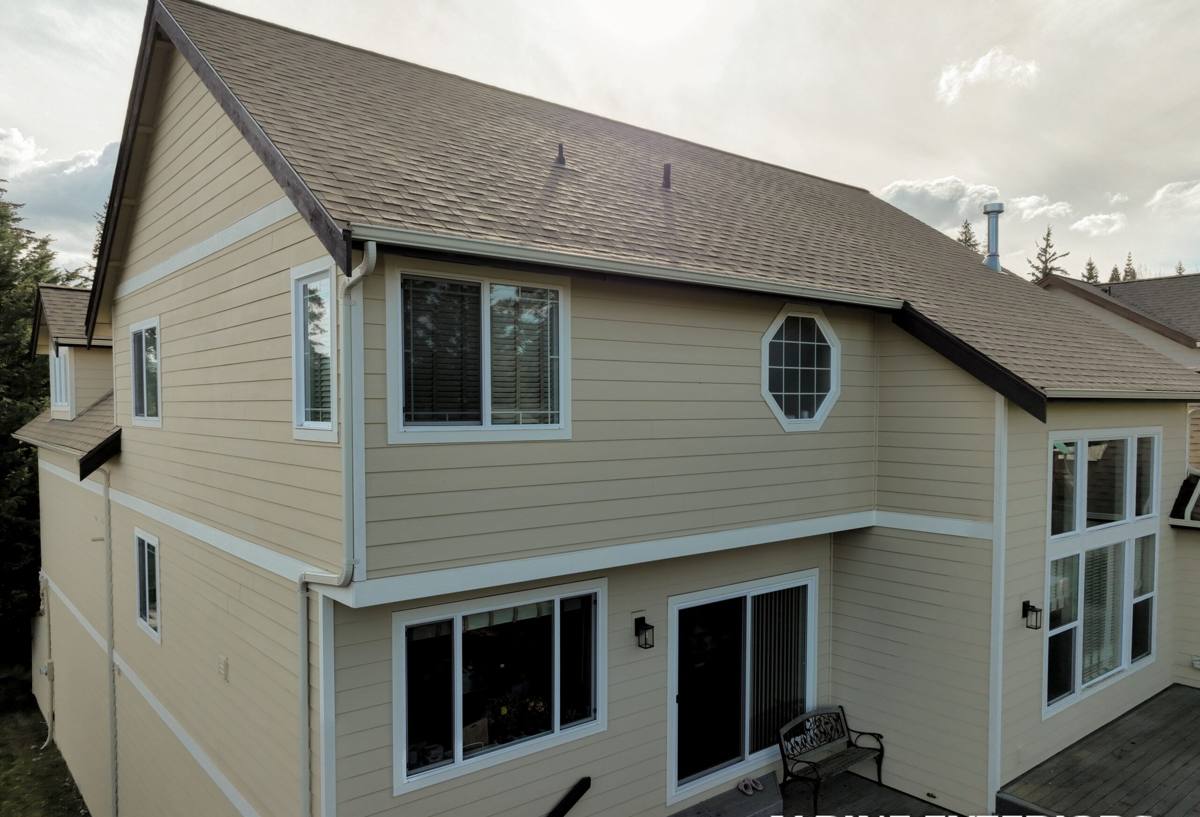
Signs Your Siding Has Reached the End of the Road
Siding failure in this climate is usually gradual, then sudden. Here's what we look for during an inspection, and what you can check yourself before calling anyone out:
- Soft or spongy spots when you press on the siding, especially near the bottom courses and around windows
- Persistent moss or algae staining that comes back within a season or two of cleaning
- Visible swelling, delamination, or bubbling, particularly on horizontal seams
- Paint that's failing faster than it should, or that's failed unevenly in patches
- Gaps or separation at butt joints, corners, and trim where caulk has pulled away
- A musty smell or visible staining on interior walls that share an exterior wall with damaged siding
- Warping or cupping boards, especially on wood-based or engineered wood products
Any one of these can be a minor fix. Several at once, especially combined with soft sheathing underneath, usually means it's time to talk about full replacement rather than another round of patching.
What a Correct Siding Replacement Actually Involves
Siding replacement done right is not just swapping old boards for new ones. It's a full wall assembly job, and skipping steps is exactly how a house ends up with the same moisture problems five years later.
Tear-off and sheathing inspection
The old siding comes off down to the sheathing, and that sheathing gets inspected — not assumed to be fine. Any rot, soft spots, or water-damaged OSB or plywood needs to be cut out and replaced before anything new goes up. Covering damaged sheathing with new siding just hides a problem that keeps getting worse.
Water-resistive barrier and flashing
A correctly lapped weather-resistive barrier goes over the sheathing, and flashing gets integrated at every window, door, deck ledger, and roof-to-wall intersection. In a climate that drives rain sideways for months at a time, flashing details are where most siding failures actually start. This is the step that's easiest to rush and most expensive to get wrong.
Fastening, clearances, and joints
Proper fastener spacing and placement, correct clearance from grade, decks, and roof lines, and properly sealed or flashed butt joints all matter more here than in a dry climate, because any shortcut gives moisture a path in and nowhere to dry out. We install to the manufacturer's specifications, not general carpentry habit, because that's what keeps the warranty valid and the wall performing.
Why We Install Only James Hardie Fiber Cement
We don't offer vinyl, LP SmartSide, Cemplank, Allura, primed spruce, or cedar. That's a deliberate standard, not a matter of what we happen to stock. In a climate like this one, the material matters as much as the installation.
Engineered for this climate, not just any climate
James Hardie makes climate-specific product lines, and the HZ5 formulation used in this region is engineered for the wet, moderate Pacific Northwest — different from the versions sold in hot, dry, or freeze-heavy climates. Fiber cement itself doesn't swell, rot, or feed the moss and mildew growth that thrives in constant valley dampness the way wood-based products can. It's also non-combustible, which matters given the wildfire smoke seasons the region has seen in recent years.
ColorPlus finish versus field-applied paint
Hardie's ColorPlus finish is baked on at the factory under controlled conditions, which gives it better adhesion and fade resistance than paint applied on-site in variable weather. Field-painted siding depends heavily on the day's humidity and temperature at the time of application — not something you can control on a job site in a valley known for fog and drizzle. That factory finish is a meaningful part of why we standardized on this product.
A warranty structure built around correct installation
James Hardie backs its siding with a strong transferable warranty, but that protection is conditioned on installation to their specifications. That's part of why we treat flashing, fastening, and clearance details as non-negotiable rather than optional upgrades — cutting corners on installation is the fastest way to void the protection the product is supposed to offer.
Comparing Common Siding Materials for This Climate
| Material | Moisture Behavior in Wet Climates | Finish | Where It Struggles Locally |
|---|---|---|---|
| James Hardie fiber cement | Does not swell or rot; resists moss/algae growth on the material itself | Factory ColorPlus finish, long fade resistance | Requires correct installation to specification for warranty |
| Vinyl | Doesn't absorb water, but seams and panels can warp, and trapped moisture behind it goes unnoticed | Color molded through, but fades and becomes brittle over time | Can crack in impact, warp in heat, and hide moisture problems behind it |
| LP SmartSide (engineered wood) | Treated to resist moisture, but any breach in the coating exposes wood substrate to swelling | Factory primed or finished, needs edge sealing at every cut | Extended damp, foggy periods increase risk if joints aren't perfectly sealed |
| Cedar / primed spruce | Natural wood; absorbs and releases moisture constantly | Field-applied stain or paint, needs regular maintenance | Long moss season and driving rain accelerate maintenance cycles significantly |
Our Sedro-Woolley Siding Replacement Process
- On-site assessment: We walk the exterior, check the sheathing where accessible, and identify problem areas — not just where damage is visible, but where the wall assembly is likely to be compromised based on how the house is built and oriented.
- Scope and product selection: We go over the right James Hardie product line and profile for the home, and lay out exactly what the job includes — tear-off, sheathing repair if needed, house wrap, flashing, and finish siding.
- Protection and tear-off: Landscaping, walkways, and windows get protected before old siding comes off in sections, so the wall isn't left exposed to weather for longer than necessary.
- Sheathing repair and moisture barrier: Any compromised sheathing is replaced, then the water-resistive barrier goes on with correct lapping and integrated flashing at every penetration.
- Hardie installation: Siding, trim, and accessories go up to manufacturer specification — fastening, clearances, and joint treatment done to the standard that keeps the warranty intact.
- Final walkthrough and cleanup: We inspect the finished work with you, check caulking and touch-up paint at cut edges, and clear the site of debris and old material.
Why a Crew That Already Works Sedro-Woolley Matters
A siding job in this part of the state isn't the same as one in a drier region, and a crew that regularly works Sedro-Woolley and the wider Chuckanut area brings a few real advantages you don't get from an out-of-area contractor bidding the job sight unseen.
We know how long the wet season here actually runs, which affects how we schedule tear-off and how much of a house can be safely opened up at once. We're familiar with the moss and moisture patterns typical of this valley, so we know where to look for hidden damage before it becomes a surprise mid-job. And we're local enough to be back quickly if a question comes up after the work is done — not a name on an invoice from three counties away.
What Affects the Cost of a Siding Replacement
Every home is different, but the same handful of factors drive most of the variation in siding replacement cost. Knowing them ahead of time makes it easier to understand a quote when you get one.
| Factor | Why It Matters |
|---|---|
| Sheathing condition | Hidden rot found during tear-off adds material and labor that can't be fully priced until the old siding is off |
| Home size and wall complexity | More corners, gables, and dormers mean more cutting, flashing, and trim work per square foot |
| Siding profile and accessories | Lap width, trim details, and accent features affect both material cost and installation time |
| Access and site conditions | Tight lots, slopes, or landscaping close to the house can slow tear-off and staging |
| Existing moisture damage | Extended wet seasons in this valley mean some homes need more sheathing and framing repair than others of the same age |
Questions Worth Asking Before You Sign a Contract
- Will you inspect and photograph the sheathing before covering it back up?
- What water-resistive barrier and flashing details will you use around windows and doors?
- Is the quoted price based on an assumption of undamaged sheathing, or does it include a contingency?
- Are you installing to the manufacturer's specifications required to keep the warranty valid?
- Who's actually on the crew doing the work, and do they have experience with this specific product?
If you're weighing a siding replacement for a home in Sedro-Woolley or elsewhere in the Chuckanut service area, we're happy to walk the exterior with you, take an honest look at what's going on under the surface where we can, and put together a straightforward, no-pressure estimate. There's no obligation — just a clear look at what your home actually needs.