 Chuckanut Exterior
 Windows Around Lake Samish Work Harder Than Most
Homes near Lake Samish sit in one of the wetter, shadier pockets of Whatcom County. The lake basin and the tree cover that rings it hold moisture close to the ground long after a storm has passed, and the moist, marine-influenced air that moves through the Chuckanut corridor keeps siding, trim, and window assemblies damp for extended stretches of the fall and winter. Add driving rain that comes in sideways off the water during a southwest blow, and a window installation here has to do more than look good — it has to manage water that hits the wall from more angles, more often, than a comparable house on a dry, open lot.
The practical result is that a window job done to "good enough" standards in a drier part of the county can fail years sooner around Lake Samish. Moisture that would evaporate off a sunny wall lingers in the shade of the surrounding trees, so any weak point in flashing, sealant, or frame material gets tested constantly instead of occasionally. That's the standard we install to on every Lake Samish job.
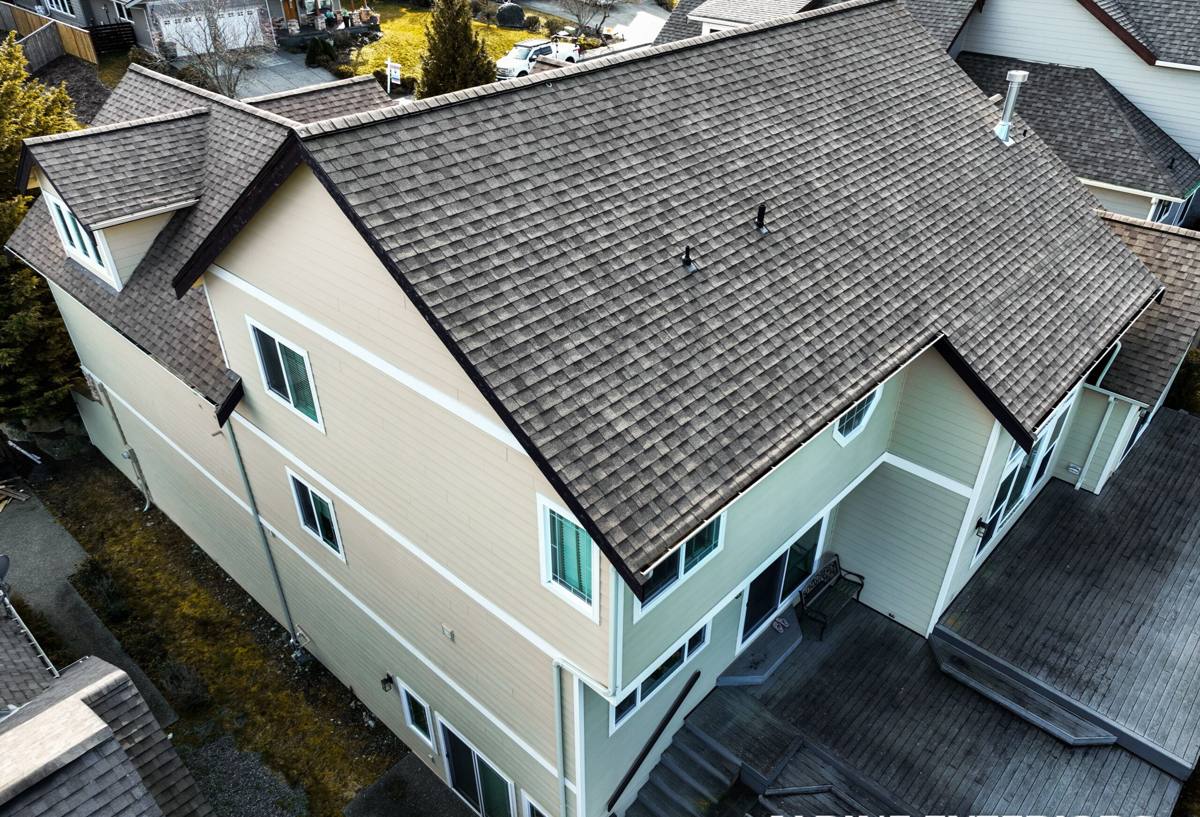
How This Climate Shows Up in Older Windows
Before we talk about installation, it helps to know what failure actually looks like on homes in this area, because it's rarely dramatic. It's usually slow.
- Green or black staining building up in the corners of the frame or along the bottom rail, even where there's no visible leak yet
- Moss or algae starting to grow on the sill or exterior trim — a sign that surface is staying wet far longer than it should
- Soft or spongy wood when you press on the sill, jamb, or the trim just below the window
- Fogging or a milky look between the panes of a double-pane unit, meaning the seal has failed and the gas fill is gone
- Drafts you can feel with a hand near the frame on a windy day, even with the window latched shut
- Paint or finish that's bubbling, peeling, or chalking faster on window trim than on the rest of the siding
- Difficulty latching or operating the window, which often means the frame has swelled, warped, or racked out of square
Any one of these on its own isn't an emergency. Several together, especially the staining and softness combination, usually mean water has been getting behind the frame for a while and the fix is bigger than the window itself.
What a Correct Installation Actually Involves
Flashing and the Water-Resistive Barrier
The window is the easy part. What determines whether it stays dry for the next twenty years is the flashing detail underneath it — how the sill pan is built, how the water-resistive barrier laps over and under the flashing, and whether water that does get past the glazing has a clear path back out instead of a place to pool. On a lake-adjacent, tree-shaded lot, we treat every opening as if it will see standing water at the sill at some point, because eventually it will.
Fit, Shim, and Square
A window that's shimmed out of square puts uneven stress on the sash and the weatherstripping, which is exactly how small gaps start. We set every unit level, plumb, and square in the rough opening, then fasten it so the frame can't rack over time as the house settles or the wood around it swells and shrinks with the seasons.
Sealing Without Trapping Moisture
It's tempting to just caulk everything solid and call it weatherproof, but sealing the wrong layer can trap moisture inside the wall instead of keeping it out. We seal the exterior joints that need to shed water while leaving the assembly able to drain and dry if moisture does get in — that balance matters more here than in drier parts of the state.
Choosing Materials for a Wet, Shaded Lot
Frame material matters more around Lake Samish than it does in a lot of the county, simply because the window spends more of the year damp. Here's how the common options generally compare for this kind of setting:
| Frame Material | Moisture Behavior | Moss/Algae Susceptibility | Maintenance |
|---|---|---|---|
| Vinyl | Won't rot; can flex slightly in temperature swings | Low, but grime and moss can build in corners without cleaning | Low — occasional rinse |
| Fiberglass | Very stable, minimal expansion/contraction | Low | Low to moderate |
| Wood (unclad) | Can absorb moisture and swell if finish fails | Higher if shaded and not maintained | High — refinishing on a schedule |
| Wood-clad (metal or vinyl exterior) | Good, as long as the cladding is properly sealed at joints | Low on the clad face | Moderate |
| Aluminum | Prone to condensation without a thermal break | Low, but condensation can feed nearby wood rot | Low |
We don't push one material as the only answer for every house. A shaded, close-to-the-lake lot with heavy tree cover pushes us toward vinyl or fiberglass more often than bare wood, because those materials don't need a finish to stay watertight. If you want the look of wood, wood-clad units can work well as long as the cladding and its joints are detailed correctly — that installation detail matters as much as the product choice itself.
Our Installation Process
- On-site assessment — we look at the existing window, the flashing behind it, and the condition of the sheathing and framing before quoting anything, so there are no surprises once the old unit comes out.
- Removal and opening inspection — once the old window is out, we check the rough opening for hidden rot or moisture damage, which is common on homes that have sat through a few decades of Chuckanut winters.
- Repair as needed — any soft framing or sheathing gets replaced before a new window ever goes in. Installing a new window over damaged framing just hides the problem.
- Sill pan and flashing — a sloped, sealed sill pan and properly lapped flashing go in to direct water out, not into the wall.
- Set, shim, and fasten — the window is leveled, squared, and secured according to the manufacturer's fastening schedule, which also protects the warranty.
- Insulate and seal — the gap around the frame is insulated (not overpacked, which can bow the frame) and sealed on the exterior in the layers that need it.
- Interior and exterior trim — trim is reinstalled or replaced, caulked, and finished so the whole assembly sheds water and looks right from the curb.
- Final check — every window is opened, closed, and latched to confirm smooth operation before we consider the job done.
New Construction vs. Replacing Existing Windows
New Construction Windows
On new builds or additions around Lake Samish, we can integrate the flashing and water-resistive barrier from scratch, which gives the most reliable long-term result. There's no guesswork about what's hidden behind the old trim.
Replacement in an Existing Opening
Most of our Lake Samish work is replacement in older homes. Here the opening condition drives the decision: if the framing is sound, an insert (pocket) replacement can be efficient and less invasive. If we find rot, staining, or soft wood once the old window is out — which happens more often on lake-adjacent, shaded homes than on sunnier lots — a full-frame replacement is the honest recommendation, even though it costs more, because it's the only way to actually fix what's wrong instead of building a new window around a damaged opening.
What Affects the Cost
| Factor | Why It Matters Here |
|---|---|
| Number and size of windows | Larger openings and picture windows cost more in materials and labor |
| Frame material | Vinyl is typically the most economical; fiberglass and wood-clad cost more upfront |
| Condition of the existing opening | Hidden rot or moisture damage found during removal adds repair time |
| Insert vs. full-frame replacement | Full-frame costs more but is often necessary once trim comes off on older, shaded homes |
| Access and site conditions | Steep lakefront lots or second-story openings can add setup time |
| Trim and finish work | Matching existing trim profiles or repainting adds to the scope |
We give a firm number after we've actually looked at the openings — not a phone estimate — because on homes in this area, what we find once trim comes off changes the scope often enough that a guess isn't fair to you.
Why Local Experience Matters Here
A crew that mostly works drier, sunnier neighborhoods can still install a window correctly on paper and still get the details wrong for a lot like this. Knowing how long moisture actually sits on a shaded Lake Samish wall, how moss establishes itself on north-facing trim, and how driving rain off the water behaves against a wall changes real decisions — sill pan slope, flashing lap sequence, which caulk joints to leave open for drainage, and which frame materials are worth the extra cost. We work this area regularly, and we build every installation around what actually happens to a window here over the following ten or twenty winters, not just what passes inspection on day one.
Keeping Your Windows Ahead of the Moss Season
Even a correctly installed window benefits from a little seasonal attention in this climate. A few habits go a long way:
- Rinse sills and tracks in early fall before the heavy rains set in, clearing out debris that holds moisture
- Trim back tree branches and brush that keep a window in constant shade or dripping onto the sill
- Check exterior caulk lines once a year for cracking or gaps, especially on south and west-facing units that see the most weather
- Watch for moss starting on sills or trim and remove it early, before it holds moisture against the frame
- Operate each window a few times through the year so hardware and weatherstripping don't seize or compress unevenly
None of this replaces a correct installation, but it does extend the life of one.
If you're noticing drafts, staining, or windows that are getting hard to operate in your Lake Samish home, we're glad to take a look. We offer a free, no-pressure estimate — no obligation, just an honest read on what your windows need and what it would take to fix it right. Use the form below to get started.