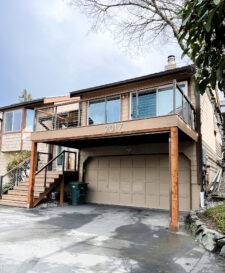
 Chuckanut Exterior
 Decking Built for Blanchard's Conditions, Not Just Any Deck
Blanchard sits in that stretch of Whatcom and Skagit County terrain where the Chuckanut Drive corridor meets Puget Sound — wooded hillsides, saltwater exposure, and weather that doesn't give a deck much of a break. Homes here deal with a combination most decking products were never designed around: salt-laden air off the Sound, long stretches of driving rain, and a moss and algae season that can run most of the year in shaded, tree-covered lots. A deck that looks fine in a showroom in Seattle can start showing problems within a couple of seasons out here if it wasn't specified and installed with this environment in mind.
We install composite decking specifically for this kind of site — homes tucked into the trees along the Chuckanut corridor, exposed to a mix of coastal moisture and forest shade. That combination changes what "correct installation" actually means, and it's a big part of why composite decking has become the practical choice for a lot of Blanchard homeowners who are tired of refinishing wood every year or two.
Why Composite Makes Sense for This Area
Wood decking isn't a bad product — it's just a high-maintenance one, and Blanchard's climate raises that maintenance bar higher than most places. Salt air accelerates corrosion on fasteners and hardware. Rain that sits in shaded, low-airflow areas keeps wood damp longer between dry spells, which is exactly what moss, algae, and rot need to take hold. If a wood deck isn't sanded, sealed, and re-stained on a strict schedule, it starts to gray, splinter, and eventually cup or check.
Composite decking doesn't solve every problem automatically — it still needs to be installed correctly and kept clean — but it removes the yearly refinishing cycle. The material doesn't absorb moisture the way solid wood does, it doesn't need staining, and modern capped composite boards resist the kind of surface staining that moss and algae leave behind on bare wood. For a property that gets shaded, damp, and salty air for months at a stretch, that's a meaningful difference in how much upkeep the deck actually demands.
What Composite Doesn't Fix on Its Own
- Composite boards still need proper drainage underneath — trapped moisture against the substructure causes problems regardless of what's on top
- Fasteners and hardware still need to be corrosion-rated for coastal exposure, or they'll fail before the decking does
- Moss and algae can still grow on the surface of composite in shaded, damp spots — it just doesn't stain or rot the board the way it does with wood
- A poorly framed or poorly ventilated substructure will shorten the life of composite decking just as it would wood
What a Correct Composite Deck Build Involves
The board itself is only part of the job. Most composite decking problems we get called out to inspect trace back to the substructure or the installation details, not the decking material. In a climate like this, a few things matter more than they would in a drier region.
Substructure and Ventilation
Composite decking is heavier than most wood, so joist spacing and framing need to be sized correctly for the specific product — manufacturers publish span tables for a reason, and cutting corners here shows up as bounce or sag over time. Just as important in a wet climate: the space under the deck needs airflow. A deck built low to the ground or against a slope with poor drainage traps moisture underneath, which accelerates corrosion on hardware and can rot ledger boards and framing even though the decking on top looks fine.
Ledger Attachment and Flashing
Where the deck ties into the house is the single most common failure point on any deck, wood or composite. Correct flashing at the ledger board keeps water from working its way behind the siding and into the wall assembly — a real risk given how much rain this area sees. This is also where corrosion-resistant, code-rated hardware matters most, since it's structural and hard to inspect once the deck is built.
Fasteners and Hardware
Salt air is hard on standard fasteners. We spec stainless steel or coated hardware rated for coastal exposure on every composite install in this area, including hidden fastener systems where the product allows it. Cheaper, uncoated fasteners can start showing rust streaks on the board surface within a season or two — a cosmetic problem that's avoidable with the right hardware from the start.
Board Layout and Drainage
Proper gapping between boards, correct picture-framing at the perimeter, and attention to slope for water runoff all matter more when a deck sits under tree cover and gets less direct sun to dry out between rains. We lay out boards to shed water efficiently rather than trap it in low spots where moss and debris can accumulate.
Comparing Decking Materials for a Blanchard Property
| Factor | Pressure-Treated Wood | Cedar | Composite |
|---|---|---|---|
| Upfront cost | Lowest | Moderate to high | Moderate to high |
| Annual maintenance | Sanding, staining, sealing | Sanding, staining, sealing | Periodic cleaning only |
| Moss/algae resistance | Low — absorbs moisture | Low to moderate | Higher on capped boards |
| Coastal fastener corrosion risk | Moderate — depends on hardware | Moderate — depends on hardware | Moderate — depends on hardware |
| Typical lifespan with upkeep | 10-15 years | 15-20 years | 25-30+ years (manufacturer dependent) |
| Refinishing needed | Yes, regularly | Yes, regularly | No |
None of these materials are maintenance-free. The real difference with composite is what kind of maintenance it needs — periodic washing versus a refinishing cycle that has to happen on a schedule whether the deck needs it cosmetically or not.
Our Process for a Blanchard Composite Deck Install
- On-site assessment — we look at sun exposure, tree cover, slope, drainage, and how close the site is to salt air exposure, since all of it affects material and hardware choices
- Substructure evaluation — for replacements, we check whether the existing framing is sound enough to build on or needs to be rebuilt; for new decks, we frame to the specific composite product's span requirements
- Material and hardware selection — board style, color, and fastener system matched to the site conditions and your budget, not a one-size-fits-all package
- Flashing and ledger work — done to code, with attention to keeping water out of the wall assembly where the deck meets the house
- Installation — proper gapping, drainage slope, and fastening, with corrosion-rated hardware throughout
- Final walkthrough — we go over care basics with you, including realistic cleaning frequency for a shaded or coastal-exposed deck
Maintenance Reality: What Owning a Composite Deck Here Actually Looks Like
Composite decking is lower-maintenance, not no-maintenance, and it's worth being honest about what that means in this specific climate. Expect to wash the deck surface a couple of times a year — more often in heavily shaded spots — to keep moss and algae from getting a foothold, since organic growth can develop on any deck surface given enough shade and moisture, composite included. A garden hose and a soft-bristle brush handle most of it; pressure washing should be done carefully and at the settings the manufacturer allows, since too much pressure can damage the board surface.
Check hardware and fastener points periodically, especially in the first couple of years, for any early signs of corrosion or loosening. And keep gutters and downspouts near the deck clear — a lot of the moisture problems we see under decks in this area trace back to water being dumped nearby from a clogged gutter rather than anything wrong with the deck itself.
Quick Reference: Signs Your Existing Deck Needs Attention
- Soft or spongy spots underfoot, especially near the house or stairs
- Rust streaking around fastener heads
- Persistent green or black staining that doesn't wash off
- Gaps or movement where the deck attaches to the house
- Visible sagging between support posts
Why a Crew That Already Works This Area Matters
A lot of decking problems in this part of Whatcom and Skagit County aren't material failures — they're installation choices that didn't account for the local conditions. A contractor who builds mostly in drier inland climates might not think twice about standard fasteners or minimal under-deck ventilation, because those shortcuts don't show up as problems there. Out here, along the Chuckanut corridor and in communities like Blanchard, those same shortcuts show up as rust, rot, or a soft substructure within a few years.
We work this area regularly, which means we're already familiar with how salt exposure, shade patterns, and rainfall behave on the properties here, and we spec every composite deck accordingly — right down to the hardware. That's not a marketing point, it's just what correct installation requires in this specific environment.
If you're weighing a new composite deck or replacing a wood deck that's showing its age, we're happy to take a look and give you a straightforward assessment. Use the form below to request a free, no-pressure estimate.