 Chuckanut Exterior
 Building Decks for Mount Vernon's Climate
Mount Vernon sits in the Skagit Valley south of Chuckanut and Whatcom County, and it shares the same weather pattern that shapes every outdoor structure in this part of the state: long wet winters, a real fog and moss season, occasional salt-tinged air pushing in off the Sound, and short but intense dry spells in summer. A deck built to a generic national spec doesn't hold up here the way it would in a drier climate. Fasteners corrode faster, framing that isn't detailed for drainage traps water, and decking that isn't rated for constant moisture exposure grows moss, cups, or delaminates well before it should.
We've built and repaired decks throughout this corridor long enough to know which details matter and which ones are just upsells. This page is about one thing specifically: what it actually takes to build a deck in Mount Vernon that stays solid, safe, and good-looking for decades instead of years.
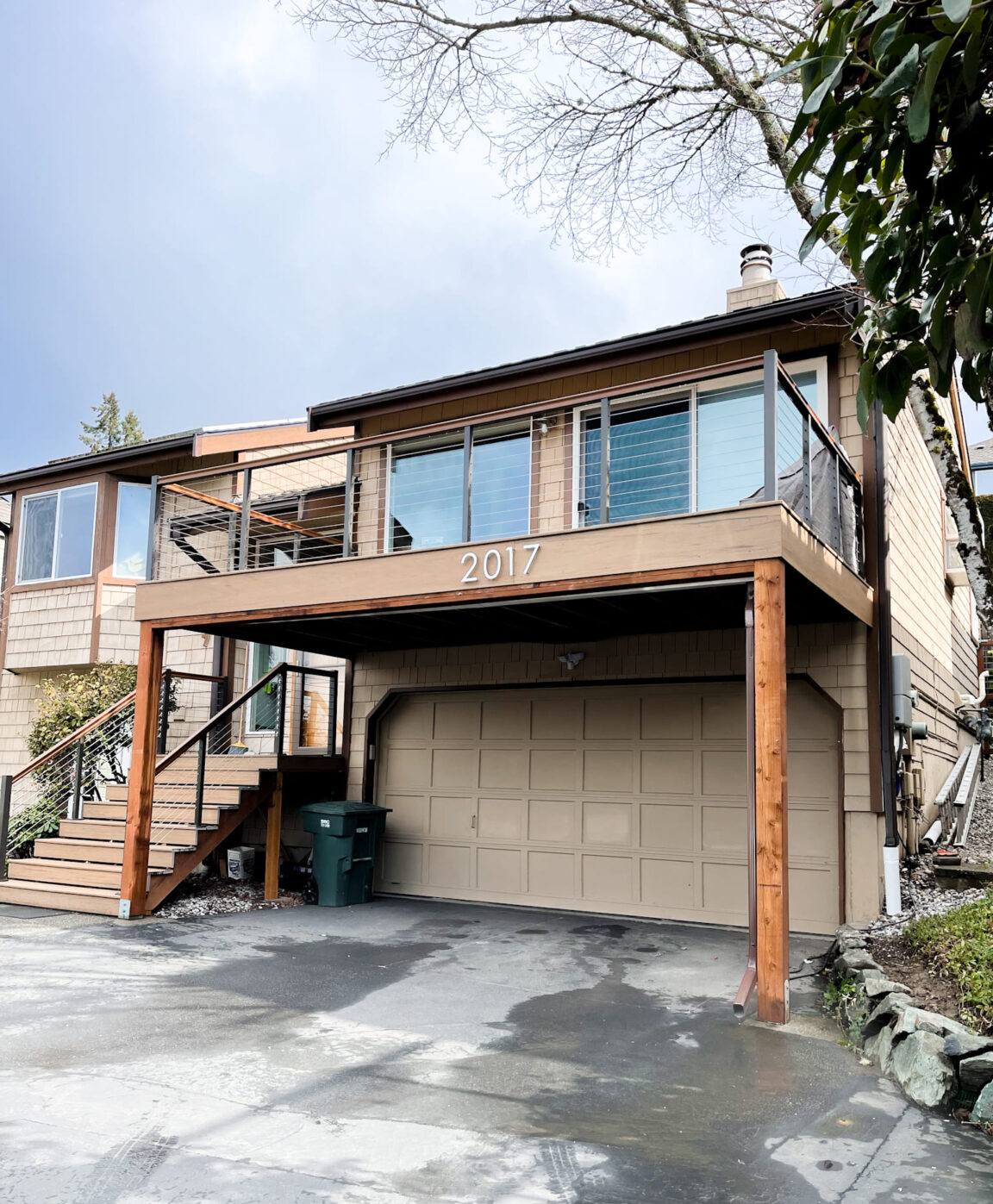
What Local Conditions Do to an Ordinary Deck
Homeowners in this area usually don't see deck failure as a single dramatic event. It's gradual — a board that feels slightly spongy underfoot, a joist hanger with a bloom of rust, a north-facing corner that never quite dries out and grows a green film every fall. Left alone, these small signs compound.
- Moss and algae growth on shaded or low-airflow sections, which retains moisture against the wood surface far longer than open, sunlit areas
- Fastener corrosion where standard hardware wasn't rated for a wet marine-influenced climate, leading to streaking and weakened connections over time
- Ledger board rot where the deck attaches to the house, if flashing and water diversion weren't detailed correctly at construction
- Cupping or checking in decking boards that absorb and release moisture unevenly through repeated wet-dry cycles
- Undersized or poorly spaced framing that flexes under load once wood fibers have softened from years of moisture exposure
None of this is inevitable. It's the result of a deck being built to a minimum standard rather than to the standard this climate actually demands.
What a Correctly Built Deck Requires Here
Framing and Structure
The framing is the part no one sees once the deck is finished, which is exactly why it's the part most likely to get shortcuts. Proper framing for this region means pressure-treated lumber rated for ground contact where posts meet footings, joist spacing sized to the decking material rather than the widest allowable code spacing, and — critically — a ledger connection that is flashed to shed water away from the house rather than trapping it against the rim joist.
Footings and Support
Footing depth and bearing need to account for our soil conditions and frost behavior, not just a generic minimum. We size and place footings so the deck won't heave, settle unevenly, or transfer movement into the ledger connection over time.
Fasteners and Hardware
Every structural connector — joist hangers, hurricane ties, ledger bolts, deck screws — should be rated for exterior and, ideally, coastal-adjacent exposure. This is one of the cheapest details to get right and one of the most expensive to fix later, since replacing corroded hardware on a finished deck usually means partial disassembly.
Drainage and Airflow
Water needs somewhere to go. That means proper board spacing for drainage, grading under the deck so water doesn't pool against posts, and, where the deck sits low or close to grade, enough ventilation underneath that the structure can actually dry out between rain events instead of staying damp for weeks at a stretch.
Decking Material Options and Trade-Offs
There's no single "best" decking material — there's the right material for how a homeowner uses the space, how much upkeep they want to do, and their budget. Here's how the common options actually compare in this climate:
| Material | Moisture Behavior | Maintenance | Typical Lifespan Here |
|---|---|---|---|
| Pressure-treated wood | Absorbs and releases moisture readily; needs sealing to control cupping | Annual cleaning, re-seal every 2-3 years | 15-20 years with upkeep |
| Cedar | Naturally moisture- and insect-resistant, but still an organic material | Cleaning and oiling every 1-2 years to hold color and resist moss | 20-25 years with upkeep |
| Composite decking | Resists rot and moisture absorption; can still support surface algae if not cleaned | Periodic washing, no sealing or staining required | 25-30+ years |
| PVC/capped polymer | Fully moisture-resistant surface layer | Lowest upkeep of the common options | 25-30+ years |
We install all of these depending on what a homeowner wants. Our job is to lay out the honest maintenance commitment each one carries in this specific climate, not to steer everyone toward the highest-margin product. A cedar deck that gets oiled on schedule can look better than a neglected composite deck — it comes down to whether the upkeep actually happens.
Railings, Fasteners, and the Details That Get Skipped
Railings and guard posts take direct weather exposure and structural load at the same time, which makes them a common failure point when corners get cut. Post connections should use structural screws or through-bolts rated for exterior use — not just deck screws driven in at an angle. Any metal railing components need a finish that can handle sustained moisture and, near the Sound, occasional salt air without pitting or streaking onto the decking below.
Stair stringers deserve the same attention as the main deck frame. They flex under repeated foot traffic and sit closer to grade, which means more splash-back moisture and faster wear if they aren't built from appropriately rated material with adequate fastening.
Our Process for a Mount Vernon Deck Project
- On-site assessment — we look at sun exposure, drainage patterns, existing structure (for replacements), and how the space will actually be used before recommending anything
- Design and material selection — layout, decking material, and railing system sized to the budget and maintenance appetite, not a one-size template
- Permitting — we handle the permit process with the local jurisdiction so the structure is inspected and documented correctly
- Demolition (if replacing) — old material removed and hauled, with the substructure inspected for hidden rot before new framing goes in
- Framing and structural work — footings, posts, beams, and joists built to the standard this climate requires, not the code minimum
- Decking, railing, and finish work — installed with attention to fastener spacing, drainage gaps, and clean sightlines
- Final walkthrough — we go over care and maintenance specific to the material chosen so the deck actually reaches its expected lifespan
Repair, Rebuild, or Replace?
Not every aging deck needs to be torn out. When we're called out to look at an older deck, the decision usually comes down to the condition of the framing underneath the visible surface.
- Repair makes sense when the framing is sound and only the surface decking, railing sections, or fasteners have degraded
- Partial rebuild fits when the ledger connection or a section of framing has moisture damage but the footings and overall structure are still solid
- Full replacement is the honest recommendation when multiple structural members show rot, the footings are undersized for current code, or the deck was never properly flashed at the house
We'll tell a homeowner straight if repair is enough — there's no reason to sell a full rebuild when it isn't warranted.
Maintenance That Actually Extends Lifespan
Whatever material is chosen, a few habits make the biggest difference in a climate like this: keep the deck surface clear of leaves and debris where moisture collects, wash off moss and algae before it gets a foothold rather than after, check fastener heads and railing connections once a year, and make sure under-deck airflow isn't blocked by stored items or overgrown landscaping. These take an afternoon a year and prevent most of the problems we get called out to fix.
Why It Matters That We Already Work in This Area
A deck built to a spec sheet written for a different climate is a deck that starts failing early — and by the time a homeowner notices, the damage is usually below the surface. Building decks throughout the Skagit Valley and Whatcom County region means we've seen firsthand which framing details, hardware choices, and drainage approaches hold up against real Pacific Northwest weather versus which ones look fine on installation day and fail in year six. That's not something a contractor unfamiliar with this specific climate picks up from a manual.
If you're planning a new deck or dealing with one that's showing its age, we're happy to take a look and give you a straightforward, no-pressure estimate — just fill out the form below.