 Chuckanut Exterior
 Lake Samish sits in a pocket of Whatcom County that gets more shade, more standing dampness, and more moss pressure than most of the surrounding area. Homes ring a freshwater lake tucked under forested, sloped ground just a few miles inland from Samish Bay and the Sound, close enough that salt-tinged air still reaches these tree-covered lots on top of everything the lake itself adds to the mix. If you're planning a siding installation on a Lake Samish property, the material and the workmanship both have to answer to that specific combination of conditions, not to a generic climate spec written for a drier part of the country. This page walks through what that means in practice — what the climate does to siding here, what a correct installation actually involves, and how our process is built around this particular lake environment.
Why Lake Samish Siding Needs a Different Approach
Three things define exterior wear on a Lake Samish home: driving rain that comes in sideways off Pacific storm fronts rather than falling straight down, a moss and algae season that runs long because tree-covered, lake-adjacent lots don't dry out the way an open, sunny lot would, and a persistent low-level dampness that settles into shaded walls and never fully clears before the next storm arrives. Add the salt-tinged air drifting up from nearby Samish Bay, and you have a climate that works harder on a home's cladding, joints, and fasteners than most siding products were ever engineered to handle.
None of this shows up as one dramatic failure. It accumulates — a finish that dulls a season or two early, a joint that opens just enough for wind-driven rain to find its way behind a panel, a shaded corner that stays damp long enough for moss to take hold and hold moisture against the wall even longer. A siding installation done right on this lake has to account for all of that from the first panel, not patch around it later.
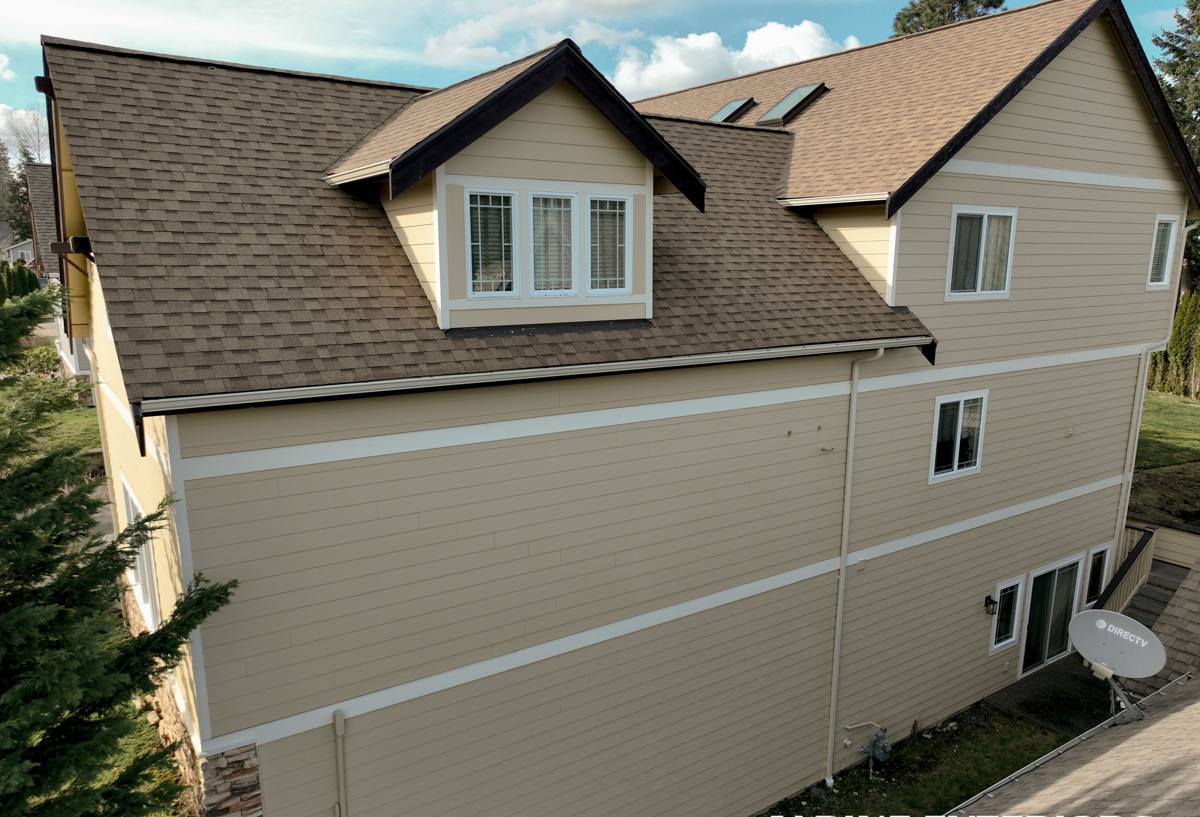
What This Climate Does to Siding Over Time
Shaded, Wooded Lots and Trapped Moisture
A lot of Lake Samish properties sit under significant tree cover, whether that's second-growth forest crowding the back of the lot or mature trees shading the lake-facing side of the house. That shade is part of the appeal of living out here, but it also means walls dry more slowly after rain, morning dew lingers longer, and airflow around the house is more restricted than it would be on an open, exposed lot. Siding on those shaded faces is doing more work than siding on a sunny wall three miles away, even though it's the same house in the same general climate.
A Moss and Algae Season That Doesn't Really End
Where shade and dampness overlap — north-facing walls, areas under eaves, sections close to tree canopy — moss and algae get a long runway to establish themselves. Once they take hold on a wall surface, they hold moisture against whatever is behind them for longer stretches than an open, sun-exposed wall ever experiences. On an organic siding substrate, that sustained dampness is exactly the condition that leads to premature finish breakdown and, eventually, decay at the substrate itself. On an inorganic substrate, moss and algae are still unwelcome, but they aren't feeding on or breaking down the material underneath them the way they can with wood-based products.
What a Correct Siding Installation Actually Involves
The product matters, but installation quality is what actually determines whether a house stays dry for the next twenty years. On a lake property with this much shade and moisture exposure, the installation details below aren't optional extras — they're the difference between siding that performs and siding that starts showing problems within a few wet seasons.
Water Management Starts Behind the Panel
Correct installation begins with a properly lapped weather-resistant barrier and correctly integrated flashing at every window, door, and roof-to-wall transition — installed so that water is always directed out and down, never trapped behind the cladding. On a shaded, damp lot, any point where that sequence is rushed or skipped becomes the spot where moisture gets in and has no good way to leave. Butt joints get sealed and, where the wall orientation calls for it, treated with extra attention on faces that stay wet longest.
Fastening, Clearance, and Spacing
Fasteners have to be rated for the climate and driven to the manufacturer's spacing specification — not just close enough. Proper clearance from grade, decks, and roof lines keeps the bottom edge of the siding out of splash-back and standing moisture, which matters more on a lot where the ground itself often stays damp under tree cover. Panels need the gaps the manufacturer specifies for expansion, and trim has to be fitted so it sheds water instead of holding it against a seam.
Why We Install Only James Hardie Fiber Cement Here
We install one siding product, on every job, including every Lake Samish property we work on: James Hardie fiber cement. We don't install vinyl, LP SmartSide, Cemplank, Allura, primed spruce, or cedar. That's a professional standard, not a limited lineup — each of those alternatives has real strengths, but each also depends on a level of ongoing field maintenance or organic-material tolerance that we don't think holds up well on a shaded, damp lake lot over the long run.
Fiber cement's core isn't organic, so it doesn't give moss, algae, or sustained moisture the kind of substrate they can work into the way a wood-based product's core can. James Hardie builds its HZ product lines specifically for regions dealing with sustained moisture and coastal exposure, rather than selling a single generic formulation everywhere in the country, which matters directly on a lot like this one. It's also non-combustible, which we consider a baseline regardless of a property's specific climate exposure. And the factory-applied ColorPlus finish is baked on under controlled conditions rather than brushed on in the field, which means it holds color and resists cracking through more wet seasons than a site-applied paint job typically manages in this kind of shade and moisture.
That combination — an inorganic core, a climate-engineered product line, and a factory finish backed by a strong transferable warranty — is why we put it on Lake Samish homes instead of the alternatives, and why we don't offer those alternatives as a fallback option.
Our Installation Process for a Lake Samish Home
The steps themselves aren't unusual, but the order and attention we put into each one are shaped by what this specific lake environment demands.
- On-site assessment. We walk the property, note sun and shade exposure wall by wall, check the current siding and trim for moisture damage, and look at how the lot's tree cover and grade affect drainage around the house.
- Removal and substrate check. Old siding comes off and we inspect the sheathing underneath for any hidden moisture damage before anything new goes up — a step that matters more here than on a drier, more exposed lot.
- Weather barrier and flashing. A correctly lapped water-resistant barrier goes on first, followed by flashing at every window, door, and penetration, installed so water is directed out rather than trapped.
- Hardie installation. Panels or lap siding go up to manufacturer spacing and fastening specifications, with extra attention to joint treatment on the shaded, slower-drying wall faces.
- Trim, caulk, and finish detail. Trim is fitted to shed water, joints are sealed correctly, and any factory-finish touch-up is matched so it doesn't stand out as a field repair down the road.
- Final walkthrough. We go over the finished work with the homeowner, point out anything worth keeping an eye on given the lot's specific shade and moisture pattern, and answer questions about long-term care.
Cost Factors for a Lake Samish Siding Project
We don't publish blanket pricing, because an honest number depends on the specific house — but the factors that move a project's cost up or down are consistent enough to explain plainly before we ever give you a number.
| Factor | How It Affects the Project |
|---|---|
| Existing moisture damage | Hidden rot found at tear-off under old siding or trim adds repair scope before new siding can go on |
| Tree cover and lot access | Dense tree cover or a steep, wooded approach can affect staging, scaffolding, and crew access |
| Wall complexity | More corners, gables, and window or door openings mean more flashing and cutting labor |
| Siding profile and finish choice | Lap width, panel style, and ColorPlus color selection affect material cost |
| Story height | Second-story and lake-facing elevated walls require additional staging and safety setup |
| Trim and accessory scope | Full trim replacement versus reusing sound existing trim changes both material and labor cost |
Why Hiring a Crew That Already Works Lake Samish Matters
A siding crew that mostly works open, sunny suburban lots is used to a different set of problems than a shaded, wooded lake property presents. Knowing which walls on a lake lot stay wet the longest, how tree debris and needle buildup affect drainage at trim and roof lines, and how to sequence an installation around a wet-heavy local weather pattern isn't something a generic install crew picks up on the first pass. It's the kind of judgment that comes from having done this specific type of job, on this specific kind of property, more than once.
It also matters for the parts of the job a homeowner doesn't see directly — flashing choices at a shaded wall-roof transition, or deciding where extra joint sealing is worth the time because of how long that section of wall stays damp after a storm. A crew that already understands Lake Samish's particular mix of shade, moisture, and tree cover makes those calls correctly the first time, instead of learning the hard way after a callback.
Signs Your Siding May Already Be Telling You Something
Before deciding whether a full replacement makes sense, it's worth knowing what to look for. On a Lake Samish property, keep an eye out for:
- Persistent moss or algae growth that comes back quickly after cleaning, especially on shaded or tree-adjacent walls
- Soft spots, warping, or visible swelling anywhere on the siding or trim
- Cracked or missing caulk at joints, corners, and window and door trim
- Paint or finish that's peeling, chalking, or noticeably duller than the rest of the house
- Staining or streaking below joints or fasteners, which often points to water tracking down from a gap above
- Any siding that's held out from the wall or visibly separating at a seam
None of these on their own necessarily means a full replacement is needed, but they're worth having a professional look at before they turn into a bigger repair.
If you own a home on Lake Samish and you're weighing a siding project, we're glad to come take a look, walk the property with you, and give you a straight answer about what your house needs and why. Reach out for a free, no-pressure estimate.