 Chuckanut Exterior
 Decks in Larrabee Take a Different Kind of Beating
Ask anyone who's spent a winter in a house along Chuckanut Drive: a deck out here doesn't fail the way a deck in a dry, open subdivision fails. Homes in the Larrabee area sit close to the water and under a lot of tree cover, which means decks deal with three things at once — salt-laden air coming off the bay, driving rain that gets pushed sideways by wind off the water, and a moss season that can run eight or nine months out of the year in shaded spots. Any one of those is manageable. All three together, on the same structure, is what causes decks here to age faster than the manufacturer's warranty ever assumed.
Salt air accelerates corrosion on any exposed metal — nails, screws, joist hangers, railing brackets. Driving rain finds every gap in flashing and every place where boards butt up against the house, and it doesn't just wet the surface, it drives moisture sideways into end grain and fastener holes. And moss, which loves the shade and dampness this stretch of Whatcom County provides, holds water against the deck surface long after a normal deck would have dried out. That combination is why we see rot and fastener failure here years before it would show up on an equivalent deck twenty miles inland.
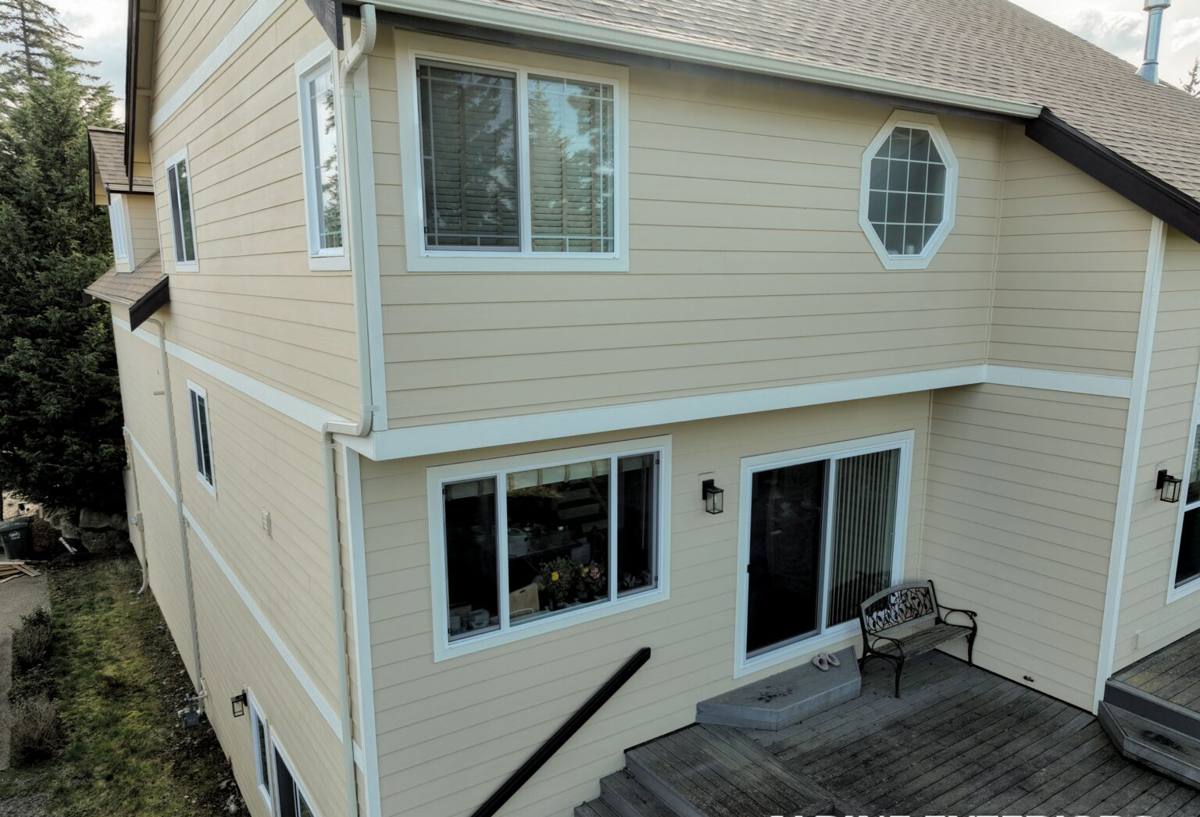
Signs a Larrabee Deck Needs Repair
Most deck problems don't announce themselves with a collapse — they show up as small, specific symptoms first. If you're not sure whether your deck needs attention, walk it and check for these:
- Soft or spongy spots when you press on decking boards, especially near the house or at board ends
- Rust streaking around nail or screw heads, or fasteners that have backed out or snapped off
- Green or black staining that comes back within weeks of cleaning it off
- Gaps opening up between the deck and the house wall, or between the deck and support posts
- Railings or stair rails that feel loose, wobbly, or flex more than they used to
- Visible sagging along a joist line, or a floor that feels slightly bouncy underfoot
- Ledger board area (where the deck attaches to the house) showing water staining on the siding above or below it
None of these mean the whole deck is a loss. Most are localized problems that, caught early, are a repair — not a rebuild.
What a Correct Deck Repair Actually Involves
It starts underneath, not on the surface
A repair that only replaces the boards you can see is a cosmetic fix, not a structural one. The framing underneath — joists, beams, the ledger connection to the house, and the posts and footings — is where moisture damage actually does its work, because that's where water collects and where it's hardest to see. Any repair worth doing starts with pulling a few boards or getting underneath the deck to check that structure before touching anything visible.
Flashing and the ledger connection
Where a deck attaches to the house is the single most common failure point we find on repairs in this area, largely because of the driving rain this stretch of coastline gets. Flashing that was installed flat, undersized, or without proper lapping lets water track behind the ledger board and into the house rim joist. A correct repair addresses the flashing itself, not just the rotted wood it failed to protect — otherwise the same damage comes back in a few years.
Fasteners and hardware
Given the salt air, we replace failing fasteners and hardware with hot-dip galvanized or stainless connectors rated for exterior and coastal-adjacent use, not the standard interior-grade hardware that sometimes gets used on lower-cost builds. It costs a bit more up front and it's the difference between a repair that holds for another decade and one that starts rusting again in three years.
Matching structural capacity, not just appearance
When we sister a joist, replace a post, or reinforce a beam, the replacement lumber and connection method have to match or exceed the structural capacity of what was there — not just look similar from above. This matters most on stairs and railings, which take direct human load and are the last thing you want to discover is weak.
Repair or Replace? What Actually Decides It
This is the question almost every homeowner asks first, and the honest answer is "it depends on where the damage is," not on the age of the deck alone.
| Factor | Leans toward Repair | Leans toward Replacement |
|---|---|---|
| Extent of rot | Isolated to a few boards or one framing member | Widespread across multiple joists, the ledger, and decking |
| Ledger condition | Solid, properly flashed, dry framing behind it | Soft rim joist or repeated water intrusion at the house connection |
| Post/footing condition | Footings sound, posts show only surface weathering | Footings undersized, shifted, or posts rotted at grade |
| Age of original build | Under 15 years, built to a reasonable spec | Older deck built before current fastener and flashing standards |
| Railing and stair safety | Solid connections, minor cosmetic wear | Loose posts, undersized rail framing, code-noncompliant spacing |
A deck can look rough on the surface and be structurally fine underneath — or look fine on the surface and be hiding a rotted ledger. That's why we don't quote repair vs. replacement over the phone; it takes an actual look underneath.
Decking Materials: What Holds Up Out Here
Whatcom County homeowners generally choose between pressure-treated lumber, cedar, and composite decking, and each has real trade-offs in this climate rather than one clearly "best" answer.
Pressure-treated lumber is affordable and easy to repair in sections, but it needs consistent sealing to resist the moss and moisture cycle here — skip a season of maintenance near the water and you'll see it. Cedar has natural rot resistance and weathers attractively, but it's softer and more prone to surface checking under repeated wet-dry cycling, and it still needs periodic sealing to keep moss from taking hold. Composite decking resists rot and moss better than either wood option and needs less upkeep, but it comes with its own considerations — it can trap moisture against framing if ventilation underneath is inadequate, and it has less repair flexibility than wood if a board is ever damaged, since color-matching older composite runs can be difficult once a product line changes.
We don't push one material as universally superior. We tell you honestly what each one asks of you in upkeep, and help you weigh that against how the deck gets used and how much shade and moisture exposure your specific lot has.
How We Approach a Deck Repair Job
- On-site inspection. We walk the deck surface, get underneath it, and check the ledger, posts, and footings — not just the boards you can see.
- Honest assessment. We tell you what's actually failing, what's just cosmetic, and where repair stops making sense compared to replacement.
- Written scope and estimate. You get a clear breakdown of what's being replaced, what hardware and flashing is being used, and why.
- Repair work. Framing and flashing issues get fixed first, then decking, then railings and stairs — in that order, because sequence matters for a repair that actually lasts.
- Site cleanup. Old lumber, fasteners, and debris hauled off — we don't leave a job site looking like a job site.
Why Local Experience Matters for This Job
A deck repair crew that mostly works dry, inland neighborhoods will often underestimate what a Chuckanut-area deck needs — they'll spec standard fasteners where corrosion-resistant hardware is needed, or miss that a shaded, water-adjacent deck needs better ventilation underneath to keep moss and rot from coming right back. Working repeatedly in and around Larrabee means we already know which details get skipped on a lower-bid job and cause a callback two years later: the flashing detail at the ledger, the fastener grade, and the airflow underneath the structure. That's not a marketing point — it's just what shows up consistently when we open up a deck out here versus one from a drier part of the county.
Keeping a Repaired Deck Working for You
A repair is only as good as the maintenance that follows it, especially in a moss-heavy, salt-air environment. A few habits make a real difference:
- Sweep leaves, needles, and debris off the deck surface regularly — trapped organic matter is what feeds moss and holds moisture against the wood
- Clean and re-seal wood decking on the schedule appropriate to the product, generally every one to three years depending on exposure
- Keep gutters and downspouts near the deck clear so runoff isn't dumping directly onto or under the structure
- Check railings and stair connections once a year for looseness before it becomes a safety issue
- Make sure vegetation isn't crowding the deck and keeping it in permanent shade and dampness
If you're seeing soft spots, rust streaks, moss that won't quit, or a deck that just doesn't feel as solid as it used to, we're happy to take a look. We offer free, no-pressure estimates for homeowners in the Larrabee and Chuckanut area — use the form below to get a time on the calendar.