 Chuckanut Exterior
 Why Roof Repair Works Differently in the Mount Vernon Area
A roof repair in a dry inland climate is a different job than a roof repair here. Homes in and around Mount Vernon sit in a stretch of Washington where salt-laden air off the Salish Sea, long stretches of driving rain, and a moss season that can run most of the year all work on a roof at the same time. A repair that only addresses the visible symptom — a missing shingle, a drip in the ceiling — without accounting for what caused it usually comes back within a year or two. We treat every repair call in this area as a chance to find the actual source of the problem, not just patch the spot where the water showed up.
That distinction matters more here than in most parts of the country. The combination of moisture, wind, and organic growth means small issues compound quickly. A loose shingle that would sit harmless for a season in a drier climate becomes an entry point for wind-driven rain within weeks. Understanding that is the difference between a repair that lasts and one that's just a temporary patch.
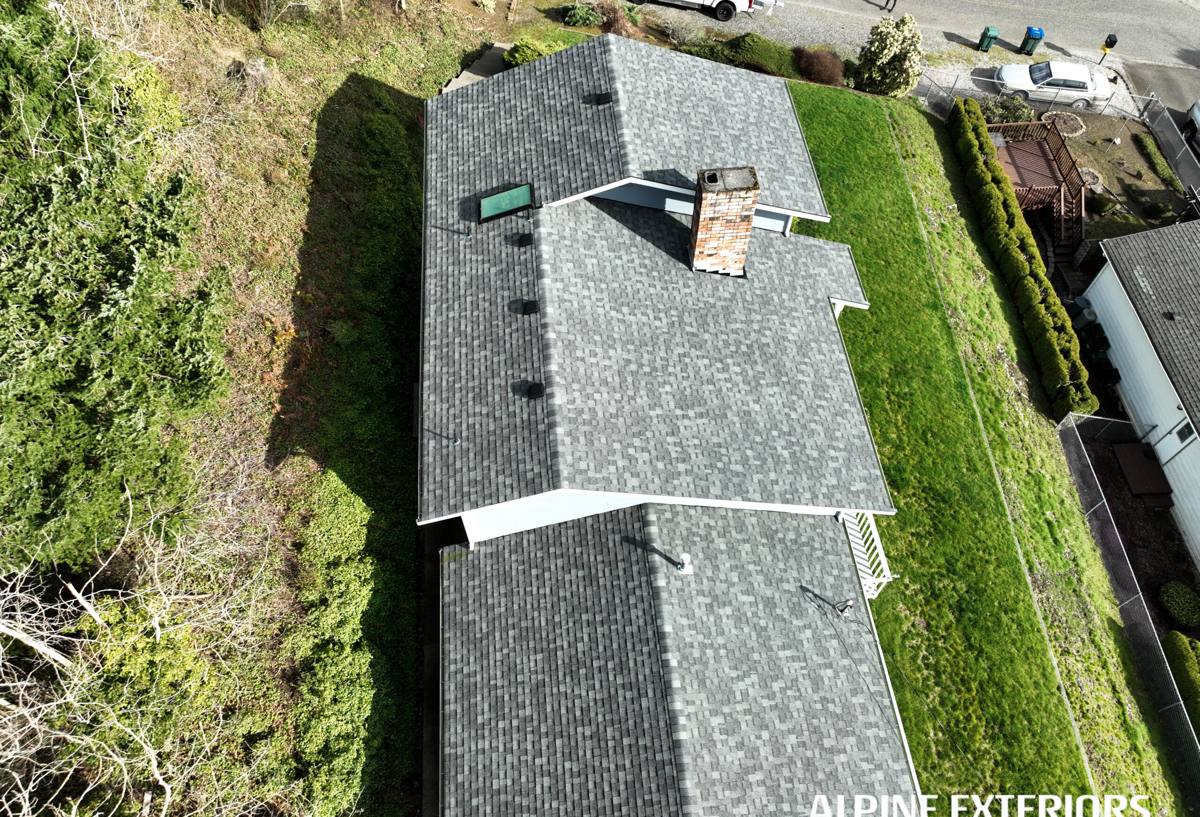
What Salt Air, Rain, and Moss Actually Do to a Roof
Salt Air and Corrosion
Proximity to saltwater accelerates corrosion on any exposed metal — flashing, fasteners, gutter hardware, vent caps. Galvanized nails and lower-grade flashing lose their protective coating faster near the coast, and once that coating is gone, rust sets in and fastener heads weaken. A repair that reuses corroded fasteners or thin flashing is a repair that's already on a shorter clock than it should be.
Driving Rain and Wind-Driven Water
Rain that falls straight down is easy for any roof to shed. Rain that comes in sideways during a windstorm is a different challenge — it gets pushed up under shingle edges, into vent flashing, and along ridge lines that were never designed to handle water moving uphill. Most of the "mystery leaks" we get called about in this area trace back to wind-driven water finding a gap that would never leak in calm weather.
Moss and Trapped Moisture
Moss doesn't just look bad — it holds moisture directly against the roofing material and, over time, lifts shingle edges as it grows and spreads. Once moss establishes itself in a shaded, north-facing section of roof (common on tree-covered lots throughout this region), it can trap enough moisture to accelerate granule loss and rot the decking underneath before the damage is visible from the ground.
The Repair Calls We See Most Often Near Mount Vernon
- Wind-lifted or missing shingles after a storm, especially on roof edges and ridges
- Flashing failures around chimneys, skylights, and roof-wall intersections where water intrusion is hardest to trace
- Moss buildup in shaded valleys and north-facing slopes causing shingle lift and granule loss
- Corroded or failing metal at vent boots, drip edges, and valley flashing
- Soft or stained decking discovered during a repair that started as a "small leak"
- Clogged or damaged gutters contributing to water backing up under the roof edge
What a Correct Repair Involves (vs. a Quick Patch)
Not every repair is created equal. A lot of roof problems in this climate get temporarily "solved" with sealant or a single replacement shingle, which can mask a leak for a season without addressing what let water in to begin with. Here's the difference in approach:
| Quick Patch Approach | Correct Repair Approach |
|---|---|
| Seals the visible symptom (a gap, a stain, a drip point) | Traces the leak path back to its actual entry point, which is often several feet from where water shows up inside |
| Reuses existing flashing and fasteners regardless of condition | Inspects and replaces corroded flashing and fasteners as part of the fix |
| Treats moss as a cosmetic issue | Checks decking condition under moss-affected areas before closing the repair back up |
| Uses general-purpose sealant as the primary fix | Uses sealant as a secondary detail, not a substitute for proper flashing and shingle work |
| Addresses one leak at a time as it appears | Looks at the surrounding roof plane for related wear so you're not back on the roof again next season |
Materials We Use for Lasting Repairs
Repair materials matter as much as technique in a climate that's hard on roofs. We standardize on materials chosen for how they hold up here, not just what's cheapest to install.
| Component | Standard We Use | Why It Matters in This Climate |
|---|---|---|
| Flashing | Corrosion-resistant metal, properly lapped and sealed | Resists salt-air corrosion far longer than thin or bare galvanized stock |
| Fasteners | Corrosion-resistant roofing nails rated for coastal exposure | Standard fasteners can rust and back out well before the shingles around them wear out |
| Underlayment at repair points | Self-adhering waterproof membrane at vulnerable transitions | Gives a second line of defense where wind-driven rain is most likely to get pushed under the surface |
| Shingle matching | Closest available match in style, weight, and granule type | Mismatched patches weather differently and stand out — and can shed water unevenly |
We don't push algae-resistant or "zinc-strip" upgrades as a cure-all during a repair — they're worth discussing as a longer-term maintenance measure, but they don't replace correcting the actual moisture or flashing problem in front of us.
Our Process, Start to Finish
- Inspection first. We walk the roof (and the attic, when accessible) to find the actual source of the leak or damage, not just the spot where it's showing up inside.
- Honest assessment. We tell you plainly whether this is a repair, or whether the roof's age and condition mean a repair would just be delaying a replacement you'll need soon anyway.
- Written scope. Before any work starts, you get a clear description of what's being fixed and why — no vague line items.
- The repair. We replace damaged materials, correct flashing details, and check surrounding areas for related wear while we're already on the roof.
- Cleanup and check. Debris and old material removed, and we confirm the repair holds under close inspection before we consider the job done.
What Affects the Cost of a Repair
Most straightforward repairs — a section of storm-damaged shingles, a single flashing failure — land in a modest, predictable range. Costs move up when there's hidden decking damage, steep or hard-to-access roof sections, or when moss removal and treatment are needed alongside the repair itself. We give you the real number after inspection, not a guess over the phone.
Signs Your Roof Needs Attention Now
- Granules collecting in gutters or at downspout outlets
- Visible moss or dark streaking on north-facing or shaded roof sections
- Curling, cracked, or missing shingles, especially after a windstorm
- Staining on interior ceilings or walls, even faint or intermittent
- Rust streaks below metal flashing, vents, or valleys
- Daylight visible through the roof deck from inside the attic
- Sagging or soft spots noticeable when walking the attic floor
Any one of these on its own isn't necessarily an emergency, but ignoring several at once in this climate tends to shorten the timeline between "small repair" and "much bigger project."
Why Hiring a Crew That Already Works Mount Vernon Matters
A roofer who mainly works drier, inland areas can still do competent general repair work — but they may not think to check for the specific failure patterns that show up here: corrosion at fastener heads, moss establishing in shaded valleys, or flashing that was fine for years until enough wind-driven rain finally found the gap. Crews who regularly work this stretch of Washington know what a repair here needs to hold up through another wet season, not just look finished on the day the work wraps up.
We also don't treat every repair as an upsell opportunity. If a patch and some corrected flashing will get you several more good years out of the roof, that's what we'll recommend. If the roof is genuinely past the point where repair makes sense, we'll say that too — plainly, and with our reasoning, not just a recommendation to replace.
Get a Straight Answer on Your Roof
If you're dealing with a leak, storm damage, moss buildup, or just want an honest read on a roof's condition before it becomes a bigger problem, we're glad to take a look. Fill out the form below for a free, no-pressure estimate — we'll tell you exactly what we find and what it would take to fix it right.