 Chuckanut Exterior
 Storm Damage Roofing in Happy Valley: A Different Kind of Wear
Homes in Happy Valley take a beating that a lot of roofing crews from outside Whatcom County simply aren't tuned into. It's not just one big storm a year that does the damage — it's the accumulation. Wind-driven rain off the water, salty marine air working on metal fasteners and flashing, and a moss season that can stretch from fall through spring all chip away at a roof's ability to shed water. By the time a homeowner notices a stain on the ceiling, the underlying problem has usually been building for months, sometimes longer.
This page is about one thing: storm damage roof repair for Happy Valley homes specifically, done right the first time, by a crew that already understands what this neighborhood's roofs are up against.
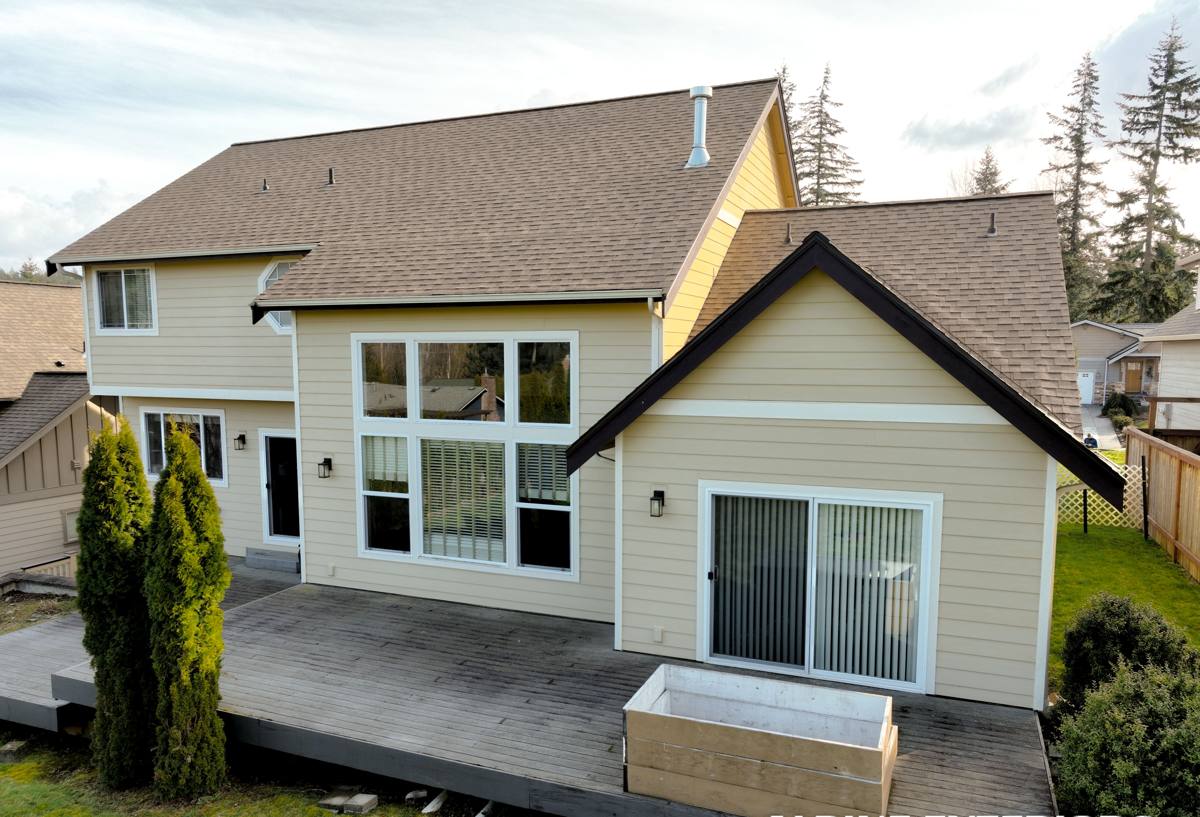
What Chuckanut's Climate Actually Does to a Roof
Wind-Driven Rain
Straight-down rain is rarely the problem. It's rain pushed sideways by wind that finds its way under shingles, around chimney flashing, and into valleys that weren't sealed with enough overlap to begin with. A roof that performs fine in a light shower can still leak in a wind-driven storm because water is being forced uphill against the shingle laps instead of just running downhill off them.
Salt Air and Metal Fatigue
Proximity to the water means airborne salt settles on every exposed surface, including roof flashing, fasteners, and any exposed metal edges. Over time this accelerates corrosion, especially on lower-grade galvanized nails and flashing that weren't specified with coastal exposure in mind. Corroded fasteners lose their grip, and corroded flashing develops pinholes long before it looks obviously "rusted through."
Moss and Trapped Moisture
Whatcom County's long, damp, mild-temperature stretch of the year is close to ideal moss habitat. Moss on a roof isn't just cosmetic — its root structure lifts shingle edges and holds moisture directly against the roofing material for weeks at a time. That constant wetness is what actually causes the granule loss, wood rot, and premature failure that gets blamed on "an old roof" when the real driver was moss nobody removed.
How Storm Damage Actually Shows Up
Storm damage rarely announces itself as a hole in the roof. More often it looks like:
- Granules collecting in gutters or downspouts after a windy rain event
- Lifted or missing shingles near ridges, hips, and roof edges — the highest-wind-load areas
- A ceiling stain that appears after a storm and then seems to "dry up" until the next one
- Flashing that has pulled away slightly from a chimney, skylight, or sidewall
- Soft or spongy decking felt underfoot in the attic near a valley or penetration
- Moss buildup concentrated on the north-facing or shaded slopes
Any one of these on its own might be minor. Two or three together, especially after a windstorm, usually means water has already gotten past the surface layer and into the deck or underlayment.
What a Correct Storm Damage Repair Involves
A Real Inspection, Not a Drive-By
A proper storm damage assessment means getting on the roof, not just looking at it from the driveway. That means checking the shingle field, all flashing points, valleys, and — just as important — going into the attic to look for water tracking, staining on the underside of the decking, and any signs of past intrusion that predate the current storm. Wind damage in particular is easy to miss from the ground because lifted shingles can re-seat themselves once the wind dies down, hiding the fact that the seal underneath is already broken.
Repair vs. Replace — An Honest Read
Not every storm-damaged roof needs full replacement, and not every repair is actually enough. The right call depends on how much of the roof's remaining service life is left, how widespread the damage is, and whether the underlying deck has been compromised. We'd rather tell a homeowner honestly that a section repair will hold for years than sell a full replacement that isn't needed — and we'd rather flag a deck that needs replacing now than patch over rot that will reappear at the next storm.
Matching Materials Correctly
Storm repairs done with the wrong fastener grade or mismatched flashing metal are a common source of repeat problems in this area. Given the salt air exposure, we pay attention to fastener and flashing material selection specifically for coastal conditions rather than defaulting to whatever is standard inland — a detail that matters more here than in most parts of the state.
Our Process for Happy Valley Storm Repairs
- Assessment. Full roof and attic inspection, documented with photos, identifying every point of entry — not just the obvious one.
- Written scope. A clear explanation of what's damaged, what's original wear versus storm-caused, and what the repair will actually involve.
- Repair. Removal of compromised materials, deck repair where needed, correct flashing and underlayment detail work, and shingle or roofing material matched as closely as possible to the existing roof.
- Verification. A final check from inside the attic and outside on the roof to confirm the repair is sealed and performing before we consider the job done.
Insurance Claims: What We Can and Can't Do
Many storm damage repairs in this area do get filed as insurance claims, particularly after a named windstorm. We can provide clear photo documentation and an honest scope of damage to support a claim, but we don't inflate damage assessments or write up problems that aren't actually storm-related just to help a claim get approved. An adjuster who sees a documented, credible scope is more likely to approve it than one who sees exaggerated claims — being straightforward is also the more effective approach.
Cost Factors in Storm Damage Repair
Every roof and every storm event is different, so we won't quote a number without seeing the damage. What we can share is what tends to drive cost up or down on a typical Happy Valley storm repair:
| Factor | Tends to Lower Cost | Tends to Raise Cost |
|---|---|---|
| Extent of damage | Isolated to one slope or section | Spread across multiple roof planes |
| Deck condition | Deck is dry and sound | Deck has rot and needs sistering or replacement |
| Access | Simple roof pitch, easy access | Steep pitch, multiple stories, difficult staging |
| Material match | Common shingle still in production | Discontinued or specialty material requiring wider tear-off |
| Moss/underlayment condition | Underlayment intact, moss recently controlled | Long-term moss growth with underlayment degradation |
Why It Matters to Hire a Crew That Already Works Happy Valley
Storm damage repair isn't a generic skill — it's a set of local judgment calls. Knowing which slopes in this specific area take the worst wind-driven rain, which fastener and flashing grades actually hold up against salt air over years rather than months, and how aggressively moss needs to be managed on a shaded Chuckanut roof are things you learn by working roofs in this exact area repeatedly, not by reading a general roofing manual. A crew that already knows Whatcom County's storm patterns spends less time diagnosing and more time fixing the actual problem.
There's also a practical, non-glamorous reason local experience matters: response time after a storm. When wind damage happens, water intrusion gets worse every day it's left open. A contractor already working in and around Chuckanut can typically get eyes on a damaged roof faster than one dispatching from farther away — and speed on that first inspection often determines whether it's a simple shingle repair or a full deck replacement by the time it's addressed.
Preventive Steps Between Storms
Storm damage repair is most affordable when the roof was in reasonable shape going into the storm. A few habits make a real difference in this climate:
- Have moss professionally treated and removed before it establishes deep growth, not after
- Keep gutters and downspouts clear so wind-driven rain has somewhere to go
- Get flashing around chimneys, skylights, and sidewalls checked every couple of years, since salt air corrosion is gradual and easy to miss
- After any significant windstorm, do a visual check from the ground for missing or lifted shingles rather than waiting for a leak to appear
- Address small leaks immediately — in this climate, a slow drip left through one more rainy season usually means deck repair instead of a simple patch
If a recent storm has you wondering whether your roof took damage, or you've noticed a stain, missing shingles, or moss that's gotten out of hand, we're happy to take a look. We offer free, no-pressure estimates for Happy Valley homeowners — no obligation, just an honest read on what's actually going on up there and what it would take to fix it right. The form below is the easiest way to get started.