 Chuckanut Exterior
 Custom Windows for Bellingham's Older and Odd-Sized Homes
"Custom" window work covers more than most homeowners expect. It's not just an arched or bay-shaped window — it's any window that isn't a stock size and shape sitting on a manufacturer's shelf. In Bellingham, that comes up constantly. The city's housing stock spans hillside homes above Bellingham Bay built decades before window manufacturers standardized their sizing, mid-century construction with openings that don't match anything in a current catalog, and newer builds and additions with picture windows or bay windows sized to make the most of a water or territorial view. Any of those situations pushes a project out of stock-size territory and into custom manufacturing, custom flashing, and sometimes structural planning.
We work window, siding, roofing, and deck projects across Bellingham and the surrounding Whatcom County area, and custom window work is where the fit challenge and the weatherproofing challenge overlap the most. Getting the size and shape right is only half the job. Getting the installation right for Bellingham's climate is the other half, and it's the half that determines whether the window is still performing cleanly in twenty years or showing rot and drafts in five.
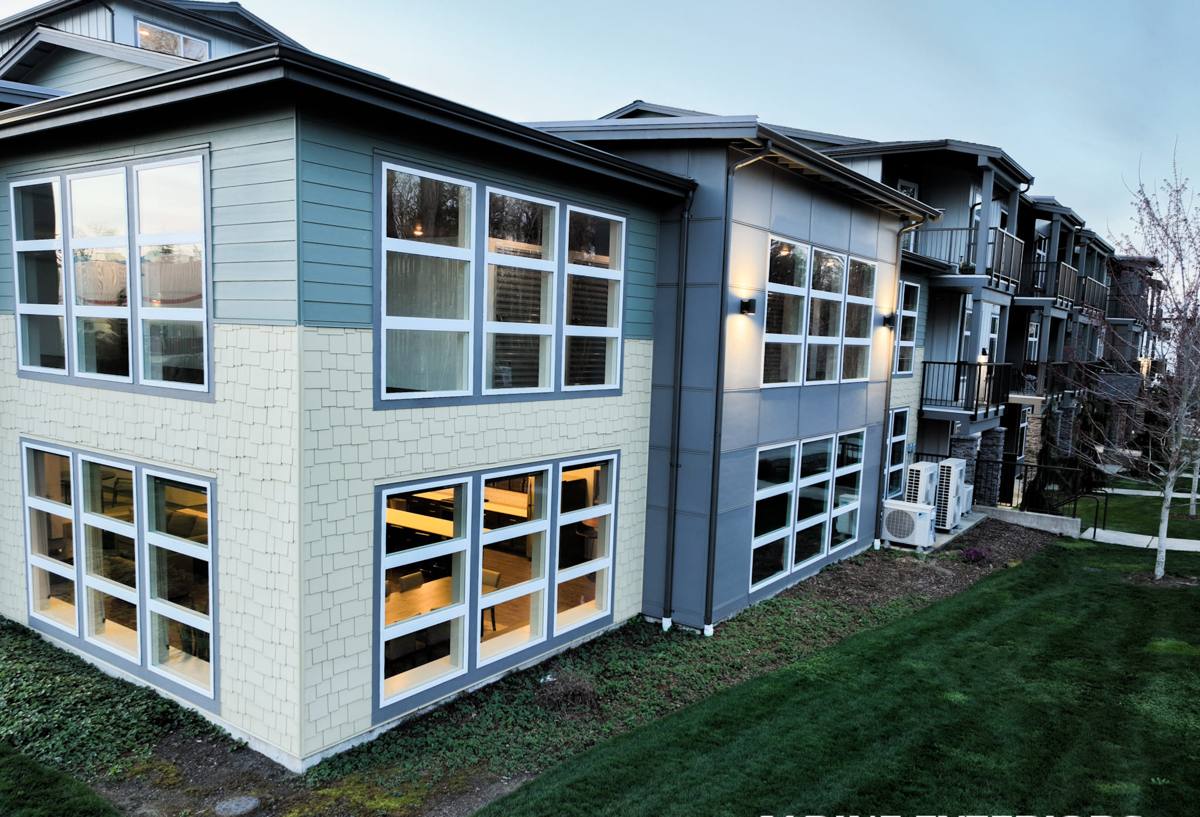
Why Bellingham Homes Need Custom Sizing More Often Than You'd Expect
A handful of things push Bellingham window projects out of stock-size territory more often than a typical inland town. The city has a wide mix of housing eras — older homes on the hillsides and in established neighborhoods were framed to whatever dimensions made sense at the time the builder was working, long before modern window sizing was standardized. A straight stock-size swap into one of those openings often means either a custom unit or reframing the rough opening, and reframing brings its own cost, timeline, and disruption to the wall assembly around it.
Additions and remodels create a second category. A room addition, a converted porch, or a bumped-out kitchen wall almost never lines up with an off-the-shelf window size, and matching new openings to existing windows elsewhere on the house for a consistent sightline is its own kind of custom work even when the shape itself is a plain rectangle. And a fair number of Bellingham properties, especially those with any view toward the bay or the surrounding hills, were designed or later modified with picture windows, bay windows, or oversized openings meant to capture that view — none of which are stock sizes by definition.
None of this is unusual for us. It's routine work in this part of Whatcom County. But it does mean the project starts differently than a same-size swap: with careful field measurement, an honest conversation about what the existing opening will actually support, and a realistic lead time, since custom units are built to order rather than pulled from a warehouse shelf.
What Bellingham's Climate Does to Custom Windows Specifically
Salt Air Off the Bay
Bellingham's setting on Bellingham Bay means a steady flow of moisture-laden, salt-tinged air moving through the city on an ordinary day, not just during storms. That kind of sustained exposure accelerates corrosion on hardware, fasteners, and lower-grade frame components faster than an inland climate would. On a custom unit, that risk goes up rather than down — a larger picture window or a projecting bay window has more hardware, more perimeter, and more exposed surface area for salt-laden air to work against over the years.
Driving Rain
Storms coming off the Salish Sea push rain sideways into wall assemblies rather than letting gravity do the work, and that wind-driven rain finds gaps that a calmer, drier climate would never test. A larger custom opening has more perimeter to flash correctly, and a bay or bow window adds its own roof-to-wall transition where water can collect if that detail isn't built right. An arched or angled opening has curved or angled cuts in the wall assembly that are inherently harder to flash cleanly than a straight rectangular opening.
A Long Moss Season
Mild temperatures, tree cover common on Bellingham's hillside and wooded lots, and near-constant dampness through fall, winter, and spring add up to a moss and mildew season that can run most of the year on shaded and north-facing walls. Window sills, trim, and the framing around older wood windows are common places it takes hold, especially anywhere water can sit instead of draining away. A custom sill on a bay window or a wide picture window needs a real slope built into it for exactly this reason — a flat sill in this climate becomes a place moss and standing moisture collect.
Condensation From Temperature Swings
The gap between a heated Bellingham interior and a cold, damp exterior creates real condensation pressure on glass and frames through the wet months. Older single-pane windows and failed double-pane seals show this constantly — fogging, moisture trapped between panes, or water pooling on interior sills. On a large custom picture window, that condensation problem is magnified simply because there's more glass area for it to show up on.
Where the Risk Actually Concentrates
It's rarely the glass or the frame material itself that fails first on a custom window in this climate. It's the transition points — where a bay window's small roof ties into the main wall above it, where a wide picture window's sill meets the siding below it, where an arched top gets cut into the surrounding wall assembly. Those spots need extra flashing attention, and they're also the spots a rushed installation is most likely to shortcut, because they take real time to do correctly and don't show a problem until a wet season or two has passed.
Custom Window Types We See Around Bellingham
- Non-standard replacement sizes — matching an existing opening in an older Bellingham home built before modern sizing standards
- Bay and bow windows — projecting units that add interior space and view area but bring their own roof, support, and flashing requirements
- Picture and large-format windows — fixed units used to maximize a bay or territorial view, with more glass area to manage both structurally and for condensation
- Arched, angled, or specialty-shaped openings — architectural details common on some of Bellingham's older and character-driven homes, requiring custom-cut units and matching custom flashing
- Egress and code-driven openings — bedroom or basement conversions where the required opening size is set by code, not by convenience
- Matched sets for additions — new windows sized and placed to sightline correctly with existing windows on the rest of the house
Retrofit Replacement vs. Full-Frame Replacement
Custom sizing decisions usually come with a second question: does the new window go into the existing frame, or does the whole frame come out down to the rough opening? Both approaches have a real place in Bellingham's mix of older and newer housing stock, and the right call depends on the condition of what's already there, not on which is faster to install.
| Approach | What It Involves | When It Makes Sense in Bellingham |
|---|---|---|
| Retrofit (insert) replacement | New window unit fits inside the existing frame; original frame, trim, and exterior finish largely stay in place | Existing frame is sound, dry, and free of rot — common on newer or well-maintained homes |
| Full-frame replacement | Old window and frame come out completely down to the rough opening; new flashing and window go in from scratch | Frame shows rot, past water damage, or the opening is changing size or shape — common on older hillside and pre-modern-code homes |
A retrofit is usually faster and less disruptive to interior trim and exterior siding. But it also seals in whatever condition the existing frame and flashing are already in, which is a real risk on an older Bellingham property where a wall has been absorbing wind-driven rain for decades. We check the condition of the existing opening before recommending either path, and we'll tell you plainly if a retrofit would just be sealing a problem in rather than fixing it.
Choosing a Frame Material for This Climate
Frame material matters more on a custom unit than on a small standard-size replacement, since a larger or more exposed window has more surface area for salt air and sustained moisture to work against over time.
| Frame Material | Moisture Resistance | Maintenance | Best Fit |
|---|---|---|---|
| Vinyl | Good — won't rot, resists moisture well | Low — no painting or sealing required | Budget-conscious replacements, most standard custom sizes |
| Fiberglass | Very good — dimensionally stable across wet-dry and hot-cold cycles | Low — can be painted if a custom color is wanted | Larger custom units, bay and picture windows carrying more structural load |
| Wood-clad (exterior-clad, wood interior) | Good on the exterior if the cladding is intact; interior wood needs the exterior seal to hold | Moderate — exterior cladding is low-maintenance, but any breach exposes wood underneath to this climate's moisture | Homes where an interior wood look matters and the exterior is properly protected |
| Aluminum | Poor without thermal breaks — conducts cold and can promote interior condensation | Low physically, but condensation issues often follow it in this climate | Rarely our first recommendation for Bellingham's marine, high-moisture conditions |
We'll walk through the honest trade-offs for your specific opening rather than defaulting to whichever material is easiest to install. In general, we lead with fiberglass and vinyl on weather-facing custom units in Bellingham because they hold up to sustained coastal moisture with less ongoing maintenance than an uncladded wood exterior finish would need in this climate.
What a Correct Custom Window Job Involves
Field Measurement and Ordering
Custom work starts with precise, on-site measurement, not a catalog lookup or a guess from old plans. We measure the actual opening, note any out-of-square or out-of-level conditions common in Bellingham's older housing stock, and account for what the finished exterior trim and flashing will need in terms of clearance. Because custom units are built to order, this step also sets honest expectations on lead time — custom windows generally take weeks to arrive, not days, and we'll tell you a realistic timeline before you commit rather than the best-case number.
Structural Review for Larger Units
Bay and bow windows, and some oversized picture windows, sometimes need structural support beyond what a standard opening requires, since they carry more weight and project outward from the wall plane. We evaluate that during the assessment, not as a surprise once the wall is already open. On older Bellingham homes, this is also frequently where we find out whether the original framing or flashing around an opening needs correction before a new unit goes in.
Flashing and Weatherproofing Sequence
This is the step that decides how the window actually performs in Bellingham's climate. Every custom shape changes how flashing has to be sequenced — a bay window's small roof needs its own weatherproofing layer separate from the wall flashing below it, a wide picture window's sill needs a real slope to shed water outward instead of letting it pool, and an arched top needs flashing cut and lapped to follow the curve rather than run in a straight course. Caulk is a supplement to that sequence, not a substitute for it — caulk alone breaks down and cracks over time and was never meant to be the only line of defense against wind-driven rain off the bay.
Trim and Finish Integration
Custom windows often sit in visually prominent spots — a bay window facing the street, a picture window centered on a water or hillside view — so the trim and finish work has to match the rest of the exterior cleanly. We plan that integration before the window arrives so the finished result reads as original to the house rather than added on.
A Quick Checklist Before You Order
- Confirm the opening has been field-measured, not estimated from old plans or a rough guess
- Ask what the flashing plan looks like for the specific shape you're getting, not a generic answer
- Get a realistic lead time in writing before you commit to a schedule
- Ask whether the opening needs structural review, especially for bay, bow, or oversized units
- Confirm what's covered under warranty, since the window unit and the installation labor are typically covered separately
- Ask how trim and finish will be matched to the rest of the exterior
Signs a Bellingham Window Needs Attention Now
- Fogging or visible moisture trapped between the panes of a double-pane window
- Drafts or cold spots near the frame even when the window is fully latched
- Wood trim or a sill that feels soft, looks discolored, or shows visible rot
- Moss or dark staining on a sill or lower trim that comes back quickly after cleaning
- Difficulty opening, closing, or locking a window that used to operate smoothly
- Visible daylight or gaps where the frame meets the surrounding siding or trim
Our Process, Start to Finish
- On-site assessment — we measure the opening, check square and level, and evaluate any structural or flashing concerns specific to the shape or size involved
- Honest recommendation — custom order, retrofit replacement, or full-frame replacement with a reframed opening, explained with the reasoning behind it, not just whatever's fastest to sell
- Ordering and lead time — we give you a realistic timeline for the custom unit to arrive, since it's not typically a same-week job
- Removal and opening prep — the old unit comes out carefully, and any hidden rot or past flashing failures get addressed before the new window goes in
- Installation and flashing — the new unit is set, shimmed, and flashed following a sequence built for its specific shape and size, not a generic template
- Trim, finish, and final walkthrough — exterior trim is integrated to match the surrounding siding, and we walk the finished opening with you before calling the job done
What Drives Cost on a Custom Window Project
We won't quote a number without seeing the opening in person, but the factors that move price on custom work in Bellingham are consistent from job to job.
| Factor | Why It Matters |
|---|---|
| Size and glass area | Larger units cost more to manufacture and are heavier and more labor-intensive to install |
| Shape complexity | Arched, angled, or curved units require specialty manufacturing and more flashing labor to install correctly |
| Retrofit vs. full-frame | Full-frame work involves more demolition, framing repair, and flashing labor, but is often the right call on an older opening |
| Structural work | Bay and bow windows sometimes need added support framing before the unit goes in |
| Frame material | Vinyl, fiberglass, and wood-clad units differ in both material cost and long-term maintenance in this climate |
| Opening condition | Rot, old flashing failures, or out-of-square framing add repair work before the new unit can go in |
| Number of units | A matched set for an addition or a whole-house project typically has better per-unit economics than a single window |
Why Local Experience in Bellingham Matters for This Kind of Work
Manufacturer installation guides are written for average, standard conditions. Custom windows rarely fit that description on their own, and Bellingham's climate doesn't fit it either — salt air off the bay, wind-driven rain, and a long wet season stack the deck against a shortcut installation more than they would in a drier, calmer market. A crew that has actually built out bay windows, flashed arched openings, and reframed odd-sized rough openings in Bellingham's specific mix of hillside and older housing stock knows which details in the manufacturer's guidance are non-negotiable here, and where extra time on flashing or sealant is worth it even when nothing on paper requires it.
That experience shows up in decisions that rarely make it into a sales conversation — how a bay window's small roof ties into the main wall's water management, how much lap a flashing course needs on an arched opening, when a sill needs a sloped composite cap instead of relying on caulk to do that job. Those are the details that decide whether a custom window is still performing cleanly in fifteen years or showing rot and drafts in five, and they're easiest to get right the first time when the crew installing it already knows how this specific stretch of Whatcom County behaves across a full wet season.
Ready to Talk About Your Windows
If you're planning an addition, replacing an odd-sized opening in an older Bellingham home, or considering a bay or picture window to make the most of a view, it's worth having someone look at the actual opening before you start pricing units. We offer free, no-pressure estimates for custom window projects in Bellingham and the surrounding Whatcom County area — use the form below to get a time on the schedule.