 Chuckanut Exterior
 Building Decks for Fairhaven's Coastal Conditions
Fairhaven sits close enough to the water that its air carries salt, and its winters bring long stretches of steady, driving rain followed by a moss season that seems to start earlier every year. A deck built here does a different job than a deck built inland. It has to shed water fast, resist corrosion from salt-laden air, and stay usable through months of damp, shaded weather without turning slick or soft underfoot. We build decks in this neighborhood with those specific conditions in mind, not with a generic build spec pulled from a catalog.
This page covers what a custom deck project in Fairhaven actually involves — material choices, framing details, hardware, our process, and the upkeep that keeps a deck sound for decades in a Whatcom County climate.
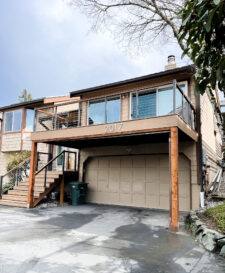
What Salt Air, Rain, and Moss Actually Do to a Deck
Before talking about materials, it helps to understand the specific stresses at play, because they're different from what a deck faces in a drier or inland climate.
Salt Air and Corrosion
Salt in the air accelerates corrosion on any exposed metal — fasteners, brackets, railing hardware, even the heads of screws that look fine for the first year or two. Standard galvanized hardware can start showing rust streaks and pitting well before a deck's wood or composite decking shows any wear. Once fasteners corrode, they weaken, and a deck's structural connections are only as good as the hardware holding them together.
Driving Rain and Water Intrusion
Rain that comes in sideways off the water finds its way into places vertical-only rain never reaches — under railing caps, behind ledger boards, into end grain that isn't properly sealed. Flat surfaces that don't shed water fast enough stay wet longer, which is exactly the condition that leads to rot in wood framing and premature failure in lower-grade decking.
Moss, Algae, and a Long Damp Season
Shaded decks, or decks near trees and dense landscaping, stay damp for extended stretches through fall, winter, and spring. That moisture supports moss and algae growth on decking surfaces, which isn't just a maintenance nuisance — a mossy deck surface is a slip hazard, and moss holds moisture against the board longer than bare wood or composite would on its own.
Choosing the Right Decking Material for This Climate
There's no single "best" decking material for every Fairhaven home — it depends on budget, how much upkeep you want to do, and how exposed the deck is to sun, shade, and weather. Here's how the common options actually perform in this kind of climate.
| Material | Moisture Resistance | Maintenance | Typical Lifespan |
|---|---|---|---|
| Pressure-treated wood | Good if sealed regularly; end grain is a weak point | Annual cleaning and re-sealing recommended | 15–25 years with upkeep |
| Cedar | Naturally rot-resistant but still needs sealing near salt air | Periodic cleaning, staining or sealing every 1–3 years | 15–25 years with upkeep |
| Composite decking | Very good — doesn't absorb water like wood | Periodic washing to prevent surface algae/moss buildup | 25–30+ years, manufacturer-warrantied |
| PVC/capstock decking | Excellent — fully moisture-resistant surface | Low; occasional washing | 25–30+ years, manufacturer-warrantied |
Wood costs less up front and gives a natural look many homeowners prefer, but it asks for consistent maintenance to hold up in this climate — skipping a season of sealing matters more here than it would somewhere drier. Composite and PVC cost more initially but trade ongoing upkeep for consistency, which is worth considering on a deck that gets heavy shade or salt exposure and won't get attention every year.
Framing and Structure: What's Underneath Matters More Than the Surface
The decking boards are what you see, but the framing underneath is what actually determines how long a deck lasts in a wet coastal climate. This is where we see the biggest difference between a deck that holds up for decades and one that starts having problems in five to ten years.
Ledger Board Flashing
The ledger board — where the deck attaches to the house — is the single most common point of water intrusion and structural failure on residential decks. Proper flashing that directs water away from the house sheathing, rather than trapping it against the ledger, is non-negotiable in a climate with this much rainfall.
Joist Protection
Joist tape or an equivalent moisture barrier over the tops of joists keeps water from pooling in fastener holes and wicking into the wood grain. It's inexpensive relative to the total project cost and makes a real difference in how long the frame lasts before rot sets in.
Footings and Post Bases
Footings need to sit below frost depth and be sized for the soil conditions on the actual lot — this isn't a place to guess. Post bases should hold posts up off the concrete rather than letting end grain sit in standing water, which is a common shortcut that shortens post life significantly in a wet climate.
Fasteners and Hardware Built for Salt Air
Hardware choice is one of the easiest things to get wrong on a coastal build, because low-grade fasteners can look identical to the right ones when the deck is finished. We spec stainless steel or high-grade coated fasteners rated for coastal and salt-air exposure on connections that matter structurally — ledger bolts, joist hangers, railing posts — rather than standard galvanized hardware that's adequate inland but corrodes faster here.
The same logic applies to railing hardware and any exposed brackets. It costs more than the minimum-grade option, but replacing corroded structural hardware years later means tearing into a finished deck — it's far cheaper to spec it correctly the first time.
Our Process for a Fairhaven Deck Build
- Site visit and design conversation: we walk the property, talk through how you'll use the deck, and account for sun exposure, drainage, and how close it sits to salt-laden air off the water.
- Material and layout selection: we go over decking, railing, and structural options against your budget and how much maintenance you want to take on long-term.
- Permitting: we handle the permit application and any required inspections through the local building department before work starts.
- Framing and structural work: footings, framing, ledger flashing, and joist protection go in first, since this is the work that determines the deck's lifespan.
- Decking, railing, and finish work: surface materials and railings go on last, with attention to fastener placement and drainage gaps between boards.
- Final walkthrough: we go over the finished deck with you, including what maintenance it needs and roughly when.
Maintenance That Actually Matters in This Climate
A well-built deck in Fairhaven still needs some seasonal attention — the climate here just makes maintenance timing matter more than it would elsewhere. This isn't a long list, but skipping it tends to show up as problems within a few years rather than a few decades.
- Sweep off leaves and debris regularly, especially in fall — trapped organic matter holds moisture against the deck surface and feeds moss growth
- Wash the deck surface at least once a year to clear early moss and algae growth before it gets established
- Check and re-seal wood decking on the manufacturer's or installer's recommended schedule — don't wait until it visibly looks dry
- Inspect railing posts and hardware annually for early rust or corrosion, particularly on decks with direct exposure toward the water
- Keep gutters and downspouts near the deck clear so runoff isn't dumping extra water directly onto or under the structure
- Check that drainage gaps between boards stay clear so water doesn't pool on the surface
Permits and Local Considerations
Most deck projects in Whatcom County require a building permit, and requirements can vary depending on the deck's height, size, and how it attaches to the house. We handle the permitting process as part of the project so you're not navigating it on your own. If the property has any specific site considerations — slope, drainage easements, proximity to the shoreline — we address those during the design phase rather than after a permit application runs into a snag.
Why Hire a Crew That Already Works in Fairhaven
A deck built to a generic spec sheet can look fine on the day it's finished and still start failing within a few years if it wasn't built for this specific climate. Crews that work regularly in Fairhaven and the surrounding Chuckanut area already know which fastener grades hold up, where flashing details matter most, and how much maintenance a given material actually needs here versus what a manufacturer's general guidance assumes for a drier climate. That local experience shows up in fewer callbacks, fewer surprises, and a deck that's still solid well past the point where a corner-cut build starts having problems.
If you're planning a new deck or replacing one that's showing its age, we're happy to take a look and put together a free, no-pressure estimate — just fill out the form below.