 Chuckanut Exterior
 Sehome's Climate Is Hard on Siding — Here's Why
Homes in Sehome sit close enough to the water and the tree cover that they take on three kinds of punishment most siding products were never designed to handle at once: salt-laden air moving in off the water, long stretches of driving, wind-blown rain, and a moss season that can stretch for the better part of the year under Whatcom County's tree canopy and cloud cover. Any one of those is manageable. Together, they shorten the working life of the wrong siding material fast.
Salt air is corrosive to fasteners and finishes, and it accelerates the breakdown of coatings that aren't formulated for it. Driving rain doesn't just wet a wall's surface — it gets pushed sideways under gaps, laps, and trim by wind, which means the water management behind the siding matters as much as the siding itself. And moss doesn't just sit on a roof; on a shaded, north-facing wall or under an overhang with poor airflow, it takes hold on siding surfaces and traps moisture against the substrate, which is exactly the condition that rots wood-based products and degrades poor coatings.
We install fiber cement specifically because it's a non-combustible, moisture-stable material that doesn't swell, rot, or feed mold and moss the way wood-based siding does. But the material is only half the equation — how it's installed determines whether it actually performs the way it's rated to in a climate like this one.
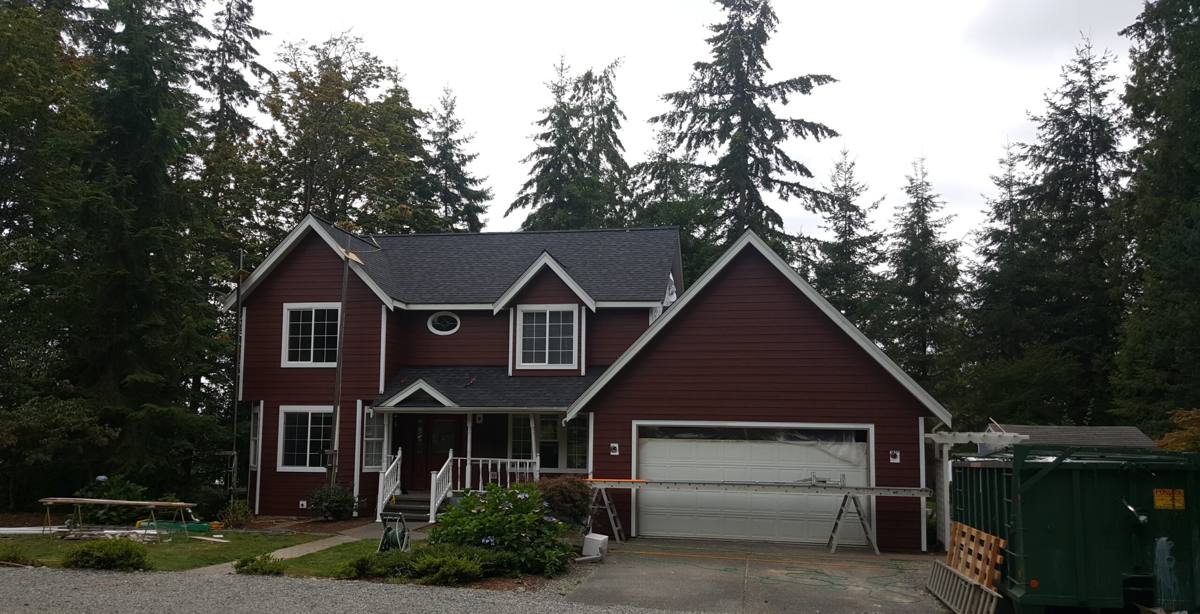
What Correct Installation Actually Involves in Sehome
Water Management Comes Before the Siding
Most siding failures we see on older Sehome homes aren't failures of the siding panel itself — they're failures of what's behind it. A weather-resistive barrier that's torn, taped incorrectly, or missing at penetrations will let wind-driven rain behind the cladding regardless of what material is on the surface. Correct installation starts with inspecting and, where needed, repairing the drainage plane before a single piece of new siding goes up.
Flashing and Clearances
Every window, door, and roof-to-wall transition needs flashing detailed to shed water outward, not into the wall assembly. Fiber cement siding also needs a minimum clearance above roof lines, decks, and grade — skipping that clearance is one of the most common shortcuts that leads to moisture wicking into the bottom edge of the boards over time.
Fastening and Joints
In a salt-air environment, fastener choice matters more than it does further inland. Correctly rated, corrosion-resistant fasteners driven to the manufacturer's specified pattern and depth keep the siding secure without splitting the board or leaving a gap where water can travel. Butt joints and trim seams need to be treated with the right sealant and gapping — not just caulked over — so they can move with temperature changes without opening back up.
Caulking and Sealing Penetrations
Every hose bib, light fixture, vent, and hanging bracket that penetrates the siding is a potential entry point for wind-driven rain. Each one needs to be sealed as part of the installation, not treated as an afterthought once the crew has moved on.
Why We Install Only James Hardie Fiber Cement
We don't install vinyl, LP SmartSide, Cemplank, Allura, or primed wood siding, and we're upfront about why. Fiber cement as a category performs well in this climate, but not all fiber cement — and none of the alternatives to it — are engineered and backed the same way.
James Hardie manufactures siding in climate-specific formulations, and the HZ5 product line is engineered for the wetter, milder Pacific climate zone that includes Western Washington. That means the board itself is formulated to resist moisture-related damage in exactly the kind of weather Sehome sees — not a generic national product applied to every region.
Hardie's ColorPlus finish is baked on at the factory under controlled conditions, which gives it better fade and wear resistance than field-applied paint, and it comes with its own finish warranty separate from the substrate warranty. That combination — climate-engineered board plus factory finish plus a real transferable warranty — is why we standardized on Hardie rather than carrying multiple fiber cement brands or offering cheaper alternatives.
How Fiber Cement Compares to the Alternatives
| Factor | James Hardie Fiber Cement | Vinyl Siding | Wood / LP-Type Composite |
|---|---|---|---|
| Moisture behavior | Dimensionally stable, won't swell or rot | Won't rot, but can warp and gap in heat/cold cycles | Wood-based core is vulnerable to swelling and rot if moisture gets in |
| Salt air / coastal exposure | Formulated for wet coastal climates (HZ5) | Holds up structurally but colors fade and chalk over time | Coatings break down faster; more frequent recoating needed |
| Moss and mold resistance | Inorganic material, doesn't feed mold or moss growth | Doesn't feed growth, but seams and laps trap debris | Wood-based composites can be vulnerable if the surface seal is compromised |
| Fire performance | Non-combustible | Combustible (petroleum-based) | Combustible |
| Finish | Factory-applied ColorPlus, warrantied | Color molded through, but fades and chalks | Field-applied paint or primer, needs ongoing maintenance |
This isn't a claim that the alternatives are junk — vinyl and wood-composite products have legitimate uses and reasonable installers behind them. It's a statement of where we drew our own line: given what we see fail and what we see hold up on homes in this exact climate, Hardie is what we're willing to put our name on.
Our Process for a Sehome Siding Project
- On-site assessment — we look at the existing siding, trim, flashing, and any signs of moisture intrusion before quoting anything.
- Tear-off and substrate check — old siding comes off and we inspect sheathing for hidden rot or damage, which is common on walls facing prevailing wind and rain.
- Water barrier repair or replacement — any damaged weather-resistive barrier is repaired or replaced before new siding goes up.
- Flashing detail work — windows, doors, and roof transitions are flashed correctly, not just caulked.
- Hardie installation to spec — correct fasteners, clearances, and joint treatment, following manufacturer installation requirements.
- Trim, caulking, and final seal — all penetrations and joints sealed before the job is called finished.
- Final walkthrough — we go over the finished work with the homeowner before we consider the job done.
Signs a Sehome Home May Need New Siding
- Visible cracking, buckling, or gaps between siding boards or panels
- Soft spots, discoloration, or a musty smell near exterior walls, especially on shaded or north-facing sides
- Moss or algae buildup that keeps coming back on the siding surface itself, not just the roof
- Paint or finish that's chalking, peeling, or fading unevenly, especially on walls exposed to prevailing wind and rain
- Fasteners that are visibly rusted, popped out, or leaving streaks down the siding
- Interior signs like peeling paint, bubbling drywall, or a damp smell along an exterior wall
- Rising heating bills that suggest the wall assembly isn't sealing the way it used to
Maintenance in a Salt Air and Moss-Prone Climate
Fiber cement is low-maintenance compared to wood, but "low-maintenance" doesn't mean "no maintenance," especially this close to the water. A periodic rinse-down removes salt residue and organic buildup before it has a chance to take hold. Keeping gutters clear and grading away from the foundation prevents water from sitting against the bottom courses of siding. Trimming back vegetation that shades a wall and limits airflow helps cut down on the moss and algae growth that thrives in damp, shaded spots. None of this is difficult, but skipping it lets a maintenance-free material start to look neglected well before it actually fails.
Why Hiring a Crew That Already Works in Sehome Matters
Siding installation looks similar on paper everywhere, but the details that actually matter — how much clearance to leave, how aggressively to flash a wall exposed to wind-driven rain, which walls are going to fight moss no matter what you do — are learned by doing the work in this specific climate, not by reading a spec sheet. A crew that regularly works in and around Chuckanut and greater Whatcom County has already seen how these homes behave through a wet winter and a mossy spring, and builds that experience into every install rather than treating each job as a generic siding replacement.
That local familiarity also means fewer surprises during the project — knowing what's typically hiding behind older siding in this area, what permitting looks like locally, and how to sequence work around the weather this region actually gets, rather than the weather a general installation manual assumes.
If your Sehome home's siding is showing its age or you're planning ahead of a wet season, we're happy to take a look and give you a straightforward, no-pressure estimate — no obligation, just an honest read on what your home needs.