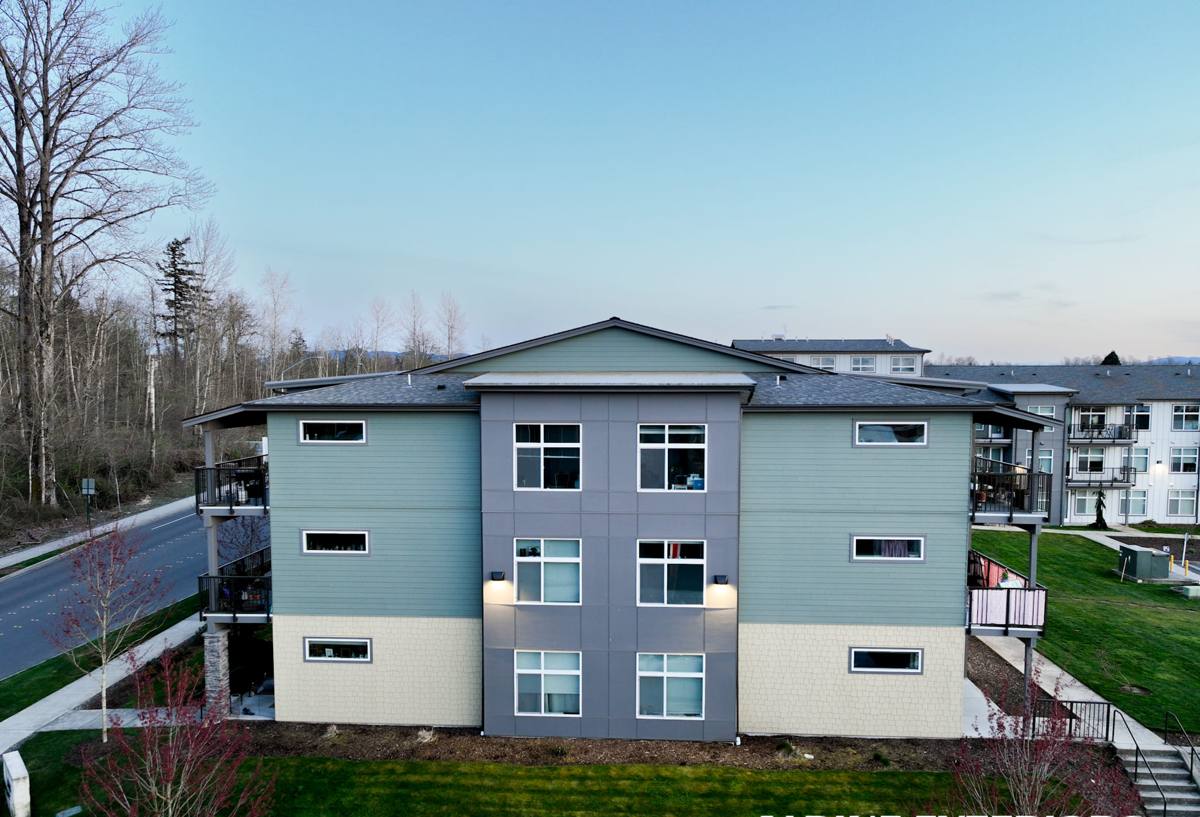
 Chuckanut Exterior
 Chuckanut's Coastal Climate and What It Does to Siding
Homes in the York area sit close enough to the water that salt air is a daily fact of life, not an occasional nuisance. Add Whatcom County's driving rain — rain that comes in sideways during winter storms instead of falling straight down — and a shaded, tree-heavy lot, and you have three separate forces working against exterior siding at the same time. Salt air accelerates corrosion of fasteners and metal trim. Wind-driven rain finds its way into seams and laps that would stay dry in a calmer climate. And the long moss season, often stretching from late fall through spring in wooded neighborhoods like this one, keeps siding damp for weeks at a stretch even when it isn't actively raining.
None of that is a reason to avoid siding altogether — it's a reason to be deliberate about the material and the installation. Siding that's rated for a drier, calmer climate — or installed the same way it would be in one — tends to show problems in York years before it would somewhere inland. That's the starting point for every siding replacement conversation we have with homeowners here.
Signs Your York Home's Siding Has Reached the End of Its Life
Siding failure in this climate rarely announces itself with a single obvious symptom. It shows up as a pattern of small issues that, taken together, mean the material or the installation behind it has given up.
- Soft or spongy spots when you press on siding, especially near the bottom courses and around window and door trim
- Persistent green or black staining that comes back within weeks of being cleaned
- Paint that's peeling, bubbling, or chalking faster than the repaint cycle would suggest it should
- Visible gaps, warping, or cupping in horizontal boards
- Rust streaks below nail heads or trim fasteners
- A musty smell or unexplained humidity in rooms along an exterior wall
Any one of these on its own might be a spot repair. Several at once, especially on a home more than fifteen or twenty years old, usually means the siding system as a whole — not just the visible boards — has reached the point where replacement costs less over time than continuing to patch it.
What a Correct Siding Replacement Job Involves
Replacing siding correctly in a climate like this is less about the boards you can see and more about everything underneath them. A job that looks right the day it's finished but skips the details below tends to fail in the same spots the old siding did — just on a faster timeline.
Tear-Off and Structural Check
Full removal of the old siding is the only reliable way to find out what's actually happening at the sheathing. Rot, soft framing, or compromised insulation hiding behind intact-looking siding is common in older homes, and it has to be addressed before anything new goes on the wall.
Water-Resistive Barrier and Flashing
A continuous, correctly lapped water-resistive barrier is what actually keeps a home dry — the siding itself is the first line of defense, not the only one. Flashing at every window, door, deck ledger, and roof-to-wall intersection has to be integrated with that barrier in the right shingle-lap order, so water is always directed out and down, never trapped behind the cladding.
Ventilation and Drainage
In a climate with a long moss season, siding that sits flush against a damp wall stays wet longer than siding with a drainage gap behind it. A rainscreen or drainage plane lets bulk water and moisture vapor escape instead of sitting against the sheathing, which is one of the biggest differences between a five-year siding job and a twenty-five-year one.
Fastening and Clearances
Manufacturer-specified fastener type, spacing, and penetration depth matter more in salt air than in a dry inland climate, where a slightly wrong fastener might go unnoticed for decades. Ground clearance, and clearance from decks, patios, and roof lines, keeps siding out of the splash zone where moisture damage starts fastest.
Why We Install Only James Hardie Fiber Cement in This Climate
We install James Hardie fiber cement siding exclusively — not vinyl, not LP SmartSide, not Cemplank or Allura, not primed spruce or cedar. That's a deliberate standard, not a default.
Fiber cement doesn't feed moss and algae the way wood-based products can, and it doesn't soften, swell, or delaminate the way engineered wood siding can when it stays wet for extended stretches — a real risk during a Whatcom County moss season. It's non-combustible, which matters for insurance and peace of mind regardless of climate. And Hardie's HZ5 product line is engineered specifically for wetter, harsher climates like the Pacific Northwest, with a formulation built to resist moisture damage rather than just tolerate it.
ColorPlus, Hardie's factory-applied finish, is baked on under controlled conditions rather than brushed or sprayed on site. That matters in a climate where field-applied paint has a shorter effective life — ColorPlus is backed by its own finish warranty separate from the substrate warranty, and it holds color and resists fading and chipping far better than a job-site paint job exposed to salt air and UV from day one.
We're not going to tell you vinyl or engineered wood siding is worthless — both have real advantages, including upfront cost. But in a climate that combines salt air, driving rain, and a long wet season, we've seen enough of what happens to those products over ten and twenty years that we no longer install them, full stop. Hardie is what we stand behind.
Siding Options Compared for Salt Air and Moss Season
| Factor | James Hardie Fiber Cement | Vinyl | Engineered Wood (LP-type) | Cedar / Primed Spruce |
|---|---|---|---|---|
| Moisture behavior | Resists swelling and rot; engineered for wet climates | Doesn't absorb water but traps moisture behind it | Can swell and delaminate if moisture reaches the substrate | Absorbs moisture; prone to rot without diligent upkeep |
| Moss and algae resistance | Non-organic; doesn't feed growth | Growth sits on surface, cleans off | Wood fiber content can support growth if finish fails | Natural wood is a food source for moss and algae |
| Finish durability in salt air | Factory ColorPlus finish, separate finish warranty | Color molded in, can fade and chalk | Field-applied paint, shorter repaint cycle | Requires frequent re-staining or re-painting |
| Fire resistance | Non-combustible | Melts and can contribute to fire spread | Combustible | Combustible |
| Typical lifespan installed to spec | 30+ years | 20-30 years | 15-25 years, climate-dependent | 15-25 years with regular maintenance |
Our Siding Replacement Process for York Homes
- On-site inspection. We walk the exterior with you, check for soft sheathing, existing moisture damage, and problem areas specific to your lot's sun and wind exposure.
- Written scope and product selection. We go over Hardie plank profiles, textures, and ColorPlus colors, and put the full scope of work — including flashing and drainage details — in writing before any work starts.
- Full tear-off. Old siding and any compromised underlayment come off down to the sheathing so we can verify what's actually there.
- Repair and prep. Any rotted sheathing or framing gets repaired before we move forward — never covered over.
- Water-resistive barrier and flashing installation. Installed and lapped to manufacturer and code specifications at every penetration.
- Hardie siding installation. Installed to James Hardie's fastening, clearance, and joint-treatment specifications, which is also what keeps the manufacturer's warranty intact.
- Trim, caulking, and detail work. Corners, trim boards, and penetrations are sealed and finished.
- Final walkthrough and cleanup. We review the finished work with you and clear the site of debris and old material.
What Siding Replacement Costs Depend On
We don't publish fixed prices because siding replacement cost depends on real, home-specific variables — anyone who quotes a number before seeing your home is guessing. The factors that move the price most are:
- Total square footage of exterior wall area
- Condition of the sheathing and framing once old siding comes off — hidden rot repair adds cost but isn't optional
- Number and complexity of corners, trim details, windows, and rooflines
- Home height and access — two-story and steep-lot homes take longer to scaffold and work safely
- Siding profile and finish selection, since Hardie offers multiple plank widths, textures, and ColorPlus tiers
- Whether additional work like new flashing, house wrap, or drainage plane installation is needed beyond a like-for-like swap
The only way to get an accurate number is a walk-through of the specific home, which is exactly what a free estimate is for.
Why a Crew That Already Works in York Matters
Siding installation instructions read the same everywhere in the country, but the judgment calls that come with them don't. A crew that already works this part of Whatcom County knows which walls take the worst of the wind-driven rain, which lots hold moisture longest under tree cover, and where extra flashing or drainage detail is worth the added labor even though it's not strictly required by code. That judgment comes from repetition, not from a manual.
There's also a practical side: familiarity with local permitting expectations, realistic scheduling around the wetter months, and a crew that isn't learning the climate on your home. When something needs a follow-up visit — a piece of trim that needs a second look after the first hard rain, for instance — a contractor who's already local and already working in the area can get back out to you without it becoming a logistics problem.
If your York home's siding is showing its age, or you just want a straight answer about whether repair or full replacement makes sense, we're happy to take a look. Reach out below for a free, no-pressure estimate — we'll walk the exterior with you and tell you honestly what we find.