 Chuckanut Exterior
 Mount Vernon's Climate Is Harder on Siding Than It Looks
Homes in the Mount Vernon area near Chuckanut sit in a stretch of Whatcom County where three things work against exterior siding at the same time: salt-laden air off the water, long stretches of driving rain, and a moss and algae season that can run most of the year in shaded, north-facing spots. None of these are dramatic on their own. Together, over ten or fifteen years, they're what separates a siding job that still looks sharp from one that's chalking, staining, and rotting at the corners.
Salt air accelerates corrosion on fasteners, flashing, and trim — the metal parts of a siding system that most homeowners never think about until something fails behind the wall. Driving rain, especially wind-driven rain that hits walls at an angle instead of falling straight down, finds every gap in flashing and caulking that a calmer climate would never expose. And moss and algae don't just look bad — they hold moisture against the siding surface far longer than dry air would, which matters a lot to a product's long-term performance.
This is the environment we're actually building for on a Mount Vernon home, not a generic "Pacific Northwest" description. It's why product choice and installation detail matter more here than they would in a drier inland climate.
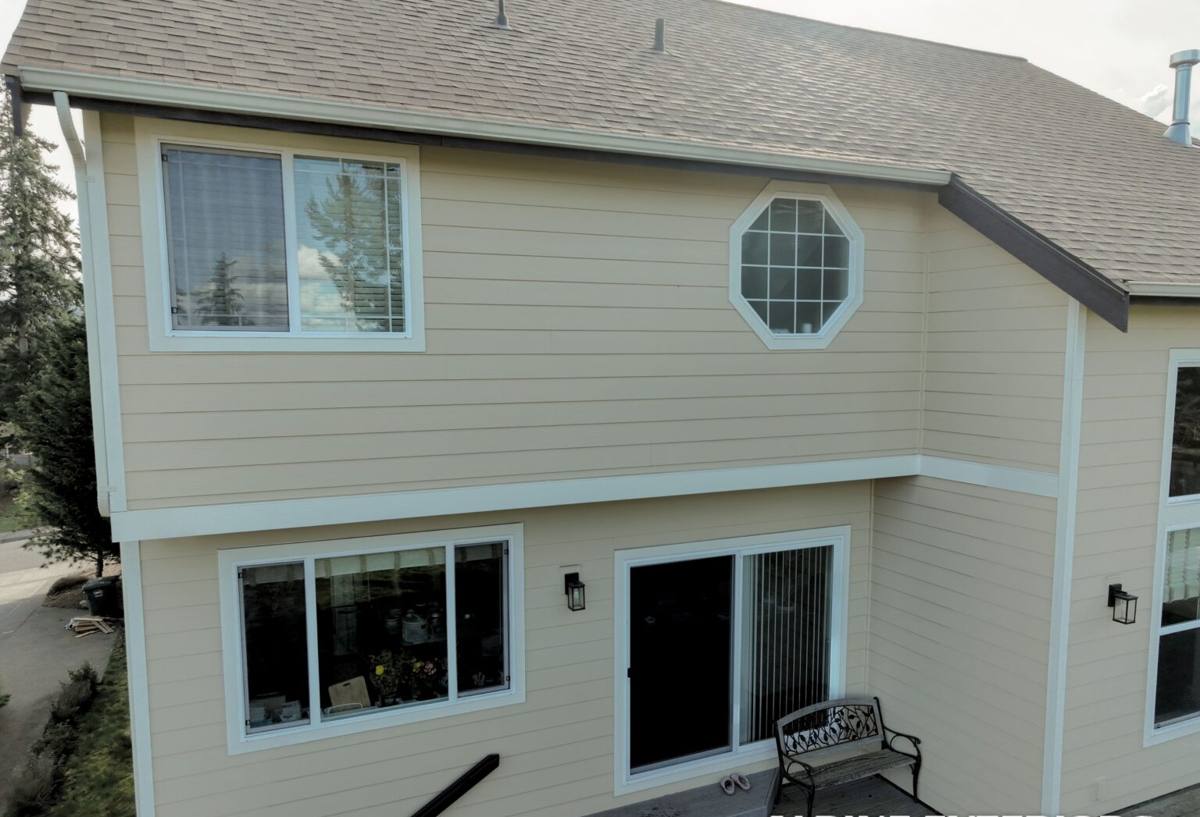
What James Hardie Siding Brings to This Climate
James Hardie fiber cement is a cement-and-cellulose composite, not wood and not vinyl. That distinction matters directly for the three problems above:
- Moisture behavior: Fiber cement doesn't absorb and swell the way wood-based products can, and it doesn't warp or buckle in sustained damp conditions the way some engineered wood siding does at cut edges and seams.
- Non-combustible: It carries a noncombustible rating, which is unrelated to rain and moss but is part of why we standardized on it as a full-house product.
- Factory finish: ColorPlus finish is baked on in a controlled factory process, which holds up more consistently against UV and salt exposure than field-applied paint, and it's backed by its own finish warranty separate from the substrate warranty.
- Climate-engineered product lines: Hardie makes region-specific formulations (their HZ5 line is engineered for wetter, harsher climates like ours) rather than one generic board for the whole country.
None of that means Hardie is maintenance-free. It means the material itself isn't the weak link — the installation is, which is why we spend more time on that part of the job than on the sales pitch.
Choosing the Right Hardie Product for a Mount Vernon Home
Hardie isn't a single product — it's a system, and the right combination depends on the house.
HardiePlank Lap Siding
The most common choice for full re-sides in this area. Available in several exposure widths and textures (smooth, cedarmill), it's the workhorse product for straightforward wall replacement and pairs well with the region's traditional and craftsman-style homes.
HardiePanel Vertical Siding
Used for gable accents, shed dormers, or a full vertical treatment on more modern designs. Requires correct joint treatment (board-and-batten strips or Z-flashing) to keep water from tracking down behind the panel — a detail that matters more in a high-rainfall climate than in a dry one.
HardieShingle Siding
Gives the look of cedar shingle siding without the moisture and moss maintenance that real cedar shingles demand in this climate. A common choice for accent gables or a full shingle-style home.
HardieTrim
Fiber cement trim boards for corners, fascia, and window/door casing. Using fiber cement trim alongside fiber cement siding avoids the classic failure point of wood trim rotting years before the siding around it does.
For most Mount Vernon and Chuckanut-area homes, we spec Hardie's HZ5 climate designation, which is formulated for regions with more moisture exposure than the standard HZ10 line covers.
What a Correct Installation Actually Involves
This is the part that determines whether a Hardie siding job performs for 30+ years or starts showing problems in five. The material is only half the equation.
- Water-resistive barrier and flashing first. House wrap and flashing go on correctly, lapped shingle-style so water is always directed outward and down, before a single piece of siding goes up.
- Proper clearances. Hardie's own installation instructions specify minimum clearances from grade, roofing, and decks — gaps that get skipped constantly by crews rushing a job, and that matter directly in a climate with sustained rain and splash-back.
- Correct fastening. Nail placement, spacing, and depth are specified by Hardie and by local code for wind and moisture exposure. Over-driven or under-driven fasteners are one of the most common causes of early siding failure.
- Sealed and painted cut edges. Factory ColorPlus finish covers the face and edges of uncut boards, but every field cut exposes raw fiber cement that must be primed and painted before installation — a step that's easy to skip and impossible to see once the wall is closed up.
- Butt joints and seams treated correctly, not just caulked and hoped for.
None of this is exotic. It's just detail work that takes time, which is exactly the part that gets shortcut when a crew is unfamiliar with the product or pricing the job too thin.
Hardie Fiber Cement vs. the Alternatives, in This Climate
We get asked regularly why we don't install vinyl or engineered wood siding like LP SmartSide. Both are legitimate products with their own track record — our answer is about what we've chosen to stand behind as a single-product specialist, not a claim that other products can't function.
| Factor | James Hardie Fiber Cement | Vinyl Siding | Engineered Wood (e.g., LP SmartSide) |
|---|---|---|---|
| Moisture/rot resistance | Cement-based, does not rot | Doesn't rot, but can trap moisture behind it | Wood-based; engineered for resistance but still vulnerable at cut edges and failed caulk joints |
| Salt air / corrosion exposure | Substrate unaffected; fasteners/flashing still need corrosion-resistant hardware | Substrate unaffected; can become brittle over time | Substrate unaffected directly, but moisture entry points are more consequential |
| Moss/algae growth | Occurs on the surface like any exterior material; doesn't feed material degradation | Occurs on the surface; can trap moisture at panel laps | Growth on a wood-based surface is more of a long-term concern if moisture penetrates |
| Fire rating | Non-combustible | Combustible (melts/deforms) | Combustible; treated but still wood-based |
| Finish life | Factory ColorPlus finish, separately warrantied | Color is through-body but can fade/chalk | Field or factory-primed; repainting is part of the maintenance plan |
| Typical maintenance | Periodic washing, repaint on your schedule (10–15 yr cycle typical) | Low, but panels can warp, crack in cold, or fade | Repainting and caulk inspection are part of the expected upkeep |
This table isn't a claim that vinyl or LP SmartSide will fail on your house — it's the honest trade-off comparison that led us to standardize on one product and install it correctly every time, rather than carry three product lines at three different service standards.
Our Process for a Mount Vernon Siding Project
- On-site assessment. We look at existing siding, trim, flashing, and — where accessible — check for moisture damage behind the current wall assembly before quoting anything.
- Product and line selection. Plank width, texture, color, and HZ climate designation are chosen for the specific house and its exposure (full sun, shaded/north-facing, wind-exposed corners).
- Tear-off and substrate check. Old siding comes off, sheathing is inspected, and any rot or damage is repaired before house wrap and flashing go back on — not covered over.
- Water-management install. Flashing, house wrap, and starter strips go in per Hardie spec and local code, then siding, then trim.
- Finish and cleanup. Cut edges are sealed and painted, caulking is completed at penetrations and joints, and the site is cleaned of debris and fasteners.
Maintenance Checklist for a Salt Air, High-Moisture Climate
Hardie siding installed correctly is genuinely low-maintenance, but "low" isn't "none" in this climate. A simple annual routine keeps a Mount Vernon home's siding performing for decades:
- Rinse siding annually with a garden hose and soft brush, focusing on shaded and north-facing walls where moss and algae take hold first
- Check and re-caulk joints, corners, and trim intersections every few years — caulk fails before the siding does
- Keep gutters clear so overflow isn't running down the wall face
- Trim back landscaping and tree cover that keeps a wall section damp and shaded longer than the rest of the house
- Repaint on the manufacturer's recommended cycle rather than waiting for visible fading
- Have flashing and fastener condition checked periodically, especially at deck ledgers, roof-to-wall intersections, and window heads
Why a Crew That Already Works Mount Vernon Matters
Siding installation instructions read the same everywhere in the country, but the judgment calls on a real job don't. A crew that regularly works the Chuckanut and Mount Vernon area already knows which wall orientations on a typical local house take the worst of the wind-driven rain, where moss tends to establish first, and how much clearance to build in around grade and hardscape given how wet the ground stays for how much of the year. That's the difference between following a spec sheet and actually building for the climate the house sits in.
It also means faster, more accurate quoting — we're not guessing at local wind exposure or moisture patterns, and warranty service (both Hardie's product warranty and our own workmanship warranty) is handled by a crew that's still local when you need them, not a company that moved on to the next region.
Ready to Talk About Your Home
If your Mount Vernon home's current siding is showing chalking, staining, soft spots, or moss that keeps coming back no matter how often it's washed, it's worth a look before another wet season goes by. We offer a free, no-pressure estimate — we'll assess your current siding and walls, talk through the right Hardie product line for your home's exposure, and give you a straight answer on what the job actually involves. Use the form below to get started.