 Chuckanut Exterior
 Why Storms Hit Lake Samish Roofs Differently
Lake Samish sits in a pocket of Whatcom County where tall conifers ring the water and the terrain around Chuckanut Mountain funnels wind in ways that a flat, open subdivision never experiences. When a winter system rolls through, homes here take wind-driven rain at an angle, not just straight down, and that changes where water finds its way into a roof system. The same evergreen canopy that makes the lake feel private and shaded also means limbs, cones, and needle litter regularly end up on roofs during wind events — sometimes doing real damage, sometimes just adding to the debris load that traps moisture.
Add in the salt-tinged air that moves up from Samish Bay and the broader Puget Sound corridor, plus a wet season that runs long even by Pacific Northwest standards, and you get roofs under more chronic, cumulative stress than a comparable home twenty miles inland. Moss isn't a cosmetic issue out here — it establishes itself in shaded valleys and north-facing slopes and keeps working at the roof surface until it's physically removed. Wind exposure, tree cover, salt-tinged moisture, and a long moss season together create a maintenance and repair picture that's specific to lake and coastal-adjacent parts of Whatcom County, and it's worth understanding before you decide what your roof actually needs after a storm.
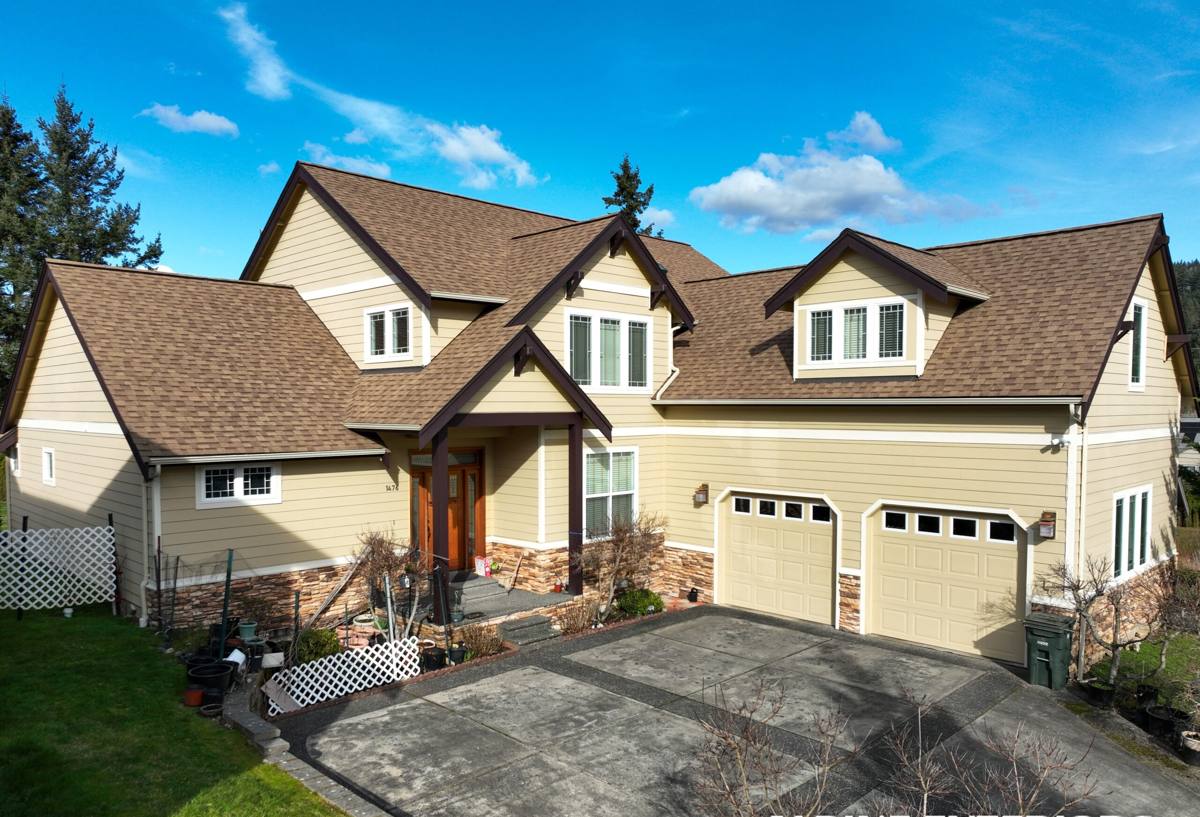
What Counts as Storm Damage (It's Not Always Obvious)
Storm damage doesn't always look dramatic. A missing shingle after a windstorm is easy to spot from the ground. What's harder to catch — and what causes the most expensive problems if it's ignored — is the damage that doesn't announce itself right away. Around Lake Samish, we most commonly find:
- Wind-lifted or creased shingles that have broken their seal but haven't blown off yet, leaving a weak point for the next storm
- Granule loss from wind-driven rain and debris abrasion, which shows up as bare-looking patches or granules collecting in gutters
- Flashing separation around chimneys, skylights, and roof-to-wall transitions, where wind flex has broken the seal without visibly removing anything
- Impact damage from limbs or cones, which can bruise or crack shingles even when nothing punctures through
- Debris-clogged valleys where needles and moss have built up, forcing water sideways instead of down and off the roof
Any one of these can sit quietly for a season or two before it turns into a stained ceiling or rotted decking. That's the main reason a post-storm inspection is worth doing even when the roof "looks fine" from the driveway.
What a Correct Storm Repair Actually Involves
Inspection and Documentation First
A repair that starts without a full inspection is a guess. Before any material goes on the roof, we walk the entire surface — not just the area that looks obviously damaged — because wind and debris rarely limit themselves to one spot. We document what we find with photos, which matters both for our own record and for any insurance claim you may file.
Matching Materials, Not Just Covering the Hole
Patching a damaged section with mismatched shingles is a short-term fix that creates a long-term eyesore and, more importantly, a weak seam where the old and new material meet. A correct repair matches the existing shingle type, profile, and as close to the original color as the product line allows, and ties the new material into the surrounding courses properly instead of just overlapping on top.
Flashing and Underlayment Get Checked, Not Assumed
Most roof leaks after a storm trace back to flashing or underlayment failure, not the shingles themselves. Any storm repair we do includes a check of the flashing at penetrations and transitions, and if the underlayment beneath the damaged area has been compromised by wind-driven moisture, we address that layer too — not just the visible shingle on top of it.
Our Process, Start to Finish
- Call or request: You describe what happened — a storm event, a fallen limb, a leak that showed up after high winds.
- On-site inspection: We walk the roof, check attic access where possible for interior signs of water intrusion, and photograph everything relevant.
- Honest scope and estimate: You get a plain-language explanation of what's damaged, what's not, and what it will take to fix it correctly — including if a repair isn't the right answer.
- Scheduling around the weather: Roof work needs a dry window. We plan around the forecast rather than rushing a repair into wet conditions, which compromises the seal.
- The repair itself: Damaged material is removed back to sound decking, underlayment and flashing are addressed as needed, and new material is tied in to match.
- Cleanup and final check: Debris, old material, and any dislodged granules are cleared from the roof and gutters, and we do a final walk-through with you.
Repair or Replace? What Actually Decides It
Not every storm-damaged roof needs to be replaced, and not every roof that "just needs a patch" should be repaired. The right call depends on a handful of factors working together, not any single one.
| Factor | Leans Toward Repair | Leans Toward Replacement |
|---|---|---|
| Roof age | Under roughly 12–15 years, especially asphalt | Near or past its expected service life |
| Extent of damage | Isolated to one slope or a small area | Spread across multiple slopes or the whole roof |
| Moss and moisture history | Minor surface moss, decking still sound | Long-term moss growth with soft or damaged decking underneath |
| Material availability | Matching shingles still in production | Discontinued line with no close match available |
| Underlying decking condition | Solid, no rot found during inspection | Rot or delamination found once damaged material is removed |
We'll tell you honestly which side of that table your roof falls on. A repair that's likely to fail again within a year or two isn't a favor to you — it just delays a bigger decision.
Working With Insurance on a Storm Claim
If your damage was caused by a specific storm event, it may be covered under your homeowner's policy. We're not your insurance adjuster and won't promise a claim outcome, but we can provide the documentation — photos, a written scope, and a clear description of cause — that makes your claim easier to support. Our advice is straightforward: don't wait weeks to report damage after a known wind event, and don't let anyone pressure you into signing an assignment of benefits or a contract before you've had a chance to read it. A legitimate local contractor will document your roof and give you a scope you can take to your carrier, on your timeline.
Moss, Trees, and Long-Term Roof Health at Lake Samish
Storm repair fixes the immediate problem. But around Lake Samish, the bigger long-term issue is usually the combination of shade, moisture, and organic debris that keeps rebuilding itself year after year. A few habits make a real difference in how often you need repair work in the first place:
- Clear needles, cones, and leaf litter from valleys and behind chimneys at least once each fall, before the wet season sets in
- Keep gutters and downspouts clear so water actually leaves the roof instead of backing up under shingle edges
- Have visibly mossy areas treated and gently cleaned rather than left to spread — aggressive pressure washing can do more harm than the moss itself
- Trim back limbs that overhang the roofline, both to reduce debris and to cut down on the standing shade that keeps moss and moisture in place
- Walk the roofline (or have it inspected) after any significant wind event, not just once a year on a fixed schedule
None of this eliminates the need for repairs entirely — this is still Whatcom County, and the weather is what it is — but it stretches the life of a roof and catches small problems before they become storm-repair emergencies.
Why a Crew That Already Works Lake Samish Matters
Lake Samish properties aren't all set up like a typical in-town lot. Tree-covered driveways, limited staging space, and lakefront or hillside access can make debris removal and material delivery more complicated than a standard job. A crew that already works this area knows how to plan around that instead of figuring it out for the first time on your roof. We're also familiar with Whatcom County permitting requirements where they apply, and with how the local climate — the wind patterns off the lake, the salt-tinged moisture drifting in from the Sound, the moss season that runs longer here than it does further inland — actually affects the materials and techniques that hold up. That's the difference between a repair that's built for this specific location and one that's built for a roof somewhere else and happens to get installed here.
If you've got storm damage, a leak that showed up after a windy week, or just want an honest second opinion on a roof that's taken some hits, we're happy to come take a look. The estimate is free, there's no pressure attached to it, and you'll get a straight answer about what your roof actually needs — use the form below to get started.