 Chuckanut Exterior
 Decks in the Larrabee Area Take a Different Kind of Beating
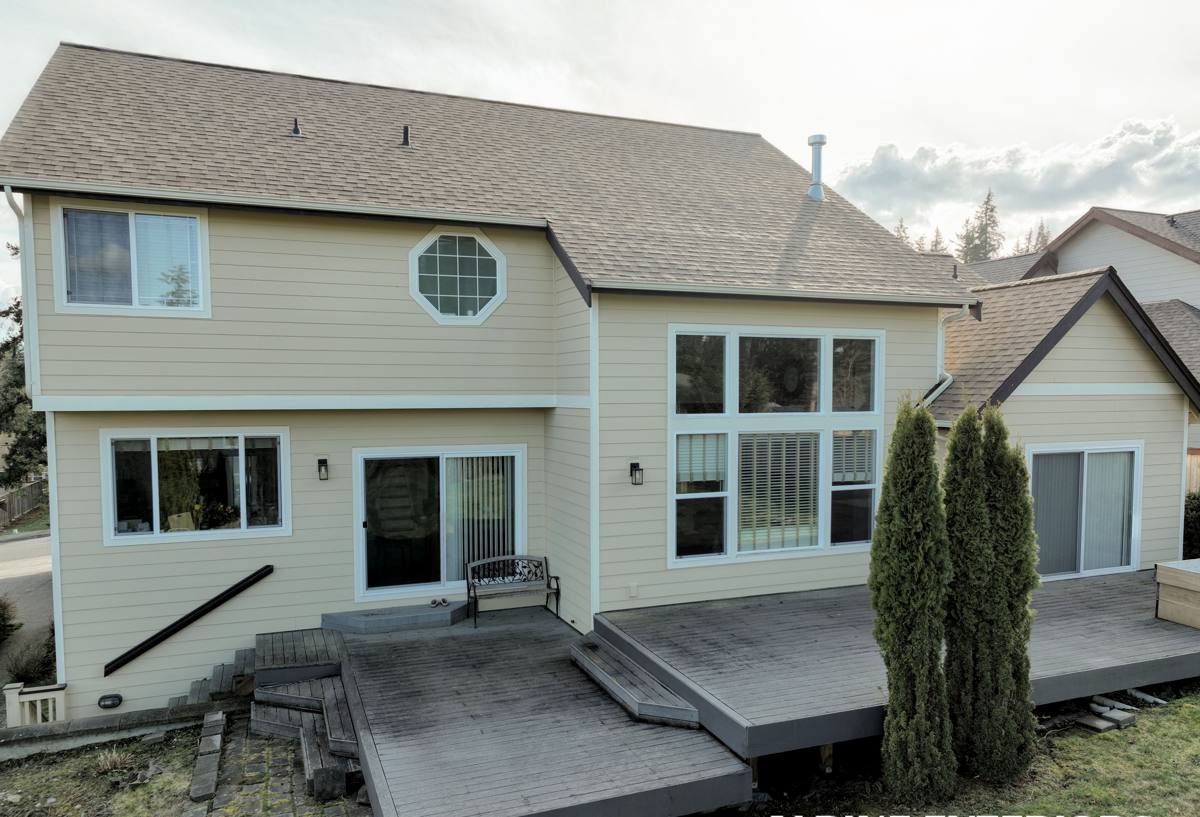
If you live in the Larrabee area near Chuckanut, you already know your deck doesn't age the way a deck fifteen miles inland does. Between the salt-laden air coming off the bay, the driving rain that blows in sideways during winter storms, and the heavy tree cover that keeps parts of a lot shaded and damp for weeks at a stretch, decks here take on moisture and moss faster than almost anywhere else in Whatcom County. A deck that looks fine from the yard can be hiding soft joists, rusted-out hardware, or a ledger connection that's been quietly failing for years.
Deck replacement isn't just about swapping old boards for new ones. Done right, it's a chance to correct whatever the original build got wrong — usually flashing, fastener choice, or drainage — so the new deck actually holds up to this specific climate instead of failing the same way in another ten years.
Why Chuckanut's Climate Is Hard on Decks Specifically
Salt Air and Metal Fatigue
Proximity to Chuckanut Bay means airborne salt reaches structures well back from the water. Salt accelerates corrosion in fasteners, joist hangers, and any exposed metal hardware. Once a fastener starts rusting, it loses holding strength long before it looks obviously bad — which is why a deck can seem structurally sound right up until it isn't.
Driving Rain and Water Intrusion
Storms here don't just fall straight down — wind-driven rain gets pushed under railings, behind ledger boards, and into any gap in the flashing. Over time, that moisture works its way into framing lumber that was never designed to stay wet, leading to rot in places you can't see from the surface.
Moss, Shade, and Slow Drying
Tree cover around many Larrabee-area lots means parts of a deck rarely see direct sun. Moss and algae take hold on shaded boards and in the gaps between them, holding moisture against the wood and turning surfaces slick and unsafe underfoot. A deck that never fully dries out between rain events ages faster than one that gets regular sun exposure.
What "Deck Replacement" Should Actually Mean
Not every deck problem calls for a full replacement — but when it does, the job should go deeper than the decking boards. A proper replacement addresses the whole system:
- The ledger board connection to the house, including flashing behind and above it
- All structural framing — joists, beams, and posts — checked for rot and code-correct spacing
- Footings and post bases, especially on sloped or uneven Chuckanut-area lots
- Fastener and hardware selection rated for coastal, high-moisture exposure
- Surface drainage so water sheds off the deck instead of pooling or soaking in
- Railings and stairs brought up to current code, not just replaced in the old configuration
If a contractor only talks about the decking material — the boards you'll walk on — and doesn't mention the ledger, framing, or fasteners, that's a sign they're planning a cosmetic re-deck, not a real replacement.
The Ledger Board: The Single Most Important Connection
Most deck failures that make the news start at the ledger — the board that attaches the deck to the house. In a climate with regular driving rain, the ledger connection has to be flashed correctly so water can't get behind it and into the house's rim joist or the deck's framing. This means proper step flashing, a water-resistant barrier between the ledger and the house, and structural fasteners rated for the load — not just deck screws. On older Larrabee-area homes, we often find ledgers that were lag-bolted with no flashing at all, which is one of the most common reasons a deck that looks fine on top is rotten underneath.
Choosing Materials That Actually Hold Up Here
There's no single "best" decking material — the right choice depends on how much sun and shade the deck gets, how much upkeep the homeowner wants to do, and budget. Here's how the common options compare specifically for a shaded, coastal, high-moisture site like Larrabee:
| Material | Moss/Moisture Behavior | Maintenance | Typical Lifespan Here |
|---|---|---|---|
| Pressure-treated wood | Absorbs moisture; needs airflow and regular cleaning to resist moss | Annual cleaning/sealing recommended | 10-15 years with upkeep |
| Cedar | Naturally moisture-resistant but still needs care in shaded spots | Periodic sealing to maintain resistance | 15-20 years with upkeep |
| Composite decking | Doesn't rot, but can still grow surface algae/moss in deep shade | Occasional washing, no sealing | 25-30 years |
| PVC/capped composite | Best moisture and moss resistance of the group | Low — occasional rinse | 25-30+ years |
We're honest with clients that composite and PVC decking cost more upfront but tend to make the most sense on shaded, moisture-heavy lots — the maintenance savings and moisture resistance add up over the life of the deck. Wood is still a good choice for homeowners who want that look and are willing to keep up with cleaning and sealing, especially on sections of the deck that do get regular sun.
Fasteners and Hardware: Where Coastal Jobs Are Won or Lost
This is the detail that gets skipped most often, and it's the one that matters most near the bay. Standard galvanized hardware corrodes faster in salt air than most homeowners expect. For Larrabee-area replacements, we use stainless steel or heavy-coated fasteners and joist hangers rated for coastal/high-corrosion exposure, not the standard-grade hardware that's fine for an inland build. It costs more per fastener. It's not optional if you want the structure to last.
How Our Process Works
- On-site assessment. We inspect the ledger connection, framing, footings, and existing drainage before quoting anything — not just the visible decking.
- Scope and materials conversation. We walk through material options based on the sun/shade pattern of your specific deck, not a one-size answer.
- Permitting. Deck replacements in Whatcom County typically require a permit, especially for structural work or decks above a certain height. We handle that paperwork.
- Demo and structural inspection. Once old decking comes off, we inspect framing and the ledger directly — this is where hidden rot or corrosion actually gets found.
- Rebuild to spec. Correct flashing, coastal-rated fasteners, code-compliant framing and railings, then the new decking surface.
- Final walkthrough. We go over drainage, maintenance expectations for the material you chose, and what to watch for seasonally.
Permits and Code Considerations in Whatcom County
Most full deck replacements — especially any that involve new footings, a rebuilt ledger connection, or a deck attached at a height requiring guardrails — need a permit and inspection through Whatcom County. This isn't paperwork for its own sake: inspection catches ledger and footing issues before they're buried under decking, which is exactly the kind of problem that's expensive to fix later. We factor permitting into the project timeline upfront so there are no surprises mid-job.
Signs Your Deck Needs Replacement, Not Repair
Not every issue means starting over. But a few signs point clearly toward full replacement rather than patching:
- Soft or spongy spots in the decking, especially near the house or in shaded corners
- Visible rust staining around fasteners or hardware
- A ledger board that's separating, cracked, or shows water staining on the house siding above it
- Persistent moss or algae that returns within weeks of cleaning
- Wobble in railings or posts, which often signals footing or framing failure below
- A deck built without visible flashing at the house connection
- Multiple past repairs that haven't solved the underlying moisture problem
If you're seeing two or more of these, a repair is usually a short-term fix on a structure that's already compromised.
Why a Crew That Already Works Larrabee Matters
A lot of deck problems in this area come from builds that followed a generic, inland-style approach — standard hardware, minimal flashing, decking chosen for looks rather than moisture behavior. A crew that regularly works the Larrabee and broader Chuckanut area already knows to spec coastal-rated fasteners by default, to pay extra attention to ledger flashing given the driving rain, and to plan drainage and material choices around shaded, tree-covered lots rather than treating every deck the same. That local pattern recognition is the difference between a deck that needs attention again in eight years and one that holds up for decades.
We also understand the practical side of working in this area — sloped and rocky lots, limited equipment access on some properties, and site conditions that come with being close to the bay and surrounded by mature trees. None of that should be a surprise mid-project if the crew has done this kind of build before.
Get a Straightforward Estimate
If your deck is showing its age or you're not sure whether it needs repair or full replacement, we're happy to take a look. The estimate is free, there's no pressure, and we'll give you an honest read on what your deck actually needs given its exposure and condition — use the form below to get started.