 Chuckanut Exterior
 Mount Vernon sits in the heart of the Skagit Valley, close enough to Skagit Bay and the wider Puget Sound system that homes here deal with salt-laden air, wind-driven rain, and a moss season that runs longer than it does a few miles inland. This page is about one material and one place: fiber cement siding, installed on Mount Vernon homes, by a crew based nearby in the Chuckanut area of Whatcom County that already works this valley on a regular basis. What follows is what the climate actually asks of a sided wall here, what correct fiber cement installation involves, and how we run a project from first look to final walk-through.
What Mount Vernon's Climate Asks of Siding
Three forces do most of the work aging a Mount Vernon home's exterior. Salt air moving in off Skagit Bay and the broader Sound corrodes fasteners and breaks down lower-grade finishes faster than a drier inland climate would. Wind-driven rain from Pacific storm fronts doesn't fall straight down — it gets pushed sideways into walls, which means it tests every lap, joint, and seam in a siding system rather than just the roof above it. And a moss season that stretches across most of the wet months keeps shaded and north-facing walls damp for long stretches at a time, especially on lots with tree cover.
None of these three forces is dramatic by itself. What they add up to, over years, is a slow erosion of paint film and caulk, corrosion at fastener points, and moisture finding its way into any joint that wasn't lapped or sealed correctly the first time. A siding material and installation approach built for a national-average climate doesn't hold up the same way here, and that gap is exactly where premature failure tends to start.
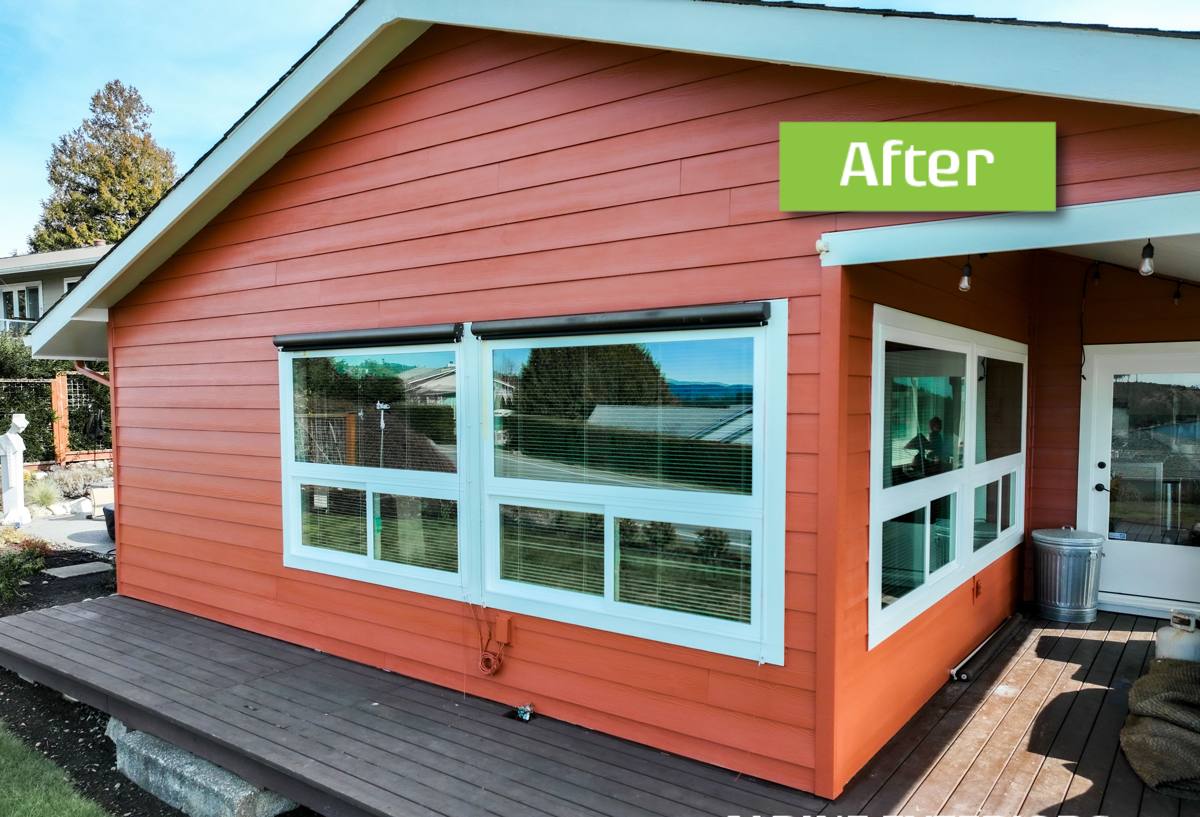
Why Fiber Cement Is the Material We Install Here
We install one siding product on every job: James Hardie fiber cement. That's a deliberate professional standard, not a lack of options. Fiber cement is not an organic material — it doesn't have a wood substrate for moisture to work into over time, and it doesn't feed moss and mildew growth the way wood-based products can. In a valley climate that doesn't offer much of a dry season to recover in, that single difference matters more than it might in a milder region.
Vinyl in a Wind-Driven Rain Climate
Vinyl siding is inexpensive and genuinely low-maintenance in milder climates. The trade-off is that its seams and J-channels give wind-driven rain a place to work its way behind the surface, and the material itself can warp or become brittle with age and repeated temperature swings. In a climate where storms push rain sideways for days at a stretch, that's a real limitation we've chosen not to build our reputation on.
Wood-Based and Engineered Wood Siding's Moisture Dependency
Engineered wood products install quickly and take paint well, but they still have an organic core underneath. Keeping that core dry depends on flawless field priming and caulking at every single cut edge, on every job, for the life of the siding — a demanding standard to hold consistently across an entire crew, in a place that stays damp most of the year.
Cedar's Maintenance Commitment
Cedar is a genuine, attractive material with real character, and we won't pretend otherwise. It's also organic, and it asks for an ongoing commitment — refinishing, sealing, and active moss control — to keep performing well. A valley that doesn't dry out for long stretches makes that maintenance schedule harder to keep up with than it would be in a drier part of the state.
The James Hardie System We Use for This Climate
"Fiber cement" isn't a single generic product, and we don't treat it that way. James Hardie builds specific product lines and finish systems around specific climate exposures, and matching those correctly to a Mount Vernon home is part of what we consider correct installation, not an upsell.
Climate-Engineered HZ Product Lines
Hardie engineers its HZ product formulations around regional exposure rather than selling one generic mix everywhere in the country. For a home dealing with sustained moisture and coastal-influenced air like Mount Vernon's, we specify the product line built for that kind of exposure, not a formulation meant for a drier or more moderate region.
ColorPlus Factory Finish
Rather than a finish applied and cured on-site, ColorPlus is baked on under controlled factory conditions. In a climate with long gray stretches and a limited number of dry windows for field paint to cure properly, that consistency is a practical advantage — it holds color and resists cracking longer than most site-applied finishes manage here, and it means less repainting over the life of the siding.
Matching Profile to the House
Hardie fiber cement comes in lap siding, panel siding, and board-and-batten profiles, each suited to different home styles and budgets. We walk through profile and trim options with the homeowner based on the house itself — its style, its exposure, and what the homeowner wants it to look like — rather than defaulting to whatever is fastest to install.
What Correct Installation Involves on a Mount Vernon Home
Fiber cement is only as good as the installation behind it, and in a climate that tests every joint, the details matter more than usual. Skipping any one of the items below doesn't usually show up as a problem right away — it shows up a year or two later, as a callback.
- Flashing correctly integrated at every window, door, and roofline transition — not simply caulked over after the fact
- Proper starter strip and clearance from grade, decks, and patios so the bottom edge stays out of standing moisture
- Fastener pattern and spacing matched to the specific Hardie product line and this location's wind exposure
- Joint and seam treatment adjusted for sun-exposed walls versus shaded, moss-prone wall faces
- Factory-finished color matched carefully at trim and touch-up points instead of a mismatched field repaint
- Sheathing and framing checked for hidden moisture damage before any new siding goes on over it
Our Process, Start to Finish
A fiber cement project runs the same basic sequence on every Mount Vernon home we work on, though the details change with the house.
- An on-site assessment of the existing exterior, including a look for hidden moisture or rot damage before any number gets discussed
- A written scope of work covering product line, profile, color, and trim, so there's a clear reference to build against
- Tear-off of the old siding with a check of the sheathing underneath, since that's where hidden problems tend to surface
- Flashing and fiber cement installation to manufacturer spec, adjusted for this wall's specific sun, shade, and wind exposure
- A final walk-through with the homeowner covering what was done and what to watch for going forward
Comparing Materials and Cost Factors
Fiber Cement vs. Other Siding Materials
| Material | Moisture Behavior | Ongoing Maintenance | Fit for Mount Vernon's Climate |
|---|---|---|---|
| Vinyl | Seams and channels can let wind-driven rain behind the surface | Low, but can warp or crack with age | Limited in sustained wind-driven storms |
| Wood-Based / Engineered Wood | Organic core depends on unbroken field priming and caulking | Ongoing repainting and edge sealing | Demanding in a valley with a long wet season |
| Cedar | Organic, holds moisture without regular refinishing | Refinishing, sealing, and moss control | Requires real commitment given limited dry seasons |
| James Hardie Fiber Cement | Non-organic core, doesn't feed moss or mildew growth | Low, with factory finish reducing repaint frequency | Engineered HZ lines built for this exposure |
What Moves the Price on a Fiber Cement Project
We don't publish blanket pricing because it wouldn't be honest — every house is different. The factors below are what actually drive cost up or down.
| Factor | How It Affects Cost |
|---|---|
| Existing sheathing condition | Hidden moisture or rot found during tear-off adds repair scope |
| Home size and wall complexity | More corners, gables, and penetrations mean more flashing and labor time |
| Profile and trim package | Board-and-batten or heavier trim details run higher than standard lap siding |
| Access and site conditions | Tree cover, tight lot lines, or difficult staging can add labor time |
| Tear-off scope | Full removal of old siding versus a simpler re-side affects timeline and cost |
Caring for Fiber Cement Siding After Installation
Fiber cement itself doesn't rot or feed moss, but the joints, caulking, and trim around it still benefit from basic seasonal attention in this climate. Keeping gutters clear before the wet season prevents overflow from soaking siding and trim at the eaves. Checking shaded, north-facing walls periodically for early moss growth keeps moisture from being held against the surface longer than it needs to be. Inspecting caulked joints at trim and penetrations every year or two catches small gaps before wind-driven rain finds them. None of this is a heavy burden, but a correctly installed system should come with a clear sense of what to watch for on your specific house.
Why a Crew That Already Works Mount Vernon Matters
A crew that works across the Skagit Valley on a regular basis sees, firsthand, how differently a shaded wall under tree cover ages compared to an open, south-facing wall a few properties over — and adjusts flashing details, joint treatment, and product recommendations accordingly. That kind of judgment comes from doing fiber cement installations in this specific climate repeatedly, not from a spec sheet written for the whole country. It also means that if a warranty question or a flashing detail needs a second look years down the road, it's a crew that's still reachable and still working in this same valley, not one that's moved on to another region entirely.
Get a Free, No-Pressure Estimate
If you're weighing fiber cement siding for a Mount Vernon home, we're glad to take a look and give you a straightforward assessment of what your house actually needs — no pressure, no generic sales pitch. Reach out for a free estimate and we'll walk the property with you and talk through what we see.