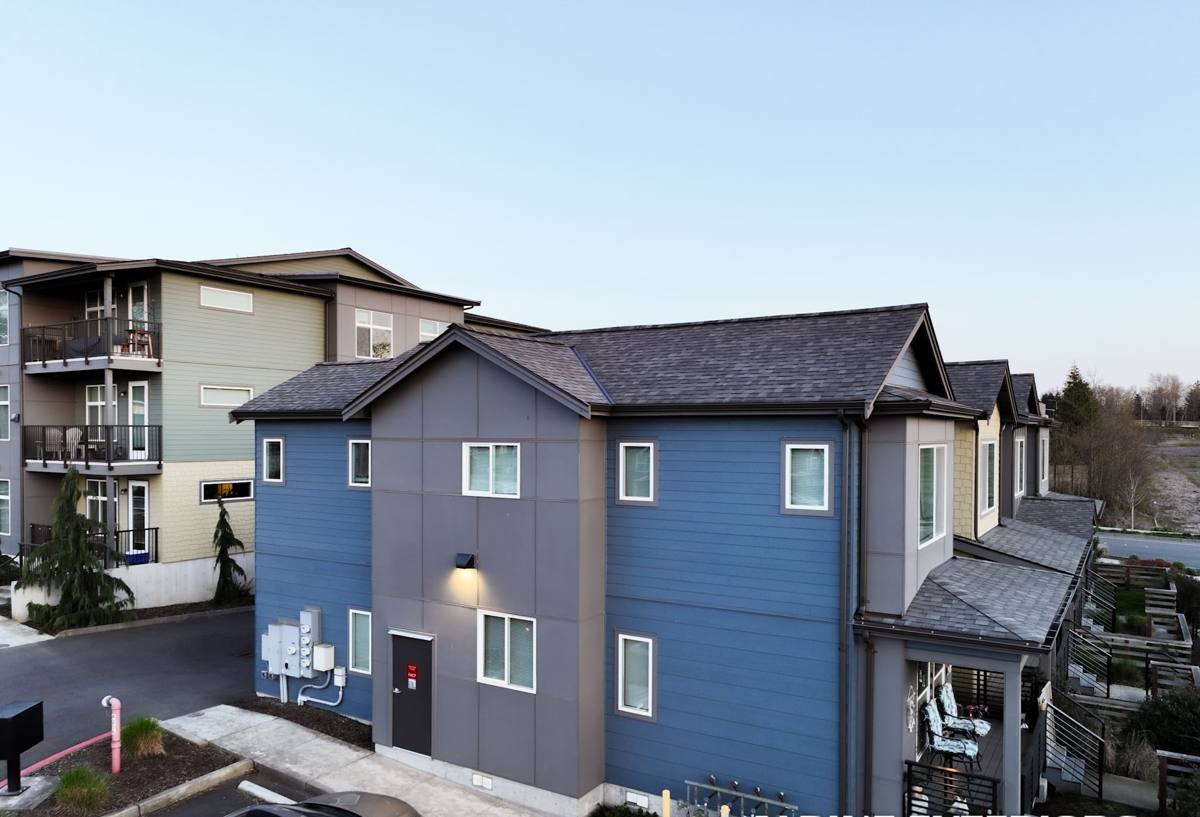
 Chuckanut Exterior
 New-Construction Windows in Blanchard: What "New Construction" Actually Means
When we say new-construction windows, we mean something specific: windows installed into a framed opening that still has open stud bays, before siding or interior finish goes on. That's different from a replacement window, which gets inserted into an existing frame from the outside with the old exterior trim still in place. New construction gives us access to the whole opening — sheathing, weather-resistive barrier, framing, sill — and that access is what makes it possible to build a genuinely weathertight assembly instead of just plugging a hole.
For a Blanchard build, that access matters more than it would in a drier inland town. This is a coastal-influenced pocket of Whatcom County, close enough to Chuckanut Bay and the Salish Sea to catch salt-laden air and wind-driven rain off the water, plus the shaded, damp conditions that keep moss and algae active most of the year. A window opening built right the first time saves the homeowner from chasing leaks and rot behind the siding a few years down the road.
Why Blanchard's Coastal Climate Changes the Window Equation
Salt Air
Proximity to the water means airborne salt settles on exterior surfaces — hardware, cladding fasteners, and any exposed metal flashing. Over years, that accelerates corrosion on lower-grade fasteners and finishes. It's not a reason to avoid windows near the water; it's a reason to spec corrosion-resistant fasteners and flashing metals and to make sure exposed hardware is rated for coastal exposure rather than a generic interior-grade finish.
Driving Rain
Storms coming off the water in this part of Whatcom County don't just fall straight down — wind pushes rain sideways into wall assemblies, which is exactly the condition that exposes a sloppy sill pan or a WRB lap done in the wrong order. A window that would perform fine in a sheltered inland yard can leak here if the flashing sequence isn't shingled correctly, because wind-driven rain finds any seam that relies on caulk alone instead of proper lapped drainage.
A Long Moss Season
Blanchard's tree cover and marine-layer humidity keep surfaces damp for long stretches of the year, which is ideal for moss and algae growth. On windows, that mostly shows up on sills, exterior trim, and anywhere water sits instead of draining. Sill design and drainage — not just the glass and frame — determine how much moss and grime buildup a homeowner deals with over time.
What a Correct New-Construction Window Install Involves
A window unit is only as good as the opening it sits in. The steps below are the ones we treat as non-negotiable on every new-construction install, and they're the ones most likely to get rushed on a job by a crew that isn't used to this climate.
- Sill pan flashing: a sloped, fully sealed pan under the rough opening so any water that gets past the window drains back outside instead of pooling on the sill.
- WRB integration: the weather-resistive barrier is cut and lapped so water sheds over each layer, shingle-style, from the sill up around the jambs to the head flashing — never the reverse order.
- Head flashing: installed last, over the top of the WRB, so water draining down the wall goes over the flashing and away from the window, not behind it.
- Proper shimming and fastening: the unit is shimmed square and plumb at the manufacturer's specified fastening points, not just at the corners, so the frame doesn't rack or bow under wind load.
- Backer rod and sealant, not sealant alone: gaps get backer rod sized to the joint with a compatible sealant tooled over it, giving the joint flexibility instead of a sealant bead that will crack and split in a few seasons.
- Insulation of the shim space: low-expansion foam or mineral wool in the gap between frame and rough opening, avoiding high-pressure foam that can bow vinyl or fiberglass frames.
Skip or rush any one of these and the window itself — no matter the brand — becomes the weak point in the wall.
New-Construction vs. Replacement Windows: Which Applies to Your Blanchard Project
We get asked fairly often whether a project needs a "new-construction" window or a "replacement" window, and the honest answer depends on what's happening to the wall, not just the window itself.
| Factor | New-Construction Window | Replacement Window |
|---|---|---|
| Typical use | New builds, additions, or full wall/siding tear-offs | Existing openings where siding and trim stay in place |
| Nailing fin | Yes — fastens directly to sheathing through the fin | No fin; frame inserts into the existing opening |
| Flashing access | Full access to build a shingled flashing system | Limited to what's exposed at the existing opening |
| Best fit for Blanchard | New builds and remodels with exterior opened up | Occupied homes not undergoing exterior work |
| Long-term weather performance | Higher, when flashing is done correctly | Dependent on the condition of the original opening |
If you're framing a new home, an addition, or pulling siding off for a remodel in Blanchard, new-construction windows are almost always the right call — you have the opening open anyway, so it makes sense to build the flashing system right rather than settle for what a retrofit unit can achieve.
Frame Material and Glass: What Holds Up Near the Water
There's no single "best" window brand for coastal Whatcom County — what matters is matching frame material and glass package to the exposure the window will actually see. Here's how the common options generally compare for a Blanchard site.
| Frame Material | Coastal/Moisture Behavior | Maintenance |
|---|---|---|
| Vinyl | Doesn't corrode or rot; performs well in salt air with good drainage design | Low — occasional cleaning, no repainting |
| Fiberglass | Very stable dimensionally; handles temperature and moisture swings well | Low — durable finish, minimal upkeep |
| Wood (unclad) | Attractive but needs careful detailing and upkeep in a wet, mossy climate | Higher — periodic finishing/sealing needed |
| Wood-clad | Exterior clad surface resists moisture; interior keeps wood look | Moderate — clad exterior is low-maintenance, interior wood still needs occasional attention |
| Aluminum | Strong but conducts heat/cold and can corrode without a marine-grade finish | Moderate — watch fastener and finish condition near salt air |
For glass, a Low-E coated, argon-filled dual-pane unit is the baseline we recommend for this area — it manages the marine layer's temperature swings and cuts condensation risk on cool, damp mornings, which are common here for a good chunk of the year. Triple-pane is worth discussing if the home faces direct wind exposure off the water or if the owner wants extra sound dampening from storm activity.
Our Process for a Blanchard New-Construction Job
- Framing walk-through: we review rough openings against the window schedule before any units arrive, catching sizing or sequencing issues while they're still cheap to fix.
- Sill pan and flashing plan: we plan the flashing sequence for each opening based on its wall assembly and exposure — a window facing prevailing wind and rain off the water gets more attention at the sill than a sheltered opening.
- Install and shim: units go in square, plumb, and fastened per manufacturer spec, with the shim space insulated properly rather than packed with high-expansion foam.
- Flashing tie-in with the WRB: head flashing and WRB laps are integrated in the correct shingled order so the whole wall drains as one system, not window-by-window.
- Final inspection and water test where warranted: especially on exposed elevations, we check the finished opening before siding closes it up, since that's the last point where a mistake is easy to correct.
Checklist: What to Confirm Before Windows Go In
- Rough openings are framed square and to the correct dimensions for the ordered units
- Sill pan flashing material is compatible with both the wall assembly and the window frame material
- WRB is lapped in the correct shingle order — sill first, then jambs, then head
- Fasteners and exposed hardware are rated for coastal/salt-air exposure, not generic interior-grade
- Sealant joints use backer rod, not sealant alone, at gaps wider than a bead can properly bridge
- Glass package (Low-E, gas fill, pane count) matches the exposure of that specific elevation
- Manufacturer's installation instructions are on hand and being followed, since they govern warranty coverage
Why a Crew That Already Works Blanchard Matters
Flashing details that work fine in a dry inland climate can fail here, and a crew that hasn't worked this stretch of Whatcom County won't necessarily know that until water shows up inside a wall. A crew that's already done new-construction window work around Chuckanut and Blanchard has a feel for which elevations catch the worst of the wind-driven rain, how much moss and algae buildup to expect on north-facing sills, and which flashing details actually hold up through a wet coastal winter rather than just on paper.
That local experience also shows up in smaller ways — knowing which sill designs shed water fastest in this humidity, or which fastener finishes actually resist the salt air instead of just being marketed as "corrosion resistant." None of that replaces good installation fundamentals, but it's the difference between a crew following a manual and a crew that's watched how these details perform through an actual Blanchard winter.
Living With Windows in a Salt-Air, Moss-Prone Climate
Even a well-installed window benefits from some basic upkeep in this environment. Rinsing accumulated salt residue off exterior frames and glass periodically helps preserve finishes and hardware. Keeping sills and tracks clear of moss, needles, and debris keeps drainage paths open so water doesn't sit and encourage more growth. And a quick visual check of exterior sealant joints once a year — looking for cracking or separation — catches small issues before they become water intrusion problems. None of this is heavy maintenance, but skipping it in a climate this damp lets small problems compound faster than they would somewhere drier.
If you're planning a new build, addition, or remodel in Blanchard and want windows installed by a crew that treats the flashing and drainage details as seriously as the window itself, we're glad to take a look at your plans. Reach out for a free, no-pressure estimate through the form below.