 Chuckanut Exterior
 Samish sits along the Chuckanut Drive corridor where Whatcom County's coastline meets forested bluffs above Samish Bay, and that setting is part of what makes the area beautiful and part of what makes it hard on a roof. A new roof installation here isn't the same job as the same product installed twenty miles inland. Salt air off the bay, driving rain that comes in sideways off Pacific storms, and a moss season that can run most of the year on shaded slopes all work on a roof system differently than a drier, more sheltered site would. This page is about what a new roof installation should actually involve for a Samish home, and why a crew that already works this specific stretch of coastline tends to get better long-term results than one seeing it for the first time.
What Chuckanut's Coastal Climate Does to a Roof
Every roofing material sold today is rated to handle rain, wind, and sun exposure in general terms. What those ratings don't always account for is the specific combination a Samish roof deals with: near-constant moisture exposure off the bay, salt-laden air that accelerates corrosion at every metal fastener and flashing point, and tree cover that keeps north- and shaded-slope roof planes damp long after a storm has passed everywhere else. That combination doesn't just test the shingles or panels themselves — it tests every seam, every penetration, and every place where two roofing components meet.
Driving rain is a particular problem because it doesn't behave the way most roofing details assume. Roofs are designed on the assumption that water moves downhill and off the edge. Wind-driven rain off the water pushes moisture sideways and even upward under shingle tabs, into vents, and around chimney and skylight flashing that would stay dry in calmer weather. A roof that's only detailed for straight-down rain will eventually leak in exactly those spots, usually well before the shingles themselves are worn out.
Moss: The Slow Damage Nobody Notices Right Away
Moss doesn't just look bad. It holds moisture directly against the roofing surface for weeks at a time, which accelerates granule loss on asphalt shingles, promotes wood rot on any exposed sheathing or trim, and can lift shingle edges enough to let wind-driven rain underneath. On a shaded Samish roof plane, moss can establish itself within a year or two of a roof going up if the roof wasn't detailed to discourage it. By the time it's visibly thick, it's usually already done some of its damage.
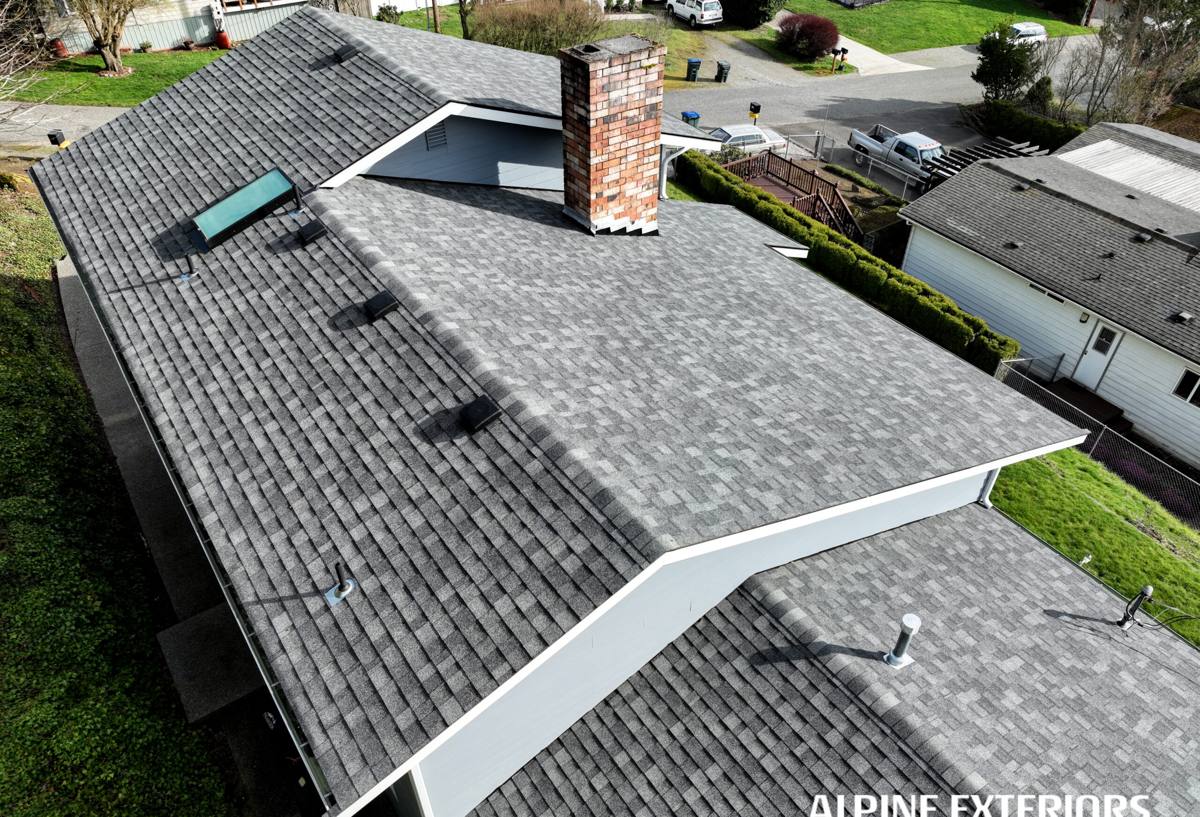
Repair or Full Replacement: How to Tell
Not every roofing problem on a Samish home means a full replacement, but a few signs reliably point that direction rather than toward a patch repair:
- Granule loss heavy enough that you can see bare asphalt mat on multiple shingles, not just one or two
- Shingles that are cupping, curling, or cracking across large sections of the roof, not isolated spots
- Daylight visible through the roof deck from inside the attic, or soft/spongy decking underfoot
- Leaks that have already caused staining on interior ceilings or walls in more than one location
- A roof original to the home and past 20-25 years old, especially if it's never had a tear-off
- Moss or algae growth that keeps returning within a season of being cleaned
If what you're seeing is a single damaged area — a section of missing shingles after a windstorm, a leak around one flashing point — a targeted repair is usually the honest recommendation. Full replacement makes sense when the roofing system as a whole is aging out, not just failing in one spot.
What a Correct New Roof Installation Involves
The finished shingles or panels are the part everyone sees, but they're the last layer of a system, not the whole system. A roof that holds up in this climate depends on what's underneath being done right.
Tear-Off and Deck Inspection
A full tear-off removes the old roofing down to the deck, which is the only way to actually see what condition the sheathing is in. Roofing over an existing layer hides rot, soft spots, and prior water damage instead of fixing it, and it voids the manufacturer warranty on most modern roofing products. Any damaged or delaminated decking needs to be replaced before new roofing goes down — skipping this step is one of the most common ways a new roof fails early.
Underlayment and Water-Entry Protection
Underlayment is the roof's backup layer against wind-driven rain that gets past the surface material, and in a climate like this one it earns its keep regularly. Self-adhering ice-and-water membrane belongs at eaves, valleys, and around every penetration — the exact spots where wind-driven rain concentrates — with synthetic underlayment covering the rest of the deck. This is not a place to cut corners to save a step; it's the layer that keeps a small surface failure from becoming an interior leak.
Flashing Details
Flashing at chimneys, skylights, sidewalls, and roof-to-wall transitions is where the majority of roof leaks actually originate, not in the field of the roof itself. Correct flashing is layered so water is always directed over and off each piece, never trapped behind it, and it should be replaced with new material during a full re-roof rather than reused. Reused flashing is one of the most common shortcuts that shows up as a leak a year or two later.
Ventilation
Balanced intake and exhaust ventilation keeps the attic temperature and moisture level close to outdoor conditions, which does two things that matter here specifically: it reduces the moisture buildup that feeds moss and mildew from the underside, and it prevents the heat buildup that shortens shingle life from below. A roof with poor ventilation can fail prematurely even if every other installation detail was done correctly.
Choosing a Roofing Material for This Climate
There's no single correct roofing material for every Samish home — the right choice depends on the roof's pitch, sun and shade exposure, budget, and how the homeowner weighs upfront cost against long-term maintenance. Here's how the common options compare against the specific conditions this area creates:
| Material | Performance in salt air and driving rain | Moss and algae resistance | Typical lifespan | Maintenance |
|---|---|---|---|---|
| Architectural asphalt shingle | Solid when installed with proper underlayment and flashing | Algae-resistant (AR) shingle lines resist staining better than standard shingles; moss still needs periodic clearing on shaded slopes | 25-30+ years | Moderate — periodic moss/debris clearing on shaded planes |
| Standing seam metal | Excellent — sheds wind-driven rain well and handles salt exposure when properly coated and fastened | Naturally shed surface discourages moss compared to a granular surface | 40-60 years | Low — occasional inspection of fasteners and seams |
| Synthetic/composite shake | Good, with correct fastening and flashing at the higher-profile joints | Varies by product; some lines are treated for algae resistance | 30-50 years | Moderate — profile can trap debris on shaded roofs if not kept clear |
For most Samish homes, a quality architectural shingle with algae-resistant granules and correct ventilation is a solid, cost-effective choice. Homes with heavy tree cover, steep pitches, or owners planning to stay long-term often lean toward metal specifically because it sheds moisture and resists moss buildup better than any granular surface can.
Our Installation Process, Start to Finish
- On-site inspection and estimate — we look at the existing roof, attic ventilation, and any visible problem areas before quoting anything
- Material selection — we walk through the honest trade-offs between options for your roof's pitch, exposure, and budget
- Permitting — pulled and handled before work begins, as required for roofing work in Whatcom County
- Tear-off and deck inspection — old roofing removed down to the deck, damaged sheathing identified and replaced
- Underlayment and flashing installation — ice-and-water membrane at vulnerable points, synthetic underlayment across the field, all-new flashing
- Roofing material installation — installed to manufacturer spec for fastening pattern and exposure, not just "close enough"
- Ventilation check — intake and exhaust balanced for the attic's actual size and layout
- Cleanup and magnetic sweep — job site and yard cleared of debris and stray fasteners
- Final walkthrough and warranty paperwork — you see the finished work and get documentation for both material and workmanship coverage
What Drives the Cost of a New Roof in Samish
Roofing costs vary enough by property that a flat number isn't honest to quote without seeing the roof, but the factors that actually move the price are consistent:
| Factor | Why it affects cost |
|---|---|
| Roof size and pitch | More square footage and steeper pitches mean more material and more labor time, plus added safety measures on steep slopes |
| Material choice | Standing seam metal and premium shingle lines cost more upfront than standard architectural shingle, offset by longer lifespan and lower maintenance |
| Deck condition | Rotted or soft sheathing found during tear-off has to be replaced before new roofing goes down, which isn't always visible from a pre-tear-off estimate |
| Number of existing layers | Removing multiple layers of old roofing takes more labor and disposal than a single-layer tear-off |
| Roof complexity | Valleys, dormers, skylights, and chimneys each add flashing work and installation time |
| Ventilation upgrades | Adding or correcting intake/exhaust ventilation is a smart long-term investment but adds to the scope |
Most full roof replacements land somewhere between a few thousand dollars for a small, simple roof and well into five figures for a larger home with a complex roofline or premium material — the only way to know where your project falls is a look at the actual roof.
What to Look for When Hiring a Roofing Crew
Roofing has a low barrier to entry, and Whatcom County sees its share of contractors who show up after a storm and are gone by the next one. A few checks protect you from that:
- Active Washington State contractor license and roofing-specific bond and liability insurance
- A written estimate that breaks out tear-off, materials, underlayment, flashing, and ventilation separately, not one lump number
- Manufacturer certification for whatever product they're proposing, which usually extends the warranty coverage
- A clear answer about deck repair — how it's identified, and how it's priced if found during tear-off
- References or a track record of work specifically in this area, not just a general service radius
- A straight answer about ventilation and moss-resistant options, not just a shingle color and a price
A contractor who can answer all of these clearly, without hedging, is a much safer bet than one who just wants to talk price.
Why Local Experience in Samish Matters
A roofing crew that already works Chuckanut and the Samish area has seen how this specific stretch of coastline treats a roof over multiple wet seasons — which roof planes moss comes back on fastest, where wind-driven rain during a real Pacific storm actually tests flashing, and what ventilation setups hold up under sustained damp conditions rather than just a dry-climate installation manual. That experience shows up in the details: where extra ice-and-water membrane gets used without being asked, how flashing gets detailed at a shaded valley, and which material actually makes sense for a given roof's exposure instead of whichever is fastest to install. It's the difference between a roof that's technically up to code and one that's actually built for where it sits.
If your roof is showing its age or you're planning ahead rather than waiting for a leak, we're glad to take a look and give you a straightforward assessment of what your Samish home actually needs. There's no pressure and no obligation — just a free estimate and an honest read on your roof.