 Chuckanut Exterior
 Roof Repair Built for Samish's Coastal Climate
Samish sits close enough to the water that homes here take a different kind of beating than roofs even a few miles inland. Salt-laden air off the bay accelerates corrosion on fasteners and flashing. Driving rain, pushed sideways by wind off the water, finds every weak seam a calmer climate would never expose. And the shade, moisture, and mild temperatures that make this part of Whatcom County beautiful also make it one of the better environments in the state for moss to take hold and stay all year. A roof repair here isn't just patching a leak — it's addressing the specific way this environment attacks a roof.
We work on homes in and around Samish regularly, which means we're not guessing at how local conditions behave. We know what a roof deck looks like after a few winters of driving rain finds a marginal repair, and we know the difference between a roof that just needs a targeted fix and one where the repair would only be buying a season or two before bigger problems surface.
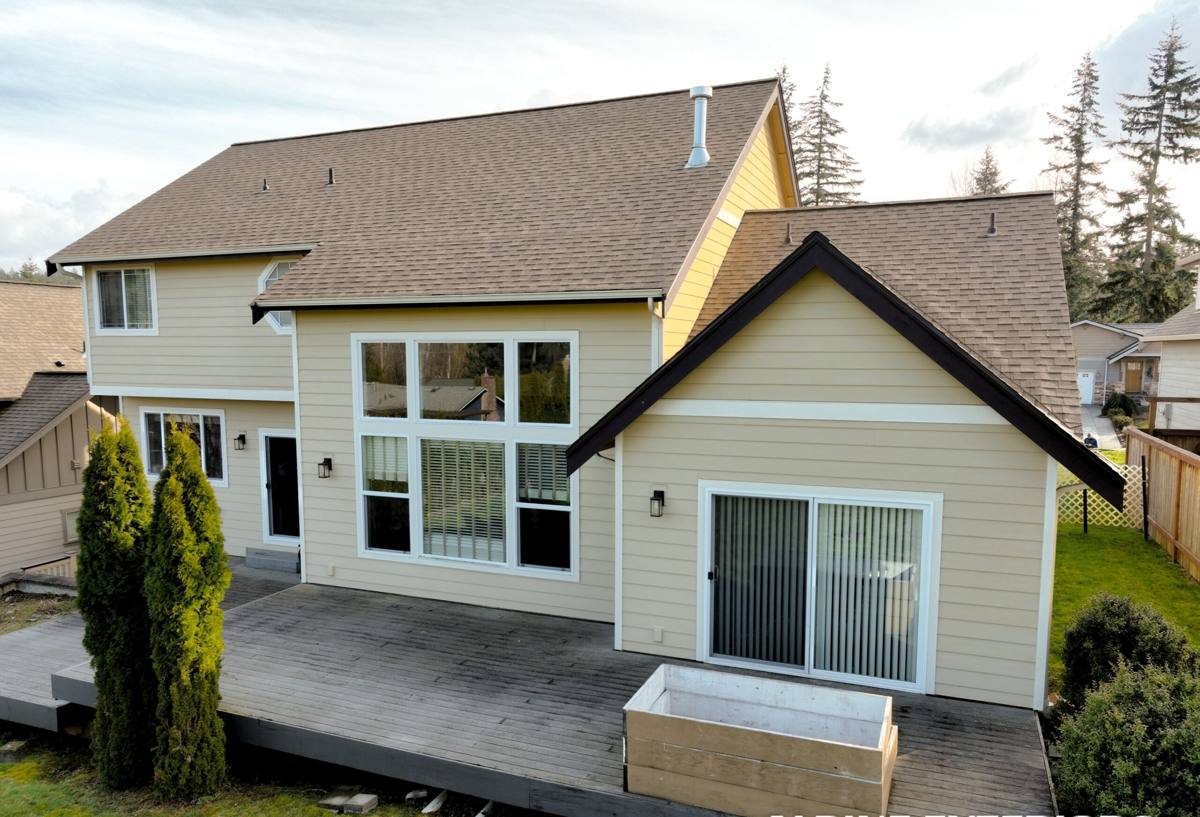
What This Climate Does to a Roof
Salt Air and Corrosion
Metal components age faster near saltwater — nails, flashing, valley metal, and fastener heads on shingles all corrode quicker than they would inland. Corroded fasteners lose their grip, which is one of the more common reasons a shingle roof that "shouldn't be old enough to leak" starts leaking anyway. Repairs in Samish need to account for this from the start, using fasteners and flashing rated for coastal exposure rather than whatever's cheapest at the yard.
Driving Rain
Wind-driven rain off the bay doesn't just fall — it pushes sideways and upward under laps, flashing edges, and shingle tabs that would stay dry in a calmer rainstorm. This is why some leaks in Samish show up only during specific storms with a particular wind direction, and why a repair that looks fine in dry weather can still fail the next time the wind comes off the water a certain way. A correct repair accounts for wind-driven water, not just water falling straight down.
Moss and a Long Growing Season
Shade, moisture, and mild temperatures mean moss doesn't just grow in Samish — it thrives for most of the year. Moss holds moisture against roofing material, works its way under shingle edges as it grows, and can lift shingles enough to let water in even before there's any visible damage. On roofs with heavier tree cover, moss is often the underlying cause of a leak that shows up somewhere else entirely.
Signs a Samish Roof Needs Repair
Most roof problems here give some warning before they turn into an active leak inside the house. Homeowners who catch these early usually pay for a repair instead of water damage remediation.
- Granules collecting in gutters or at the base of downspouts
- Dark streaking or thick moss growth, especially on north-facing or shaded slopes
- Curling, cupping, or lifted shingle edges, particularly along eaves and ridges
- Rusted or visibly corroded flashing around chimneys, vents, and valleys
- Soft spots or slight sagging when walked on (if safe to observe from the ground or ladder)
- Water stains on interior ceilings that appear only during wind-driven storms
- Daylight visible through the roof deck from inside an attic
- Shingles or debris in the yard after a windstorm
Any one of these on its own might be minor. Several at once, or any sign paired with an active interior leak, means it's time for a proper look before the next storm season.
What a Correct Repair Actually Involves
Diagnosis Before Patching
A leak's entry point and the spot where water shows up inside are often not the same place — water travels along the deck or underlayment before it drips. A repair that just patches the visible spot without tracing the actual path often looks successful for a few weeks and then fails again in the next storm. We check the full path: shingles, underlayment, deck condition, and flashing at every penetration nearby, not just the obvious one.
Flashing and Underlayment
Given the wind-driven rain this area sees, flashing detail matters more here than it would in a drier climate. Step flashing, counter-flashing at chimneys, and valley metal all need to be lapped and sealed correctly, not just caulked over. Underlayment condition matters too — if the felt or synthetic underlayment beneath the shingles has already broken down, a shingle-level repair alone won't hold.
Matching Materials, Not Just Colors
Repairs on an older roof mean sourcing shingles or metal that match both the appearance and the performance characteristics of what's already up there. Mismatched materials can create their own moisture problems at the seam between old and new, especially with metal-to-metal or metal-to-shingle transitions.
Corrosion-Resistant Fasteners
Given the salt exposure, we use fasteners and flashing rated for coastal or marine-adjacent conditions on repair work in Samish. It costs a little more up front than standard hardware, but it's the difference between a repair that lasts and one that needs redoing in a few years as the fasteners corrode.
Roof Types Common in the Area and Repair Considerations
| Roof Type | Typical Repair Focus in Samish | Watch For |
|---|---|---|
| Asphalt/composition shingle | Flashing reseal, fastener replacement, spot shingle replacement | Granule loss, corroded nail heads, moss lifting tabs |
| Cedar shake/shingle | Splitting boards, moss removal, ventilation checks | Moss retains moisture directly against wood, accelerating rot |
| Metal roofing | Fastener and seam resealing, panel corrosion spots | Salt air can pit fastener heads and seams over time |
| Low-slope/flat sections | Membrane seam and flashing repair at transitions | Wind-driven rain finds pooling or low spots fastest |
Our Repair Process
- Inspection. We look at the whole roof, not just the reported leak — including attic access if available, flashing at every penetration, and any moss or debris buildup.
- Honest assessment. We tell you whether this is a straightforward repair, a repair that buys time, or a situation where replacement is the better value. We'd rather lose a small repair job than sell you one that won't hold.
- Written scope. Before any work starts, you get a clear description of what's being fixed and why, so there's no ambiguity about what "repaired" means.
- The repair itself. Flashing, underlayment, decking, and shingle or panel work as needed, using corrosion-resistant fasteners and materials suited to this climate.
- Cleanup and check. Debris and old material removed, and a final check that the repair area sheds water correctly.
Repair vs. Replacement: What Actually Drives the Decision
| Factor | Leans Toward Repair | Leans Toward Replacement |
|---|---|---|
| Age of roof | Roof is well within its expected service life | Roof is near or past its expected lifespan |
| Extent of damage | Isolated to one area or penetration | Multiple areas, or damage found in more than one inspection |
| Deck condition | Deck is solid where exposed | Soft or rotted decking found during inspection |
| Moss/moisture history | First occurrence, addressed early | Long-term moss growth with signs of trapped moisture |
| Prior repairs | Roof hasn't needed frequent patching | Recurring repairs to the same or nearby areas |
We walk through these factors with you directly rather than defaulting to whichever answer is more profitable for us. Sometimes a repair is genuinely the right call for years to come; sometimes it's a patch on a roof that needs a bigger conversation. You'll hear which one applies to your situation and why.
Moss and Debris: An Ongoing Factor, Not a One-Time Fix
Because of how long the moss season runs here, a repair that doesn't also address moss and debris buildup nearby is incomplete. We remove moss carefully — scraping and stripping can damage shingle granules if done aggressively — and check gutters and valleys for the debris that holds moisture against the roof surface. For homes with heavy tree cover, we'll talk through a simple maintenance interval so moss doesn't quietly undo the repair over the next couple of wet seasons.
Why It Matters to Hire a Crew That Already Works in Samish
Roofing generally is the same trade everywhere, but the failure patterns aren't. A crew used to drier inland conditions may not flash a valley the same way, may not think twice about standard fasteners near saltwater, and may not recognize moss-related lifting until it's already caused a leak. We work in Samish and the surrounding Chuckanut area regularly, so the repair decisions we make — the fastener grade, the flashing detail, the call on repair versus replacement — are based on what actually holds up here, not what holds up somewhere drier and calmer.
If you've got a leak, a soft spot, or a roof that's just been collecting more moss than it used to, we're happy to take a look. Estimates are free and there's no pressure either way — just an honest read on what your roof needs and what it would take to fix it right.