 Chuckanut Exterior
 Roof Replacement in Blanchard: Built for Chuckanut's Coastal Weather
Blanchard sits close enough to the water and to Chuckanut Mountain that its roofs take a different kind of beating than homes further inland. You get salt-laden air off the bay, wind that funnels through the low passes and tree lines, driving rain that comes in sideways more often than straight down, and a moss season that seems to stretch a little longer every year. A roof replacement out here isn't just about swapping old shingles for new ones — it's about building an assembly that can shrug off all four of those things at once, for decades, without babysitting.
This page covers what a proper roof replacement looks like specifically for Blanchard and the surrounding Chuckanut area: what the climate actually does to a roof, what a correct job includes underneath the surface, and why local experience matters more here than it does in drier, more sheltered parts of the county.
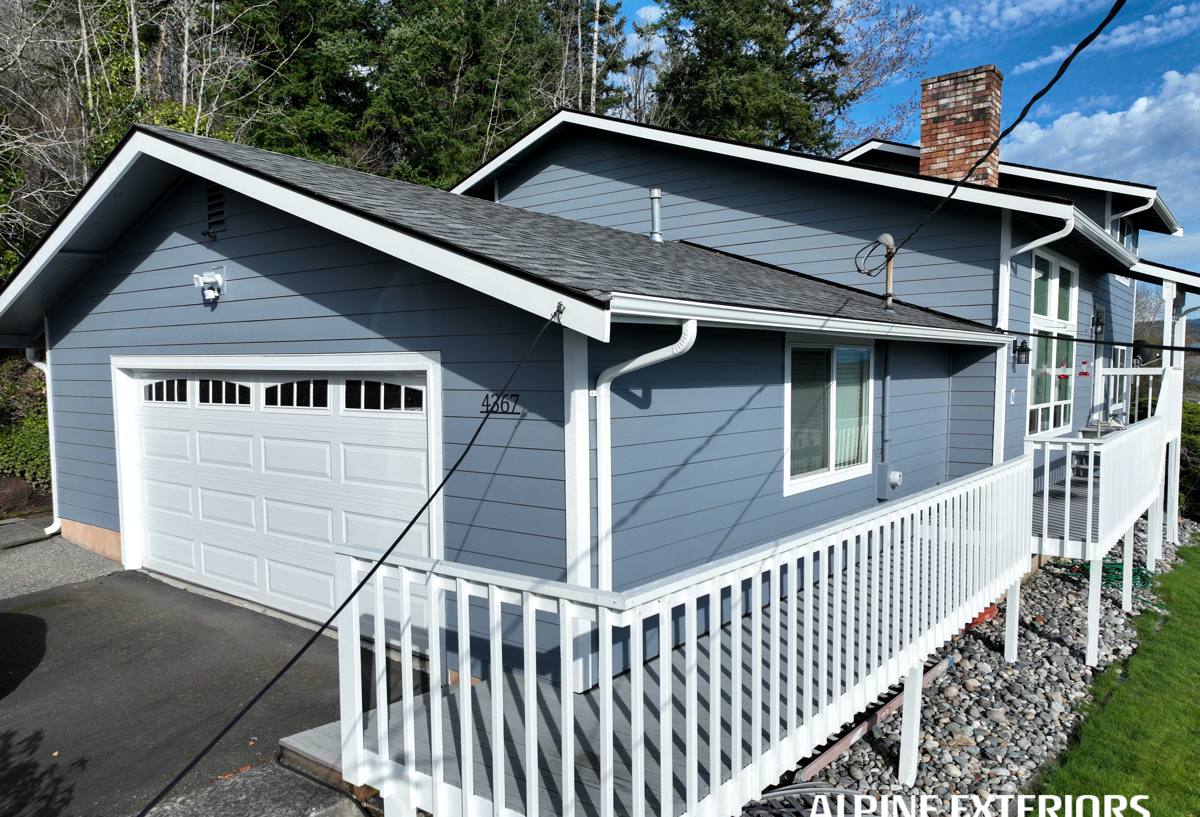
What Salt Air and Driving Rain Do to a Roof Over Time
Salt air doesn't just smell different near Blanchard — it's chemically active. Airborne salt accelerates corrosion on anything metal: nails, flashing, gutter fasteners, roof vents, even the coating on some prefinished metal panels if it's not rated for coastal exposure. A fastener that would last thirty years in a dry inland town can start weeping rust streaks in under ten if it's the wrong grade of steel out here.
Driving rain adds a second problem: wind-driven water doesn't fall straight onto a roof plane, it gets pushed sideways and upward under laps, around valleys, and against anything that interrupts the roof surface — chimneys, skylights, dormers. A roof that's only built to shed water moving straight down will eventually let water find its way under shingles, behind flashing, or into fastener holes. That's a slow leak that can take years to show up as a stain on a ceiling, by which point the decking underneath may already be soft.
Neither of these problems is dramatic day to day. They're cumulative. That's exactly why they get missed — and why a roof that "looks fine" from the driveway can be a few years from real trouble underneath.
Moss: The Slow Roof Killer in This Corner of Whatcom County
Moss loves exactly the conditions Blanchard has in abundance: shade from mature trees, persistent moisture, and mild temperatures that never get hot or dry enough to fully kill it off. Once moss gets a foothold on a roof, it does more damage than it looks like it should:
- It holds moisture directly against the roofing material far longer than open air would, softening asphalt shingles and accelerating granule loss.
- It grows under shingle tabs and gradually lifts them, breaking the seal that keeps wind-driven rain out.
- It clogs valleys and gutters, backing water up under the roofing at exactly the spots most vulnerable to leaks.
- On cedar or wood roofing, it traps moisture against the wood itself, which speeds up rot.
A roof replacement is the right time to break this cycle — not just by installing new material, but by choosing products and details (like zinc or copper strips near the ridge) that make it harder for moss to re-establish, and by making sure surrounding drainage actually clears water instead of holding it.
Signs Your Blanchard Home Needs a Roof Replacement
Not every roof problem calls for full replacement — some just need repair. But when several of these show up together, patching is usually a short-term fix on a roof that's already past its useful life:
- Shingles that are cupping, curling at the edges, or missing granules in patches
- Moss or dark streaking covering more than a small portion of the roof, especially on north-facing slopes
- Soft spots or noticeable sag when walked on (decking has already taken on moisture)
- Rusting, lifting, or visibly corroded flashing around chimneys, vents, or valleys
- Daylight visible through the roof deck from inside the attic
- Granules collecting in gutters after normal rain, not just after a storm
- A roof that's 20+ years old and has never had a full tear-off
- Repeated leak repairs in the same general area of the roof
What a Correct Roof Replacement Actually Involves
Tear-Off and Decking Inspection
We remove the old roofing down to the deck rather than layering over it. That's the only way to actually see the plywood or plank decking underneath — and in a wet climate like this, hidden decking damage is common even on roofs that don't look bad from above. Any soft, delaminated, or rotted sheathing gets replaced before anything new goes down. Skipping this step is the single most common shortcut that leads to early roof failure.
Underlayment and Ice-and-Water Protection
Given how much wind-driven rain this area sees, we don't treat underlayment as an afterthought. A quality synthetic underlayment across the full roof, with self-adhered ice-and-water membrane at eaves, valleys, and around every roof penetration, gives the assembly a real second line of defense if wind ever pushes water past the shingles themselves.
Ventilation
Balanced intake and exhaust ventilation matters as much as the roofing material. Poor attic ventilation traps moisture, which encourages both rot and the kind of persistent surface dampness that moss thrives on. Part of a correct replacement is checking that soffit intake vents aren't blocked and that exhaust venting at the ridge or roof is sized correctly for the attic space — not just adding vents for the sake of it.
Flashing and Fasteners
This is where salt air exposure gets addressed directly. We spec corrosion-resistant flashing and fastener materials appropriate for coastal conditions rather than whatever's cheapest at standard inland pricing. Chimney flashing, valley metal, and any exposed fasteners are the first things salt air attacks, so getting the material grade right here has an outsized effect on how long the whole roof lasts.
Choosing a Roofing Material for This Climate
There's no single "best" material for every home — it depends on budget, roof pitch, and how much upkeep an owner wants to do. Here's how the common options actually compare for Blanchard's conditions:
| Material | Typical Lifespan | Moss Resistance | Salt Air / Wind Performance | Maintenance |
|---|---|---|---|---|
| Architectural asphalt shingle | 25–30 years | Moderate — improves with zinc strips | Good with correct fasteners and sealing | Low |
| Standing seam metal | 40–50+ years | Good — sheds moisture quickly | Excellent when properly coated and fastened | Very low |
| Cedar shake | 20–30 years with upkeep | Poor without regular treatment | Fair — sensitive to sustained moisture | High |
We're honest about the trade-offs on cedar in particular: it's a beautiful, traditional look, but sustained moisture and moss pressure in this area mean it needs more frequent inspection and treatment than asphalt or metal to reach a full service life. That's not a knock on the material — it's a maintenance commitment we want homeowners to go in with eyes open about, not something they find out after the fact.
Our Roof Replacement Process, Step by Step
- On-site inspection — we walk the roof, check the attic, and assess decking condition, ventilation, and drainage, not just the shingles.
- Written scope and estimate — material options, underlayment spec, and any decking or ventilation work are laid out before anything is signed.
- Tear-off — full removal down to the deck, with debris contained and hauled off the same day where possible.
- Decking repair — any soft or damaged sheathing is replaced, not skimmed over.
- Ice-and-water membrane and underlayment — installed at all vulnerable points before the field underlayment goes down.
- Flashing and ventilation work — new corrosion-resistant flashing, and ventilation corrected if intake/exhaust is out of balance.
- New roofing installed to manufacturer spec, with attention to nailing pattern and exposure — details that matter more in high-wind areas than most homeowners realize.
- Final walkthrough and cleanup — magnetic sweep for stray fasteners, gutters checked and cleared, warranty paperwork reviewed in plain language.
Why a Crew That Already Works Blanchard Matters
A roofing crew that mostly works dry, inland neighborhoods can install a technically correct roof and still get it wrong for this area — the wrong fastener grade, underlayment that's adequate but not built for driving rain, or a moss strategy that's really just an afterthought. Working Chuckanut and Blanchard regularly means we already know which slopes on which lot orientations hold moss longest, how far wind-driven rain actually pushes water up a roof plane in a real storm here, and which material and fastener specs hold up to the salt air rather than just meeting a generic building code minimum.
It also means practical things go smoother: knowing local permitting requirements, having a realistic sense of scheduling around this area's wetter months, and understanding how tree cover and lot layout affect a specific roof's exposure — all things that come from doing this work here repeatedly, not from a one-off job.
Get a Free, No-Pressure Estimate
If your roof is showing moss, wear, or you're just not sure how much life it has left, we're happy to take a look. The estimate is free, there's no pressure to commit on the spot, and you'll get a straight answer about whether you need replacement now, can reasonably wait, or would be better served by a targeted repair. Use the form below to get started.