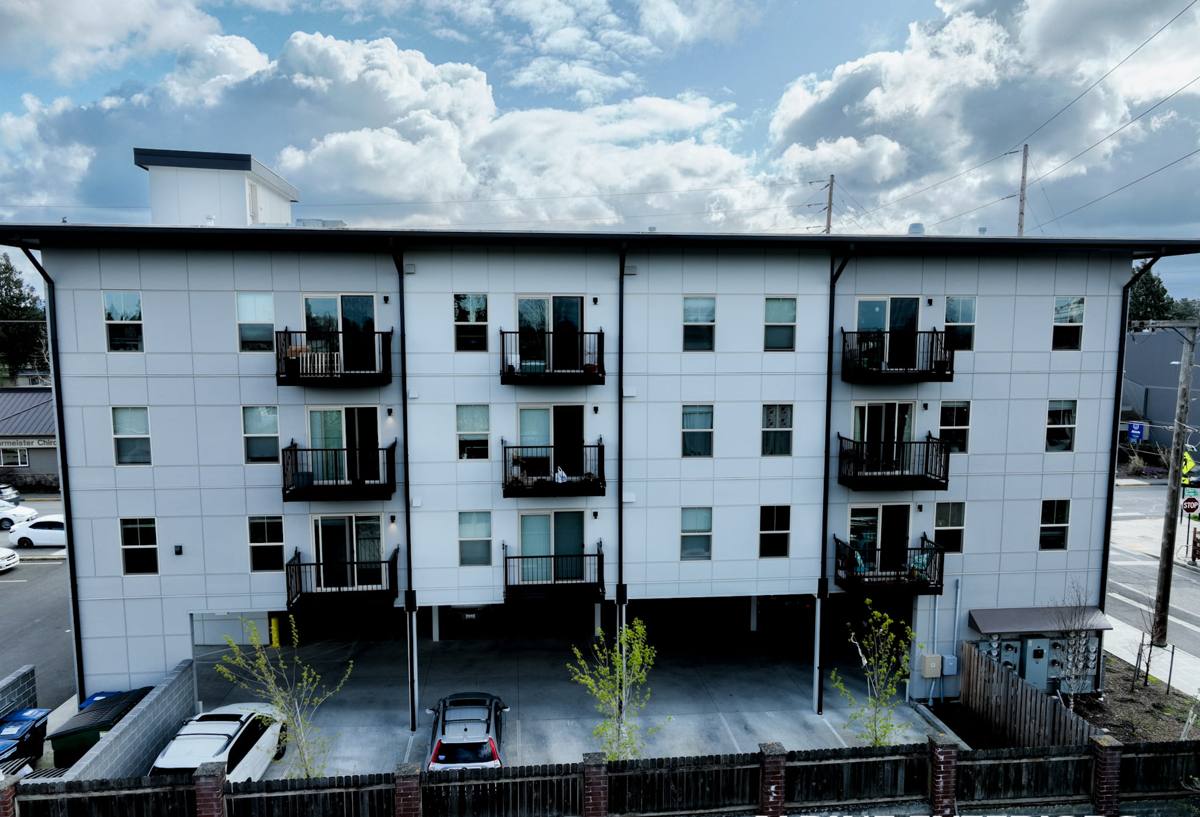
 Chuckanut Exterior
 New-Construction Windows Are a Different Job Than Replacement
When people hear "window installation," most think of replacement work — pulling out an old window and fitting a new one into an existing opening. New-construction window installs are a different trade entirely. There's no old frame to reference, no existing flashing to work around, and no finished siding or interior trim to protect. The window goes in as part of the building envelope itself, before the house is weathertight. That means the install has to be right the first time, because the wall assembly around it — the weather-resistive barrier, the flashing, the sheathing seams — is built around the window's flanges, not the other way around.
For a home going up in Samish, that sequencing matters more than it would in a drier, more sheltered part of the country. Get the window-to-wall transition wrong here and you won't find out until the first hard winter storm, when it's a lot more expensive to fix.
What Samish's Climate Actually Demands From a Window Install
Samish sits close enough to Samish Bay and the broader Salish Sea that salt-laden air is a real factor in material selection and hardware longevity, not just a coastal talking point. Combine that with the driving, wind-pushed rain typical of Whatcom County storms coming off the water, and a long, damp moss season that keeps siding, trim, and window sills wet for weeks at a stretch, and you've got three separate stresses acting on every window opening in the house:
- Salt air accelerates corrosion on unprotected fasteners, uncoated flashing, and lower-grade hardware finishes.
- Wind-driven rain doesn't fall straight down — it gets pushed sideways and upward under trim and flanges, which is exactly where a standard flashing detail can fail.
- Moss and sustained moisture hold water against sills and cladding far longer than in a drier climate, so any small gap or reverse-lap in the flashing becomes a slow, hidden leak instead of a quick dry-out.
None of this means you need exotic materials. It means the ordinary details — flashing sequence, sill pan, sealant selection, fastener spec — have to be done correctly and consistently across every opening, because this climate doesn't forgive shortcuts the way a milder one might.
Why This Matters More at New Construction Than at Replacement
A poorly flashed replacement window usually leaks into a cavity that already has some drainage path built in from the original construction. A poorly flashed new-construction window leaks directly into a wall assembly that has no history of managing that water — framing, sheathing, and insulation that were never designed to get wet. In a climate with Samish's rain and moss pressure, that difference shows up as rot and mold years sooner than it would somewhere drier.
Getting the Rough Opening and Flashing Right
This is the part of a new-construction window job that never shows once the siding goes on, and it's also the part that determines whether the window performs for the next 20-plus years or starts causing problems in five. The basics, done in the right order, every time:
- Rough opening sized and squared correctly — not just "close enough" — so the window sits plumb without shimming forcing it out of shape.
- Sill pan flashing installed with a back dam and a slight outward slope, so any water that gets past the window has somewhere to go besides the framing.
- Weather-resistive barrier integrated with the window flange in proper shingle-lap order — barrier under the top flange, over the side and bottom flanges — so water is always directed outward and down, never trapped.
- Corner and seam details sealed with compatible flashing tape or liquid-applied flashing rated for the substrate, not just caulk bridging a gap.
- Fasteners set per the manufacturer's schedule, with corrosion-resistant hardware appropriate for near-coastal exposure.
Skip or rush any one of these steps and the window itself can be a perfectly good unit and still fail the wall. This is also where hiring a crew that installs windows for a living — rather than a framing crew doing windows as one task among many — tends to show. Flashing sequencing is a specific skill, and it's the single biggest predictor of whether a window leaks.
Choosing Window Products for Samish's Exposure
New construction gives you full freedom on window selection since you're not constrained by an existing opening. That's an advantage worth using well. The main decisions are frame material, glazing package, and installation method (nail-fin vs. block-frame), and each has real trade-offs for a coastal Whatcom County property.
| Frame Material | How It Handles This Climate | Trade-Offs |
|---|---|---|
| Vinyl | Good moisture and corrosion resistance; no repainting | Lower-end vinyl can flex or discolor with prolonged sun/salt exposure; quality varies a lot by manufacturer |
| Fiberglass | Very stable dimensionally, holds paint well, strong resistance to moisture and corrosion | Higher upfront cost than vinyl |
| Aluminum-clad wood | Attractive interior wood look, exterior aluminum resists weather | Requires correct clad-to-flashing detailing; more maintenance-sensitive at seams |
| Bare wood | Traditional appearance | Highest maintenance burden in a wet, salt-air climate; we generally don't recommend it for direct coastal exposure without significant upkeep commitment |
On glazing, double-pane with a low-E coating and an argon fill is standard for new construction in this region and performs well against Whatcom County's mix of damp cold and marine humidity. Triple-pane is worth discussing for homes with more exposed north or west elevations, where wind-driven rain and heat loss are both bigger factors — it costs more but can be a reasonable investment on the most exposed walls rather than the whole house.
Nail-Fin vs. Block-Frame Installation
Most single-family new construction in Samish uses nail-fin (flange) windows, which integrate directly with the weather-resistive barrier and are the more straightforward, well-proven install method for wood-framed walls. Block-frame windows are more common in masonry or specific architectural applications and require a different flashing approach. We'll talk through which fits your wall assembly and design before framing is locked in — it's much easier to plan for the right method than to adapt mid-build.
Our New-Construction Window Process
We work directly with builders and homeowners acting as their own GC, and the process is the same either way:
- Plan review — we look at window schedules and elevations early, before framing is finalized, to flag any sizing or rough-opening issues.
- Coordination with the framing and WRB timeline — window install needs to happen at the right point in the sequence, not before the wall barrier is ready and not so late that the house sits open to weather.
- Sill pan and flashing installation — done to the sequence above, on every opening, no exceptions for "easy" windows.
- Window setting, shimming, and squaring — checked for level, plumb, and square, and fastened per manufacturer spec.
- Final flashing tie-in — head flashing and barrier lap completed so the opening is fully integrated into the drainage plane before siding covers it.
- Documentation — we note what was installed and how, which matters for warranty claims and for any future work on the home.
We don't consider a new-construction window job finished until the flashing is tied into the barrier and the opening is fully protected — not just until the window itself is set.
Working With Your Builder and Timeline
Whether you're the homeowner managing a custom build or we're working under your general contractor, window installation sits on a tight critical path: framing has to be done, the WRB has to be up, and the openings need to be ready — but siding and interior finish work are usually waiting on us to be done. We coordinate scheduling directly with the GC or framing crew so windows go in at the right moment without stalling the rest of the build. If you're early enough in planning that window selection isn't locked yet, that's the best time to loop us in — it's much easier to size openings and plan flashing details correctly from the start than to correct them after framing.
Common Mistakes We See in New-Construction Window Installs
Most window problems in newer Whatcom County homes trace back to a handful of repeat issues, all preventable:
| Mistake | Why It Causes Problems Here |
|---|---|
| Caulk used in place of proper flashing | Caulk degrades and cracks; it's not a substitute for a shingle-lapped drainage path, especially under driving rain |
| Missing or flat sill pan | Without a back dam and slope, any water that gets past the window sits on the framing instead of draining out |
| Wrong lap order on the weather barrier | Reverse-lapped barrier funnels water into the wall instead of away from it — a slow leak that often isn't found for years |
| Standard hardware in a coastal-exposure home | Salt air accelerates corrosion on fasteners and hinges not rated for the exposure |
| Windows installed before the wall assembly is ready | Rushing the sequence to hit a schedule milestone often means skipping steps that don't show until later |
What Affects Cost on a New-Construction Window Job
Every build is different, but the main cost drivers for new-construction window installation in this area are consistent:
- Number and size of openings, including any large or specialty shapes.
- Frame material and glazing package selected.
- Wall assembly complexity — number of stories, exposure on each elevation, and any architectural details around openings.
- Timeline coordination — installs bundled efficiently with the framing schedule cost less than piecemeal or rushed sequencing.
We'll walk the plans with you and give a straightforward estimate rather than a rough per-window number that doesn't account for your specific wall assembly or exposure.
Why a Crew That Already Works in Samish Matters
Flashing details that work fine in a dry inland climate aren't automatically enough for a property exposed to Samish Bay's salt air and Whatcom County's driving winter rain. A crew that installs windows across this region day in and day out knows which elevations tend to take the worst weather, which hardware finishes hold up under salt exposure, and how much margin to build into flashing details for a moss season that keeps everything wet for weeks. That's not something you can fully spec from a plan set — it comes from doing the work here, repeatedly, and seeing what holds up and what doesn't.
If you're planning new construction or an addition in Samish and want windows installed right the first time, we're happy to walk through your plans and give you a free, no-pressure estimate — just fill out the form below.