 Chuckanut Exterior
 Sehome's Climate Is Hard on Siding
Homes in Sehome sit close enough to Bellingham Bay and the broader Whatcom County coastline that salt-laden air is a year-round fact of life, not an occasional nuisance. Add in driving, wind-blown rain that rolls in off the water for much of the year, plus a moss season that can run from early fall through late spring under the region's heavy tree cover, and you've got three separate forces working against whatever material is nailed to the outside of a house. Most siding failures we see in this part of Washington aren't sudden — they're the slow result of years of salt air breaking down paint and finishes, rain finding its way behind panels through worn caulk or failed flashing, and moss holding moisture against a wall far longer than it should ever sit there.
None of that is unique to any one house. It's simply what comes with the territory here, and it means siding in Sehome has to be chosen and installed with those three stresses specifically in mind — not picked because it looked good in a showroom three counties away.
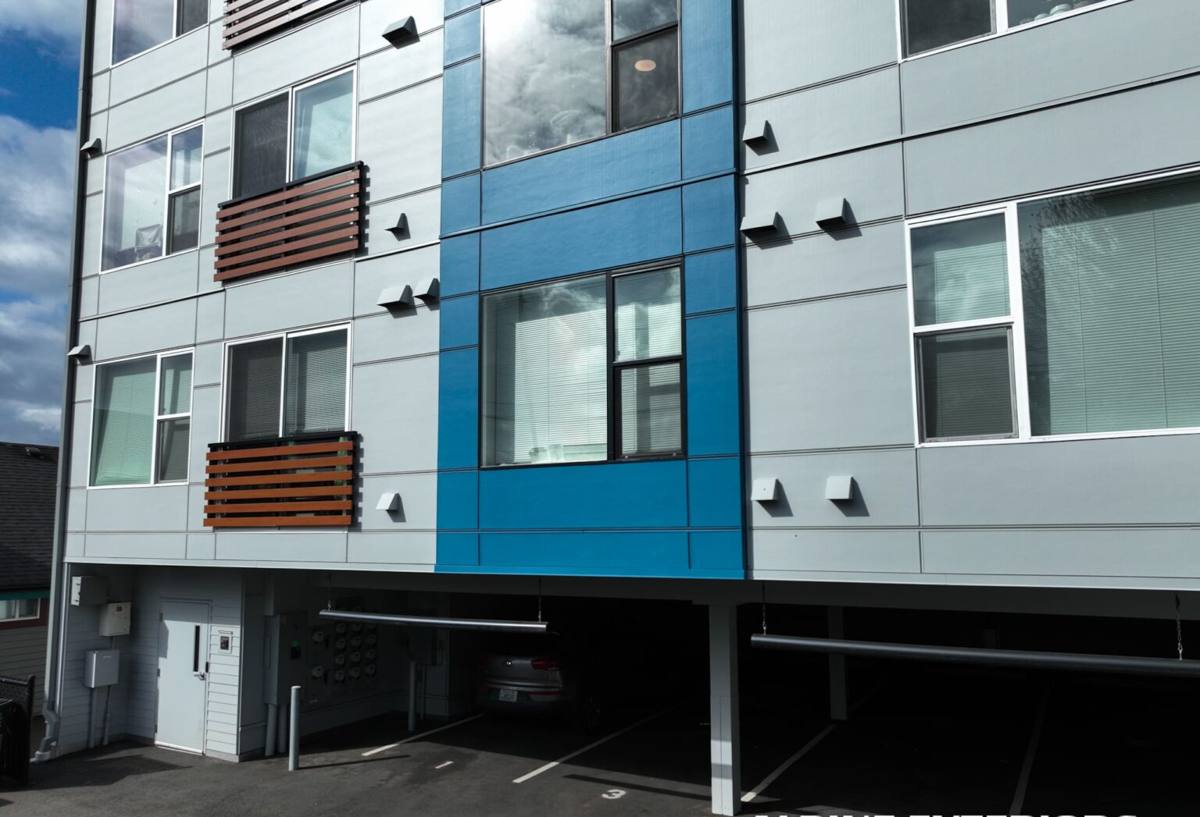
Signs a Sehome Home Needs Replacement, Not Just Repair
Not every siding problem calls for a full tear-off. A few cracked boards, some failed caulk, or a section of trim that took storm damage can often be repaired without replacing the whole exterior. But there's a point where patching stops making sense, and homes in this climate tend to reach that point faster than homes in drier parts of the state.
Cosmetic wear versus structural moisture damage
Fading, chalking paint, and small surface cracks are cosmetic — annoying, but not urgent. What changes the calculation is moisture getting behind the siding itself. Soft or spongy spots when you press on a wall, siding that's visibly bowed or pulling away from the sheathing, paint that bubbles or peels in the same spots every year, and a musty smell in an exterior wall or nearby closet are all signs that water has been getting in, not just sitting on the surface. Once moisture is behind the siding, repainting or patching the outside does nothing for the damage that's already happening underneath.
Age and material matter too
Older wood, hardboard, and some early-generation composite sidings simply weren't built to handle decades of coastal PNW weather. If a home's siding is original from a build several decades back and hasn't been replaced, it's worth a real inspection even if it looks fine from the curb — the failure often starts at seams, corners, and butt joints long before it's visible from the street.
What a Correct Siding Replacement Actually Involves
Replacing siding is not just pulling off old boards and nailing up new ones. In a climate like Sehome's, the parts of the job nobody sees are the parts that determine whether the new siding lasts fifteen years or fifty.
Tear-off and sheathing inspection
Once the old siding comes off, the sheathing underneath gets inspected for rot, soft spots, and water staining — especially around windows, doors, and any place two rooflines or wall planes meet. This is often the first time hidden damage from years of a leaky old system becomes visible, and it has to be addressed before anything new goes up. Skipping this step and installing new siding over compromised sheathing just buries the problem for the next owner to find.
Weather-resistive barrier and flashing
A correctly installed weather-resistive barrier (WRB) is what actually keeps bulk water out of the wall assembly — the siding itself is the first line of defense, but the barrier and flashing behind it are what stop water that gets past the siding from reaching the framing. Window and door flashing, kick-out flashing where roof and wall meet, and properly lapped barrier seams all matter more in a driving-rain, salt-air climate than they do somewhere dry. This is exactly the kind of detail that separates a durable install from one that looks fine for a couple of years and then starts failing at the seams.
Fastening, gaps, and clearances
Fiber cement siding has manufacturer-specified fastening patterns, joint gaps, and clearances from grade, roof lines, and decks — all of which exist for a reason. Get them wrong and you invite moisture intrusion, buckling, or premature finish failure, even with a top-tier product. Getting them right is unglamorous, careful work, and it's where experience with this specific material and this specific climate actually shows.
Why We Install Only James Hardie Fiber Cement
We standardized on James Hardie fiber cement siding for every home we side, including in Sehome, and we don't install vinyl, LP SmartSide, cedar, primed spruce, or other fiber cement brands. That's not a marketing position — it's a decision based on what holds up against salt air, driving rain, and moss over the long haul without the maintenance burden or moisture risk that comes with the alternatives.
Fiber cement is non-combustible and dimensionally stable, meaning it doesn't expand, contract, warp, or rot the way wood-based products can when they're cycling through wet Pacific Northwest winters and drier summers. James Hardie's ColorPlus factory finish is baked on under controlled conditions rather than field-painted, which matters directly for salt-air exposure — factory finishes generally hold color and resist the chalking and fading that field-applied paint shows first in coastal conditions. Hardie also builds climate-engineered HZ product lines specifically for wetter regions, and backs the product with a strong, transferable warranty. When we're putting our name on a job that has to perform in this climate for decades, that's the system we trust.
Our Siding Replacement Process
The process is the same whether it's a small single-story home or a larger multi-story property, just scaled to the size of the job.
- On-site assessment — we walk the exterior, check for moisture damage, and evaluate the current siding, trim, and flashing conditions.
- Written estimate — a clear scope of work and pricing before anything is scheduled, with no pressure to sign on the spot.
- Tear-off and sheathing inspection — old material comes off and the wall gets checked before anything new goes up.
- Repair of any hidden damage — rotted sheathing or framing gets addressed, not covered over.
- Weather-resistive barrier and flashing installation — the part of the job that determines long-term performance.
- James Hardie siding installation — installed to manufacturer specification for fastening, gaps, and clearances.
- Final walkthrough — we go over the finished job with the homeowner before calling it done.
What Siding Replacement Costs Depend On
There's no single number that applies to every Sehome home — the honest answer is "it depends," but it depends on a specific, explainable set of factors.
| Factor | Why It Matters |
|---|---|
| Home size and wall complexity | More square footage and more corners, gables, and dormers mean more material and more labor-intensive detail work. |
| Condition of the sheathing underneath | Hidden rot or water damage found during tear-off adds repair work that couldn't be priced sight unseen. |
| Siding profile and trim selection | Lap width, shingle-style panels, and trim details affect both material cost and installation time. |
| Access and site conditions | Tight lots, steep grades, or limited equipment access can add time to the job. |
| Removal and disposal of old siding | Older materials sometimes require special handling or disposal, which factors into the scope. |
We walk every one of these factors with the homeowner during the estimate, so the number on paper reflects the actual house, not a generic average.
Why Hiring a Crew That Already Works Sehome Matters
Siding installation isn't one-size-fits-all, and a crew that regularly works in Sehome and the surrounding Chuckanut area already knows what this specific climate does to a wall assembly over time. That means knowing where moss tends to build up fastest, which orientations take the worst of the driving rain, and how much clearance to leave at grade and roof lines given the amount of rain this area sees. It also means familiarity with Whatcom County permitting and inspection expectations, so the job moves through the proper channels without surprises.
A crew from outside the region — or one that installs a little bit of everything without a real specialty — is more likely to treat every job the same way regardless of local conditions. That's how you end up with a siding job that looks right at handoff but starts showing moisture problems within a few years, right where the salt air and rain are hardest on a wall.
Caring for Your New Siding After Installation
James Hardie fiber cement is low-maintenance compared to wood or vinyl, but "low-maintenance" isn't "no-maintenance" — especially in a climate that produces moss and constant moisture.
- Rinse siding periodically with a garden hose to keep salt residue and grime from building up, especially on walls facing the water.
- Keep gutters clean and downspouts directed away from the foundation so runoff doesn't wash directly down the siding.
- Trim back trees and shrubs that shade siding and keep it damp longer than it needs to be — this is the biggest driver of moss growth.
- Check and re-caulk joints around windows, doors, and trim every few years as part of normal upkeep.
- Address any impact damage or cracked boards promptly rather than letting moisture get behind a damaged panel.
Following the basics keeps a correctly installed Hardie system performing the way it's designed to for decades, even in a climate that doesn't do siding any favors.
If your Sehome home's siding is showing its age, or you just want a straight answer about whether it needs repair or replacement, we're happy to take a look. Reach out for a free, no-pressure estimate — there's a quick form below.