 Chuckanut Exterior
 Siding Built for South Hill's Coastal Climate
South Hill homes sit in one of the more demanding stretches of Whatcom County when it comes to what the weather does to a house's exterior. You've got salt-laden air rolling in off the water, long stretches of driving rain that don't just fall straight down but get pushed sideways into walls, and a moss season that seems to start earlier and last longer every year. None of that is unique to any one street in South Hill — it's the reality for most of Chuckanut, Bellingham Bay, and the surrounding shoreline communities. But it does mean that siding choices which work fine in a drier inland climate can fail early here, and it's why we install James Hardie fiber cement exclusively rather than offering vinyl, LP SmartSide, or cedar as options.
This page is specifically about James Hardie siding for South Hill homes — what the local climate demands from a siding system, what a correct installation actually involves, and how our process works from first estimate to final walk-through.
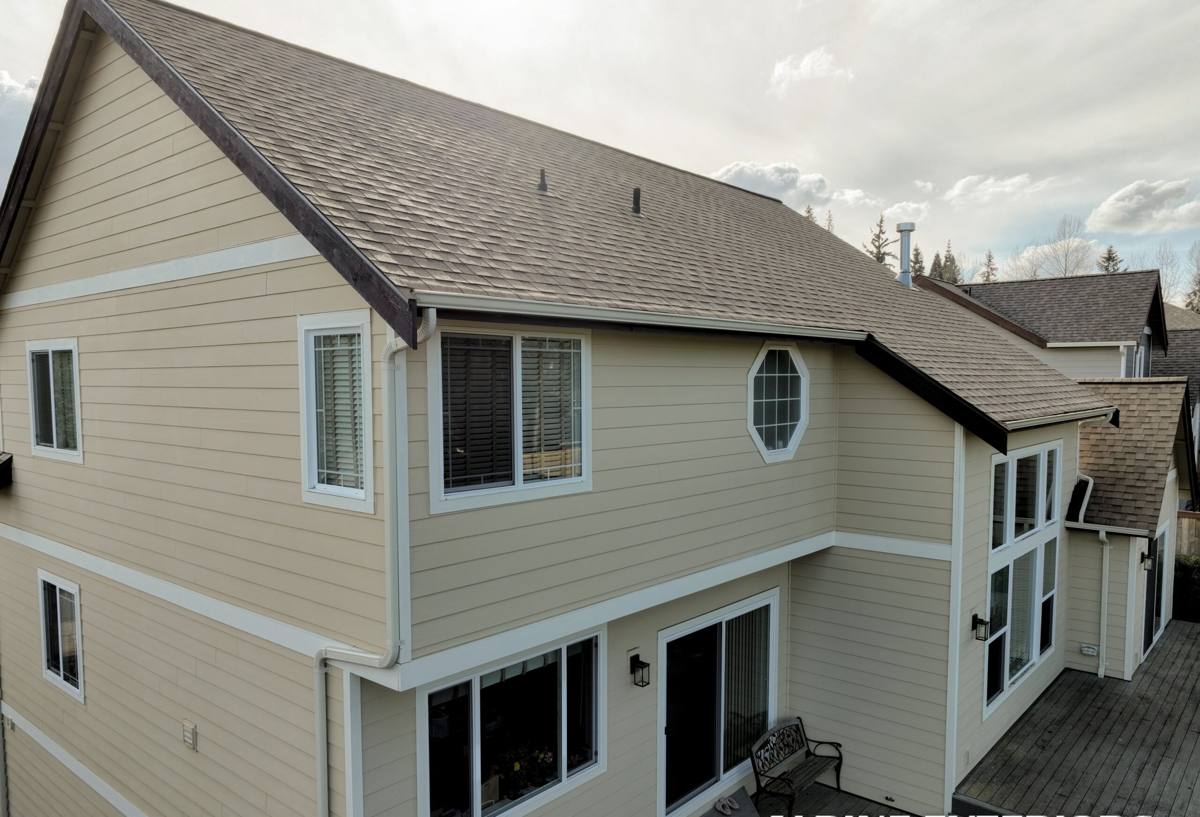
What Salt Air, Driving Rain, and Moss Actually Do to a Wall
Salt air
Salt-laden air is corrosive to unprotected metal fasteners, flashing, and trim, and it accelerates the breakdown of finishes that weren't engineered to handle it. Siding that looks fine in a showroom can chalk, fade, or start lifting at the edges within a few years once it's exposed to a steady coastal air stream. This is one of the reasons the fastener type and flashing details matter as much as the siding material itself.
Driving rain
Wind-driven rain doesn't behave like a gentle shower. It gets forced up under laps, into butt joints, and behind trim that isn't sealed or flashed correctly. A siding product with poor moisture tolerance — or a correctly-rated product installed with the wrong gaps and clearances — will start absorbing water at exactly those weak points. Once moisture gets behind the cladding, it doesn't dry out quickly in a marine climate, and that's when rot, mold, and sheathing damage start.
Moss and shade
Whatcom County's tree cover and persistent damp keep a lot of exterior surfaces shaded and slow to dry for much of the year, which is exactly the environment moss and algae need to take hold. Moss growth on siding isn't just cosmetic — it holds moisture against the surface far longer than open air would, and on the wrong material that constant dampness works its way into seams and fastener holes over time.
Why We Install Only James Hardie Fiber Cement
We made a deliberate decision years ago to stop offering vinyl, LP SmartSide, Cemplank, Allura, or wood siding, and to install James Hardie exclusively. That's not a marketing position — it's a maintenance and performance call based on what actually holds up in this climate.
- Non-combustible core. Fiber cement doesn't burn, melt, or warp from heat the way vinyl can.
- Engineered for Pacific Northwest exposure. Hardie's HZ5 product line is formulated specifically for climates with high moisture and freeze-thaw cycling, which describes Whatcom County well.
- Factory-applied ColorPlus finish. The color and protective topcoat are baked on in a controlled environment, which holds up far better against salt air and UV than field-applied paint.
- Dimensionally stable. Fiber cement doesn't expand and contract with moisture the way engineered wood products can, which matters when boards are exposed to alternating wet and dry cycles most of the year.
- A warranty that assumes long-term coastal exposure, not a best-case dry climate.
We're not going to tell you vinyl or LP SmartSide are bad products in every application — they have their place. But for a home in South Hill facing salt air, driving rain, and a long moss season, we don't think they're the right long-term investment, and we'd rather tell you that up front than sell you something we don't believe will perform.
The Hardie Product Lines That Make Sense for South Hill
James Hardie makes several distinct product lines, and picking the right one — or the right combination — depends on your home's style, exposure, and existing trim details. Here's how we typically match them to homes in this area:
| Product Line | What It Is | Best Fit for South Hill Homes |
|---|---|---|
| HardiePlank Lap Siding | Horizontal lap boards, the most common Hardie profile | Standard for most South Hill homes; smooth or cedarmill texture depending on the look you want |
| HardieShingle | Individual or panelized shingle-style siding | Accent areas — gables, dormers — where a shingle look is desired without the maintenance of real cedar |
| HardiePanel | Vertical fiber cement panels | Modern facades or as an accent alongside lap siding |
| HardieTrim | Fiber cement trim boards | Corner boards, window and door trim — matched material prevents the mismatched weathering you get pairing wood trim with fiber cement field siding |
Most South Hill projects use HardiePlank as the primary field siding with HardieTrim for corners and openings, sometimes with a HardieShingle or HardiePanel accent area. We'll walk through the options with you on-site rather than pushing a one-size-fits-all package.
What a Correct Installation Involves — Not Just the Boards
James Hardie siding performs the way it's supposed to only when it's installed to spec. A lot of premature siding failures we see on older homes aren't a materials problem at all — they're an installation problem. In a climate like South Hill's, the details below aren't optional extras; they're what separates siding that lasts decades from siding that starts causing problems in five years.
Water-resistive barrier and flashing first
Before a single board goes up, the wall needs a properly lapped weather-resistive barrier and correctly integrated flashing at every window, door, and penetration. This is the layer that actually keeps water out of the wall assembly — the siding is the second line of defense, not the first.
Fastener placement and type
Hardie specifies fastener type, spacing, and placement for a reason — get it wrong and you create stress points where the board can crack or the finish can fail early. In a salt-air environment, corrosion-resistant fasteners aren't a nice-to-have.
Clearances and gaps
Manufacturer specs call for specific gaps at butt joints, minimum clearance from grade, roofing, and decks, and proper caulking at seams. These clearances exist specifically to let the assembly dry out after the kind of driving rain events South Hill gets regularly. Skipping them is one of the most common causes of moisture damage we find behind old siding.
Caulking and sealant details
Not every seam gets caulked, and the ones that do need the right product and joint design. Over-caulking traps moisture just as badly as under-caulking lets it in.
Our Process, Start to Finish
- Free on-site estimate. We look at your home's current siding condition, trim, window flashing, and any problem areas before quoting anything.
- Product and color selection. We help you choose the right Hardie line, texture, and ColorPlus color for your home.
- Tear-off and inspection. Once old siding comes off, we inspect the sheathing for hidden moisture damage before covering anything back up.
- Weather barrier and flashing install. This is the step that actually keeps water out — done to spec, every time.
- Hardie installation. Boards, trim, and any accent materials go up to manufacturer specification, including fastener type and clearances.
- Final walk-through. We go over the finished job with you before calling it done.
Signs Your Current Siding Is Losing the Battle
South Hill's climate is hard on siding year-round, and problems tend to show up gradually before they become obvious. Worth checking for:
- Soft or spongy spots when you press on the siding, especially near the bottom courses
- Persistent moss or algae growth that comes back within weeks of cleaning
- Peeling, bubbling, or chalking paint that reappears soon after repainting
- Visible gaps, warping, or buckling at seams and corners
- Rising energy bills that can't be explained by anything else
- Musty smell or visible staining on interior walls near exterior corners
If you're seeing more than one of these, it's worth having someone take a real look rather than just patching the symptom.
Why a Crew That Already Works South Hill Matters
Installing siding correctly in a coastal Whatcom County climate isn't the same job as installing it somewhere dry and inland. A crew that regularly works South Hill and the surrounding Chuckanut area already knows what wind-driven rain exposure and salt air do to fastener choice, flashing details, and clearance requirements — they're not learning it on your house. That experience shows up in the small decisions made on-site: how tight to run a joint, which side of the house needs extra attention, where the old siding is most likely hiding moisture damage. It's the difference between a crew following a generic install checklist and one that's actually accounting for the conditions your specific home faces.
If you're weighing your siding options for a South Hill home, we're happy to come take a look and give you an honest, no-pressure assessment — what your current siding's condition actually is, what James Hardie installed correctly would involve, and a straightforward estimate. Use the form below to request your free estimate.