 Chuckanut Exterior
 Storm Damage on Mount Vernon Roofs Isn't Like Storm Damage Everywhere Else
A roof in Mount Vernon takes a specific kind of punishment. It isn't the occasional hailstorm that does the damage here — it's the accumulation. Marine air moving in off the Sound carries salt that slowly breaks down metal fasteners and flashing. Driving rain, pushed sideways by wind rather than falling straight down, finds every gap a roof in a drier climate could get away with ignoring. And then there's moss, which in this part of Washington isn't a seasonal nuisance — it's close to a year-round tenant, working its way under shingle edges and holding moisture against the roof deck long after the storm has passed.
When we talk about "storm damage repair" for a Mount Vernon home, we're usually not talking about a single dramatic event. Most of the time it's a wind event or a heavy rain system that exposed a weak point the roof had already been developing for a season or two — a lifted shingle tab, a flashing seam that had started to separate, a moss mat that finally let water track sideways instead of down. Repairing it right means fixing the storm damage and addressing why that spot was vulnerable in the first place.
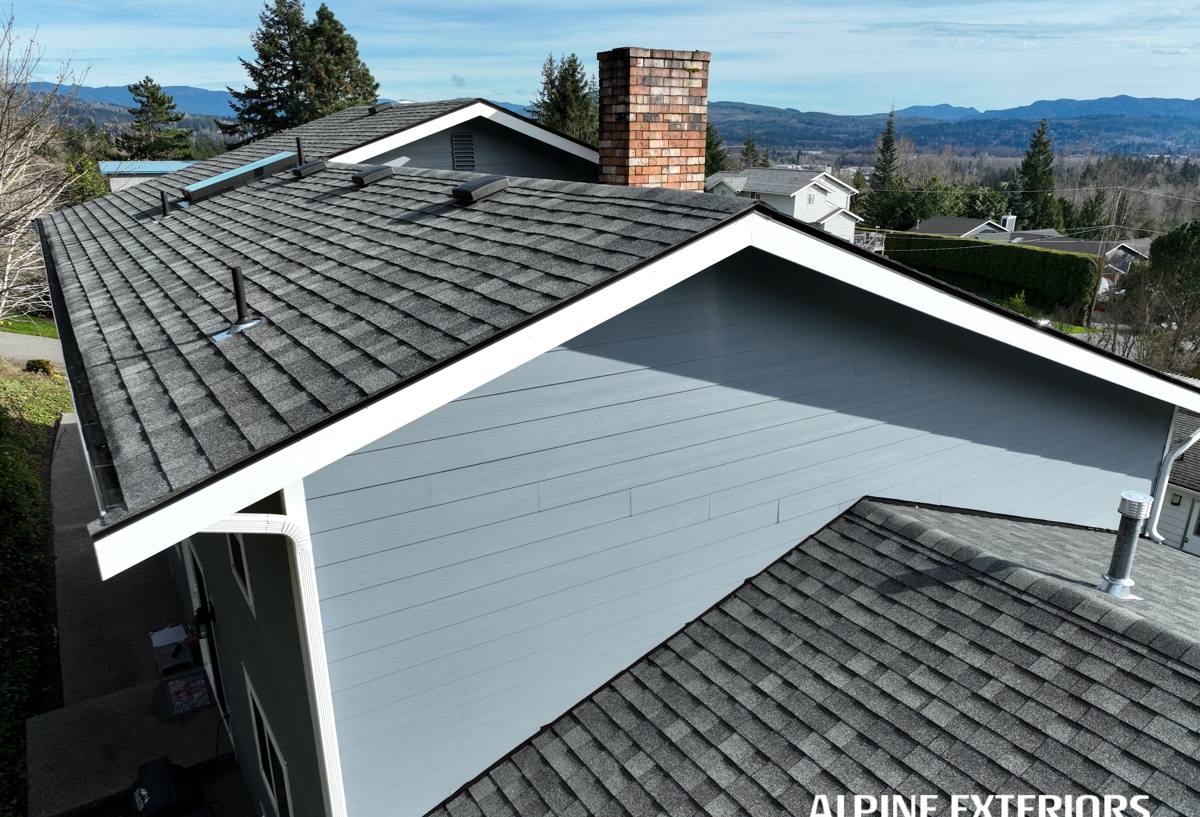
What Storm Damage Actually Looks Like Here
Wind Damage
Sustained wind and gusts off the water can lift shingle tabs, crease them, or tear them loose entirely. On older roofs, wind damage often shows up first at ridge caps and roof edges, where the wind gets the most leverage. A shingle doesn't have to blow off completely to be a problem — a creased or lifted tab has broken its seal and will leak the next time it rains, even if it's still nailed down.
Wind-Driven Rain Intrusion
Because our storms tend to bring rain sideways rather than straight down, water gets pushed up under shingle edges, around vent boots, and into flashing laps that would shed a normal rain fine. This is the damage type that's easiest to miss from the ground and the most likely to cause an interior leak weeks after the storm, once water has worked its way through the underlayment.
Moss and Trapped Moisture Damage
Moss isn't storm damage on its own, but it sets a roof up to fail during a storm. A moss mat holds water against shingles and decking, and during a heavy rain event that saturation has nowhere to go but under the shingle course below it. We regularly find storm leaks that trace back to a moss colony that had been building for a year or more before the storm exposed it.
Flashing and Fastener Failure
Chimney flashing, skylight flashing, and valley metal take the brunt of both wind uplift and rain volume. Add salt-air corrosion to the mix and fasteners that were fine five years ago can be loose or rusted through today. A storm often doesn't create this weakness — it just finds it.
How to Tell If Your Roof Needs Attention After a Storm
- Check the attic (if accessible) for new water stains, damp insulation, or daylight showing through the decking
- Look for granules collecting in gutters or at downspout outlets — a sign of shingle wear or impact damage
- Scan roof edges and ridges from the ground for shingles that look lifted, curled, or missing
- Check around chimneys, skylights, and vent pipes for flashing that looks bent, separated, or missing
- Note any new or worsening moss growth, especially on north-facing slopes that stay shaded and damp longer
- Watch ceilings and walls in the days after a storm — some leaks take time to show up indoors
- Check gutters for debris buildup or sagging that could be redirecting water back under the roof edge
You don't need to get on the roof yourself to do most of this — and after a storm, with a wet roof, we'd rather you didn't. A visual check from the ground and inside the attic tells you whether it's time to call someone out.
Our Storm Repair Process
1. Inspection First, Not a Sales Pitch
We walk the roof, check the attic where accessible, and document what we find with photos before we recommend anything. If the damage is minor and doesn't need a full repair, we'll tell you that. Storm damage repair should start with an honest read on what's actually wrong, not an assumption that every storm call needs a major job.
2. Isolating the Real Cause
Water shows up in one spot but often originates somewhere else — it can travel along the underlayment or decking before it finds a gap to drip through. We trace leaks back to their source rather than patching where the stain appears, which is a common shortcut that leads to repeat calls.
3. Matching Repair to Damage
Not every storm-damaged roof needs full replacement. Localized wind damage, a failed flashing seam, or a section of moss-compromised shingles can often be repaired in place if the rest of the roof is sound. We'll tell you plainly when a repair makes sense versus when the roof's overall condition means a repair is just delaying a bigger job.
4. Correct Materials and Technique
Given how much wind-driven rain this area sees, we pay particular attention to underlayment laps, flashing overlaps, and fastener placement — the details that matter more here than in drier climates. We also match shingle color and profile as closely as the market allows so a repair doesn't stand out like a patch.
5. A Straight Answer on What's Next
After the repair, we'll tell you what to keep an eye on — whether that's a moss treatment plan, a gutter cleaning schedule, or a note that a section of the roof is nearing the end of its useful life. We're not going to oversell a full re-roof to fix a wind-lifted ridge cap.
Repair vs. Replace: What Actually Drives That Decision
| Factor | Leans Toward Repair | Leans Toward Replacement |
|---|---|---|
| Extent of damage | Isolated to one slope or section | Spread across multiple areas or the whole roof |
| Roof age | Under two-thirds of expected lifespan | Nearing or past expected lifespan |
| Underlying decking | Solid, no rot found during inspection | Soft spots or rot found at the damaged area |
| Moss history | Recent, treatable growth | Long-term moss damage affecting multiple courses |
| Shingle condition elsewhere | Rest of roof still has good granule coverage and flexibility | Widespread brittleness, curling, or granule loss |
No single factor makes the call by itself — we weigh all of them together and explain our reasoning, since it's your money and your roof.
Working With Insurance on a Storm Claim
Many storm repairs in this area go through a homeowner's insurance claim, especially after a significant wind event. We can document the damage with photos and a written scope that your adjuster can work from, which tends to make the claims process faster and less confusing. We won't tell you what your policy covers — that's between you and your insurer — but we can make sure the physical evidence of the damage is clearly recorded before repairs cover it up.
What to Have Ready Before an Adjuster Visit
- Photos of the damage taken as soon as it's safely visible
- Any prior roof inspection or maintenance records you have on hand
- A written repair estimate that itemizes materials and scope
- Notes on the date and nature of the storm event, if known
Why a Crew That Already Works Mount Vernon Makes a Difference
Storm repair work rewards local familiarity in ways that aren't obvious until you compare it against an out-of-area crew. We already know how moss behaves on shaded, low-slope sections common in this area's older homes. We know which flashing details tend to fail first under sustained wind-driven rain rather than a quick downpour. And because we're based nearby in Chuckanut, we're not adding hours of drive time to a storm response when a tarp needs to go up before the next system rolls through.
That local presence also matters for accountability. A crew that plans to keep working in Mount Vernon and the surrounding Skagit Valley has every reason to do the repair right the first time and stand behind it — reputation in a community this size travels fast, both ways.
Protecting the Roof Between Storms
A single repair fixes the damage in front of you, but this climate keeps working on a roof year-round. A few habits go a long way toward reducing how often storm damage becomes a repair call:
- Keep gutters and downspouts clear so wind-driven rain has somewhere to go
- Address moss growth before it becomes a mat that holds moisture against the roof
- Have flashing around chimneys and skylights checked every couple of years, since salt air corrodes fasteners faster than inland climates
- Trim back tree limbs that shade roof sections and slow drying after rain
- Don't wait on small leaks — a slow drip found early is a patch; the same leak ignored through a winter can mean deck repair or replacement
Get an Honest Look at Your Roof
If a recent storm has you wondering whether your roof took damage, we'll come take an honest look — no pressure, no inflated scope. We'll tell you plainly what we find, what it will take to fix it, and whether a repair or something more is the right call for your home. Reach out for a free estimate and we'll get you scheduled.