 Chuckanut Exterior
 Windows take more abuse in Bellingham than they do almost anywhere else in Washington. Between the salt-laden air rolling off Bellingham Bay, the long stretches of driving rain that define a Whatcom County winter, and the shaded, moisture-heavy conditions that let moss and mildew take hold on anything that isn't detailed correctly, a window installation here either gets done right the first time or it starts failing within a few seasons. This page covers what that actually means for a Bellingham home, and what our crew does differently because we work in this climate every week, not occasionally.
Why Bellingham's Climate Is Hard on Windows
Three things work against windows in this area at the same time, and most window problems we get called out to inspect trace back to one of them.
Salt Air
Proximity to Bellingham Bay and the Salish Sea means airborne salt is a constant, low-level presence, even miles inland. Salt accelerates corrosion on hardware, screws, and metal flashing, and it degrades certain sealants and finishes faster than manufacturers' standard testing accounts for. Window components rated for a generic "coastal" environment aren't always rated for the specific combination of salt exposure and near-constant moisture this region delivers.
Driving Rain
Rain in this part of Washington doesn't just fall straight down — wind off the water regularly pushes it sideways into building envelopes, including window openings. A window that would perform fine in a dry climate with occasional vertical rain can still leak here if the flashing and drainage details underneath it aren't built for wind-driven water. This is one of the most common root causes we find behind interior water stains and rot around window openings.
Moss and Prolonged Dampness
Bellingham's tree cover, cloud cover, and humidity add up to a long moss season — moss and algae can establish on sills, trim, and shaded wall sections and hold moisture against wood and caulk lines far longer than a drier climate would allow. Once moss gets a foothold at a window's lower corners or sill, it accelerates rot underneath, often invisibly, until the damage is well established.
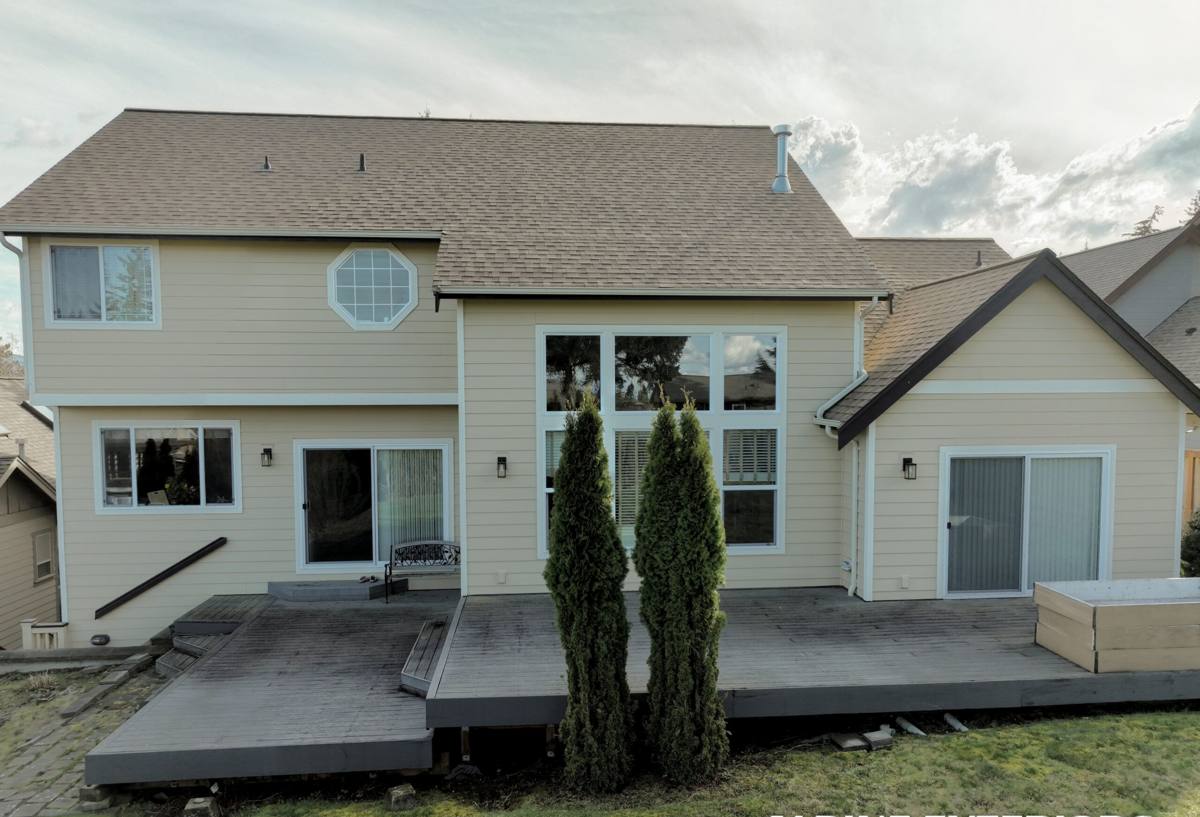
Signs Your Current Windows Are Losing the Fight
Homeowners usually notice one of these before they call us. None of them are emergencies on their own, but each one is worth taking seriously in this climate because water damage compounds quickly once it starts.
- Fogging or a visible film between the panes of a double-pane window — the seal has failed and the insulating gas has escaped
- Drafts you can feel near the frame even when the window is fully latched
- Soft, spongy, or discolored wood on the sill, jamb, or exterior trim
- Moss or dark staining building up on the sill or the wall just below the window
- Difficulty opening, closing, or locking a window that used to operate smoothly
- Paint that keeps bubbling or peeling around the same window no matter how often it's touched up
Any one of these can usually be traced back to a flashing, sealant, or drainage detail that was never quite right — sometimes from the original construction, sometimes from a prior replacement that wasn't installed for this climate.
What a Correct Window Installation Actually Involves
The window unit itself is only part of the job. In a climate like this, the installation detailing around the window matters as much as the window's quality rating, because that detailing is what keeps wind-driven rain out of the wall assembly.
Flashing and Drainage
Every opening needs a sill pan or sloped sill flashing that directs any water that gets past the window back outside the wall, not into the framing. Head flashing and properly lapped weather-resistive barrier around the sides and top complete the drainage path. Skipping or shortcutting this step is the single most common cause of hidden rot we find behind window trim in this region.
Fit, Shimming, and Air Sealing
A window has to be shimmed square and plumb in the rough opening, not just screwed in wherever it happens to sit. An out-of-square window stresses the frame, causes uneven wear on hardware, and creates gaps that let air and moisture in around the edges. After the unit is set, the gap between the window and the framing needs a proper air-sealing material — not just caulk smeared around the trim — to control both drafts and condensation.
Sealant Selection and Placement
Given the salt exposure here, sealant choice matters more than it would in a drier inland climate. We use exterior sealants rated for sustained UV and moisture exposure, and we're deliberate about where sealant is and isn't used — a fully sealed perimeter with no way for incidental moisture to escape can trap water inside a wall just as easily as a gap can let it in. The goal is a system that sheds water, not one that's simply caulked shut.
Choosing Window Materials for This Climate
Material choice affects how a window holds up to salt air and constant moisture over the long run. There's no single right answer for every home — budget, the home's style, and sun exposure all factor in — but here's how the common options generally compare in a Bellingham setting.
| Material | Salt Air / Moisture Resistance | Maintenance | Notes for This Climate |
|---|---|---|---|
| Vinyl | Strong — won't rot or corrode | Low | Good value; check hardware and weatherstripping quality, which varies a lot between product lines |
| Fiberglass | Strong — very stable in temperature and moisture swings | Low | Holds paint well if a custom color is wanted; performs consistently in wet, humid conditions |
| Aluminum | Moderate — prone to corrosion near salt air unless well-finished | Low to moderate | Thermal performance is weaker unless thermally broken; we're selective about where we recommend it here |
| Wood / Wood-clad | Weakest against sustained moisture unless maintained closely | High | Beautiful, but exposed wood exteriors need vigilant upkeep in this climate; clad versions shift the risk to the seams and joints |
Our general standard for Bellingham installations leans toward vinyl or fiberglass for most exterior exposures, simply because they hold up to salt air and damp conditions with the least ongoing maintenance. That's a trade-off, not a rule — we'll walk through the honest pros and cons for your specific home and sun/wind exposure rather than push one material across the board.
Our Installation Process
- On-site assessment. We look at the existing openings, framing condition, and any signs of prior water intrusion before we ever talk product.
- Honest measurement and product selection. We measure every opening individually — older Bellingham homes are rarely perfectly uniform — and walk through material and glass options based on your home's exposure.
- Removal and inspection. Old units come out carefully so we can inspect the rough opening and sill for hidden rot or prior flashing mistakes before anything new goes in.
- Repair as needed. Any soft framing or failed flashing gets addressed before the new window goes in — installing a new window over a compromised opening just hides the problem.
- Flashing and installation. Sill pan, flashing, shimming, and air sealing are done to the standards described above, not shortcut to save time.
- Interior and exterior finish work. Trim, caulking, and paint touch-up are completed so the finished opening looks correct inside and out.
- Final walkthrough. We check operation, seal, and finish with you before we consider the job done.
What Affects the Cost of Window Installation in Bellingham
Every home is different, so we won't quote a number without seeing the openings, but these are the main factors that move a project's cost up or down.
| Factor | Effect on Cost |
|---|---|
| Window material (vinyl vs. fiberglass vs. wood-clad) | Vinyl is generally the most budget-friendly; fiberglass and wood-clad run higher |
| Number of windows replaced at once | Doing multiple openings in one project typically lowers the per-window cost |
| Hidden rot or framing repair | Adds labor and material cost, but skipping needed repair just moves the cost to a future failure |
| Window size and configuration | Large picture windows, bays, or custom shapes cost more than standard operable sizes |
| Glass package | Upgraded low-E coatings or triple-pane glass add cost but improve comfort and condensation resistance |
| Access and site conditions | Second-story or hard-to-access openings can add labor time |
As a general sense of scale, most quality vinyl or fiberglass replacement windows in this region fall in a broad mid-four-figure range per opening once installation, flashing, and finish work are included, with wood-clad and larger custom units running higher. Full project pricing depends heavily on the factors above, which is why we always quote from an actual on-site look rather than a phone estimate.
Why Hiring a Crew That Already Works in Bellingham Matters
A window installer who mainly works drier, inland climates can put in a technically sound window and still get the flashing and drainage details wrong for this area, because those details are driven by wind-driven rain and sustained moisture exposure that inland jobs don't have to account for. A crew that regularly works Bellingham and the surrounding Whatcom County coastline has already seen how sill flashing, sealant choice, and material selection hold up — or don't — a few years down the road in this specific climate. That experience shows up in fewer callbacks and installations that are still performing correctly well after the job is finished, not just on installation day.
Local familiarity also means fewer surprises with permitting requirements and typical framing conditions found in older Bellingham-area homes, which keeps projects moving without unexpected delays.
Keeping New Windows Performing for the Long Haul
Even a correctly installed window benefits from basic seasonal attention in this climate. A simple maintenance routine goes a long way toward protecting the investment.
- Clear weep holes at the base of the frame so water can drain out instead of pooling
- Wipe down and inspect sills periodically for early moss or algae growth, especially on shaded, north-facing windows
- Check exterior caulk lines once a year for cracking or separation and have gaps resealed promptly
- Watch for condensation between panes, which signals a failed seal rather than a cleaning issue
- Keep gutters and downspouts clear so roof runoff isn't dumping extra water directly onto window heads
- Operate each window a few times a season so hardware doesn't seize up from disuse
If you're dealing with drafty, foggy, or rot-prone windows anywhere in the Bellingham area, or you're planning ahead for a full replacement, we're happy to take a look and give you a straightforward, no-pressure estimate — just fill out the form below.