 Chuckanut Exterior
 Why Blanchard Homes Wear Out Siding Faster Than Most
Homes in Blanchard sit in one of the tougher exposure zones in Whatcom County. You've got salt-laden air drifting in off the water, long stretches of driving rain that don't just fall straight down but get pushed sideways into walls and laps, and a shaded, damp growing season that keeps moss and algae established on north and west-facing elevations almost year-round. Any one of those would shorten the life of an average siding job. Together, they compound. That's the honest starting point for anyone in Chuckanut thinking about a siding replacement: this isn't a climate where you can install the cheapest product correctly-ish and expect it to hold up for twenty years.
Salt air is corrosive to fasteners and hardware, and it accelerates the breakdown of coatings and caulks faster than inland exposure does. Driving rain finds every gap in a lap system, every under-caulked seam, every spot where flashing was skipped to save time. And moss doesn't just look bad — its root structure holds moisture against the wall surface, which is exactly the condition that rots wood-based products and delaminates poorly bonded engineered ones.
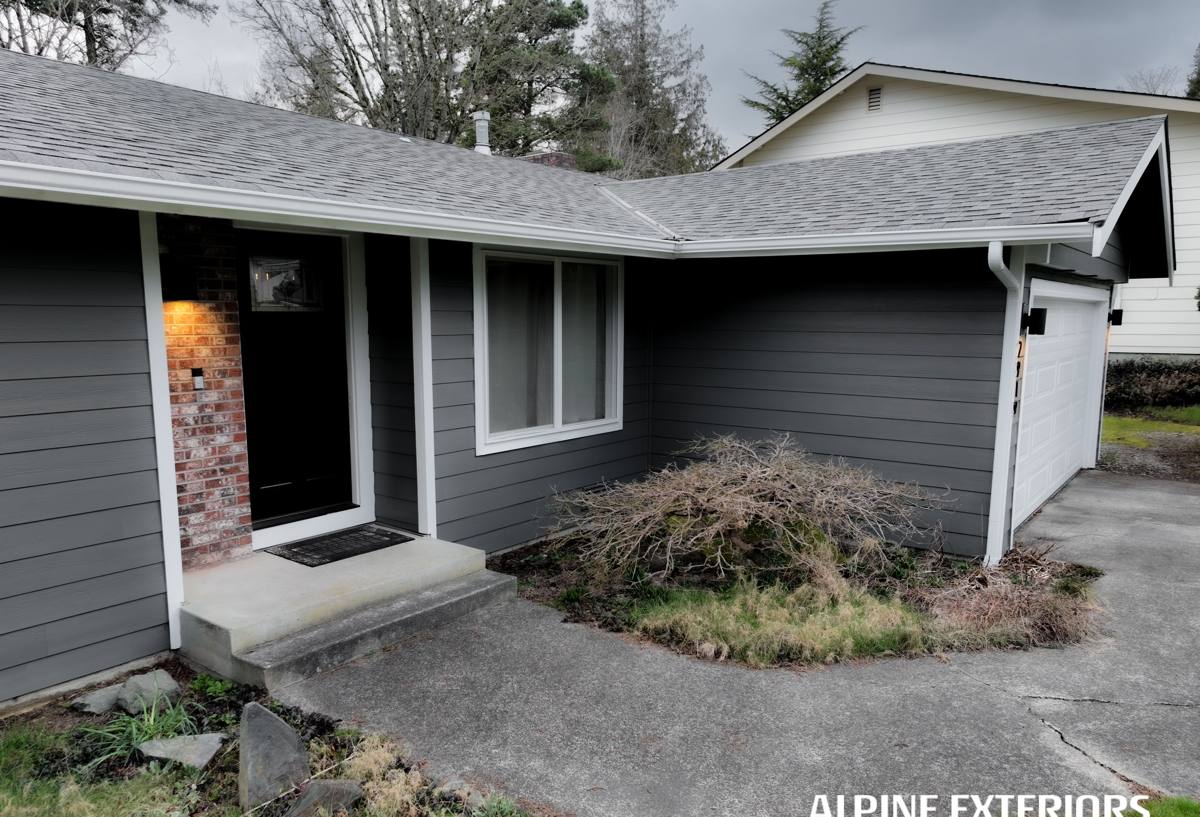
Signs a Blanchard Home Actually Needs Replacement, Not Repair
Not every siding problem calls for a full tear-off. But in this climate, cosmetic issues are often a signal of something deeper already happening behind the panels. Here's what we look for during an inspection:
- Soft or spongy spots when you press on the siding, especially near the bottom courses and around window trim
- Visible cupping, buckling, or panel separation, particularly on the sides of the house that take the most wind-driven rain
- Persistent moss or dark streaking that comes right back within a season of cleaning
- Paint or factory finish that's chalking, peeling, or has lost its bond to the substrate
- Interior signs — musty smells, peeling interior paint near exterior walls, or visible staining on sheathing during any opened-up section
- Siding that's original to a home built more than 20-25 years ago, especially if it's a wood composite or older vinyl product
If you're only seeing one or two of these and they're isolated, a repair or partial replacement might make sense. If they're showing up in multiple places, or if there's any sign of water having gotten behind the cladding, a full replacement is almost always the more honest recommendation — patching over compromised sheathing just delays a bigger repair.
What a Correct Siding Replacement Actually Involves
A siding replacement is not just swapping old panels for new ones. Done right, it's a whole-wall moisture management job, and skipping steps here is exactly how a brand-new install ends up with the same problems in half the time. A correct job includes:
Full Tear-Off and Inspection
Old siding comes off completely so the sheathing and framing underneath can be inspected. In a climate like Blanchard's, it's common to find at least some soft sheathing or minor rot around windows, doors, and low corners, even on homes that looked fine from the outside. That damage gets addressed before anything new goes up — covering it over is how small problems become structural ones.
Water-Resistive Barrier and Flashing
A proper weather-resistive barrier gets installed over the sheathing, with flashing detailed correctly around every window, door, and penetration. This is the layer that actually stops water from reaching your framing — the siding itself is the first line of defense, not the last. Given how much driving rain this area sees, corner and window flashing details matter more here than in drier inland climates.
Correct Fastening and Clearances
Fastener spacing, siding-to-ground clearance, and butt joint sealing all have to follow manufacturer specs, not shortcuts. Under-fastened siding flexes and works loose over time; siding installed too close to grade or a deck surface wicks up moisture continuously.
Why We Install Only James Hardie Fiber Cement Here
We get asked why we don't offer vinyl, LP SmartSide, or cedar as options. The honest answer is that we've standardized on James Hardie fiber cement because it's the product that holds up best to the specific combination of conditions Blanchard homes face, and we'd rather stand behind one system we trust completely than offer several and let a homeowner unknowingly pick the wrong one for this climate.
Vinyl siding is affordable and low-maintenance in mild conditions, but it's a thin material that expands and contracts significantly with temperature swings, and its seams and J-channels give wind-driven rain more opportunities to find a way behind the cladding. Over time in a wet marine climate, that can mean moisture intrusion that's hard to detect from outside. LP SmartSide and other wood-strand composite products perform reasonably well when installation and caulking are maintained perfectly, but they're wood-based at the core — any consistent moisture exposure, which this area has in abundance, puts long-term durability at the mercy of ongoing maintenance. Cedar is a beautiful, honest material, but it's also organic: it needs regular refinishing, and moss and mildew take hold on cedar faster than on almost anything else we install, especially on shaded elevations.
James Hardie fiber cement is non-combustible, dimensionally stable, and doesn't support moss and algae growth the way wood-based products do. It comes with a factory-applied ColorPlus finish that's baked on and warranted against fading and peeling, so you're not relying on job-site paint to hold up against salt air. That's the difference that matters most in Blanchard: a wall system that doesn't depend on perfect ongoing maintenance to keep performing.
Material Comparison for Chuckanut's Marine Climate
| Factor | James Hardie Fiber Cement | Vinyl | LP SmartSide | Cedar |
|---|---|---|---|---|
| Moisture resistance | High — cement composite, doesn't absorb and swell | Moderate — seams are the weak point | Moderate — dependent on caulk/paint maintenance | Low-moderate — natural wood, absorbs moisture |
| Moss/algae resistance | High — inorganic surface | Moderate | Low-moderate — organic wood fiber | Low — organic material, prone to growth |
| Salt air / coastal durability | High | Moderate | Moderate | Low-moderate |
| Finish durability | Factory-baked ColorPlus finish, warranted | Color molded through, can fade/chalk | Field-applied paint, needs upkeep | Needs periodic staining/sealing |
| Fire performance | Non-combustible | Combustible | Combustible | Combustible |
Choosing the Right Hardie Product Line for Blanchard
James Hardie makes region-specific product formulations, and for homes in this part of Washington, we spec their HZ5 climate zone products, engineered for wetter, colder coastal regions rather than the HZ10 formulation used in hot, dry climates. Beyond the base formulation, most Blanchard homes end up choosing between:
- HardiePlank lap siding — the most common choice, available in several exposure widths and textures, from smooth to traditional cedar-grain
- HardiePanel — vertical panel siding, often used for accent gables, shop buildings, or a modern look
- HardieShingle — staggered or straight-edge shingle profiles for homes wanting a more traditional coastal look
- HardieTrim — matching trim boards for corners, fascia, and window/door surrounds, so the whole exterior system is consistent and equally weather-resistant
Color selection matters here too. Darker ColorPlus tones show less of the surface staining that comes with airborne salt and organic debris, while lighter tones can show streaking sooner in shaded, damp locations — something worth discussing honestly before you commit to a color for a north-facing wall that never fully dries out.
Our Siding Replacement Process
We run every Blanchard project through the same sequence, because skipping steps is how climate-related failures happen down the road:
- On-site inspection and written scope, including a look at trim, flashing, and any visible moisture damage before we quote
- Full tear-off of existing siding and inspection of sheathing/framing, with damaged material repaired or replaced before moving forward
- Installation of a code-compliant water-resistive barrier and correctly detailed flashing at every window, door, and penetration
- Installation of James Hardie siding, trim, and accessories to manufacturer fastening and clearance specifications
- Caulking, touch-up, and a final walkthrough so you know exactly what was done and what maintenance to expect
What Affects the Cost of a Blanchard Siding Replacement
| Cost Factor | Why It Matters |
|---|---|
| Home size and wall complexity | More linear footage, gables, and dormers mean more material and labor |
| Condition of existing sheathing | Hidden moisture damage found during tear-off adds repair scope |
| Siding profile and trim package | Lap width, shingle detailing, and trim complexity affect material and install time |
| Color and finish selection | Factory ColorPlus finishes vs. field-painted trim can shift pricing |
| Site access | Steep lots, limited driveway access, or tight setbacks near neighboring homes can add labor time |
We won't quote a firm number without seeing the house, but we always walk homeowners through which of these factors are driving their specific estimate, rather than handing over a number with no explanation.
Why Hiring a Crew That Already Works in Blanchard Matters
A contractor who's spent time working this stretch of Whatcom County knows which elevations of a house typically take the worst of the wind-driven rain, where moss tends to establish first, and how to detail flashing so it accounts for salt air corrosion over the life of the fasteners — not just at the time of install. That local pattern recognition is hard to replace with a generic install crew working from a spec sheet alone. It's also worth asking any contractor you're vetting how long they've worked in this specific climate, what siding systems they actually install (versus offer as an option), and whether they'll put their process — tear-off, sheathing inspection, flashing, install — in writing before work starts.
Caring for Your New Siding After Installation
- Rinse siding gently once or twice a year to keep salt residue and organic debris from building up, especially on shaded walls
- Trim back vegetation and tree cover that keeps a wall surface damp and shaded longer than necessary
- Recaulk joints and trim seams as part of routine home maintenance, even with a low-maintenance product
- Inspect after major windstorms for any loosened trim or fastener issues
- Keep gutters and downspouts clear so roof runoff isn't adding extra water load to your siding
If you're weighing a siding replacement for a Blanchard home, we're happy to come take a look and give you a straight, no-pressure estimate — including an honest read on whether repair, partial replacement, or full replacement actually makes sense for your house.