 Chuckanut Exterior
 A roof in Bow doesn't fail the way a roof fails in a drier, more sheltered part of the state. Out here, salt air off the water works on metal fasteners and flashing year-round, driving rain gets pushed sideways into laps and seams that would stay dry in a calmer storm, and a long moss season keeps north-facing slopes damp for months at a stretch. Roof repair in this part of Whatcom County isn't just patching a leak — it's addressing whichever of these three factors actually caused the problem, so the same spot doesn't fail again next season. This page covers what Bow homes typically need from a roof repair, what a correct job involves, and how our process works from first call to final walk-through.
Why Bow Roofs Fail Differently
Most of the repair calls we get in this area trace back to one of three conditions, and they rarely act alone — a roof weakened by one is more vulnerable to the others.
Salt Air
Airborne salt corrodes exposed metal faster than most homeowners expect. Nail heads, flashing, vent stacks, and gutter hardware that would hold up for decades inland can start showing rust within a handful of years this close to the water. Corrosion at a fastener or flashing seam is one of the most common — and most avoidable — causes of a slow, hard-to-trace leak.
Driving Rain
Rain here doesn't always fall straight down. Wind off the water pushes it at an angle, which forces water into laps, valleys, and flashing details that a roof built to a bare minimum standard simply isn't set up to handle. A repair that only patches the visible gap without addressing how wind-driven rain reaches that gap in the first place tends not to last.
Moss Season
Shaded, moisture-holding conditions support a long moss and algae season on north-facing slopes and anywhere tree cover keeps a roof from drying between rains. Moss holds water against the roofing surface, lifts shingle edges, and can work its way under laps that were never quite sealed tight. A repair on a moss-heavy roof that doesn't also address the moss itself is a repair that will likely need repeating.
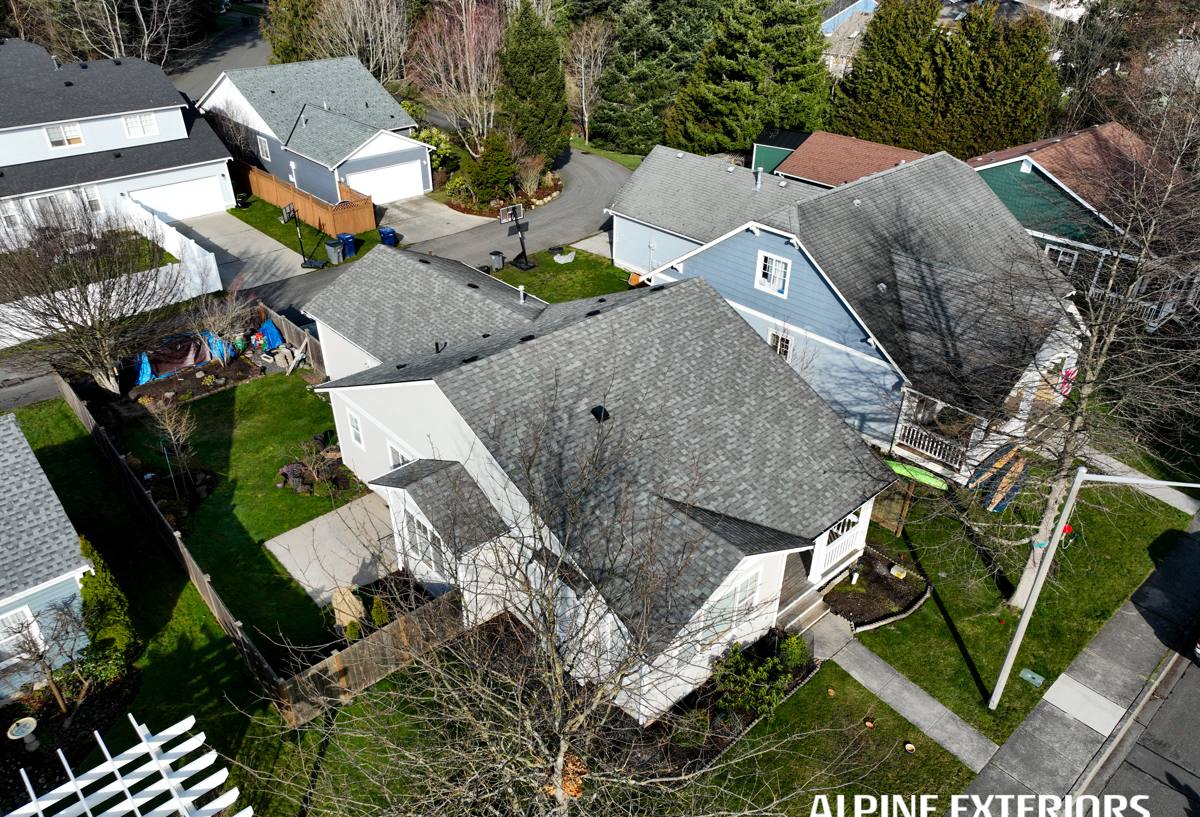
Signs a Bow Roof Needs Repair
Some of these point to a straightforward, localized repair. Others suggest a bigger problem worth having looked at before it spreads. Either way, catching them early keeps a repair a repair instead of letting it become a replacement.
- A stain on a ceiling or ceiling corner that shows up or spreads during wind-driven rain
- Missing, cracked, or curling shingles in an isolated area rather than across the whole roof
- Rust staining running down from a nail head, flashing edge, or vent stack
- Moss buildup on a slope that's thick enough to hold visible moisture after the rest of the roof has dried
- Daylight visible through the roof deck from inside the attic
- Granules collecting in gutters beyond what normal light shedding would explain
- A soft or spongy spot underfoot in one section of the roof
- A leak that only shows up during storms with strong wind, not during calm rain
Common Repair Types We Handle
Not every repair is the same job wearing a different name. The table below covers the repairs we see most often around Bow, what usually causes them, and how urgent they typically are.
| Repair Type | Typical Cause Here | Urgency |
|---|---|---|
| Flashing repair or replacement | Corroded or improperly sealed flashing at chimneys, skylights, vents, or roof-to-wall transitions | High — flashing failures are a leading source of active leaks |
| Shingle replacement (localized) | Wind damage, granule loss, or isolated storm impact | Moderate to high depending on exposure of the gap |
| Moss and debris removal with treatment | Long moss season on shaded or north-facing slopes | Moderate — left untreated it accelerates other damage |
| Fastener and hardware correction | Salt-air corrosion on standard, non-marine-rated fasteners | Moderate — often found during another repair, not on its own |
| Underlayment or valley repair | Wind-driven rain finding a path past minimum-code underlayment | High if actively leaking; moderate if caught proactively |
| Deck repair (localized sheathing) | Sustained moisture exposure from an undetected leak | High — compromised deck affects everything installed above it |
We'll tell you plainly which category your roof falls into during the on-site look, along with why — not just what needs fixing but what caused it, so you're not paying to fix the same thing twice.
What a Correct Repair Actually Involves
A repair that only addresses what's visible from the ground or the attic tends to be a short-term fix. A repair done right traces the problem back to its actual source.
Finding the Real Leak Path
Water rarely enters where it shows up inside. It can travel along rafters or sheathing before dripping somewhere entirely separate from the actual failure point. We trace the path back to the source rather than patching the spot where the stain appeared, which is the single biggest difference between a repair that holds and one that doesn't.
Matching Materials Correctly
A repair patched with mismatched shingles, incompatible flashing metal, or the wrong fastener type can create a new failure point even while fixing the old one. We match materials to what's already on the roof where possible, and use corrosion-resistant hardware suited to a marine environment regardless of what was originally installed.
Addressing the Underlying Cause
If the real issue is a flashing detail that was undersized for wind-driven rain, or ventilation that's kept a section of deck too damp for too long, patching the surface without correcting that underlying issue just delays the next call. We flag those causes honestly, even when the fix is more involved than the customer expected walking in.
Sealing and Weatherproofing
Sealant has its place, but it's not a substitute for correct flashing and lap technique — it's a backup, not the primary defense. We use it as intended, not as a shortcut to avoid doing the underlying repair correctly.
Our Roof Repair Process
- Initial call and scheduling. We get a general sense of the problem and get a visit scheduled, usually without a long wait given how quickly small leaks can become bigger ones.
- On-site inspection. We look at the roof from both outside and, where accessible, from inside the attic, to trace the actual leak path rather than guessing from the visible damage alone.
- Honest diagnosis. We explain what we found, what caused it, and what it will take to fix it correctly — including whether a repair makes sense or whether the roof's condition points toward replacement instead.
- Written estimate. You get a clear scope and price before any work starts, with no surprise add-ons once we're on the roof.
- The repair itself. Damaged material comes out, the deck underneath is checked, and the repair goes in with correct flashing, underlayment, and fastener choices for this climate.
- Cleanup and debris removal. Old material, moss debris, and any loose granules or fasteners are cleared from the roof and gutters before we consider the job done.
- Final walk-through. We show you what was done and why, and flag anything else on the roof worth keeping an eye on going forward.
Repair or Replace? How We Decide
Most homeowners calling about a leak want to know upfront whether they're looking at a repair bill or a much bigger conversation. We won't stretch a repair recommendation to avoid that conversation, and we won't push replacement on a roof that's still got useful life left in it.
- Repair usually makes sense when: the damage is localized, the roof is within a reasonable portion of its expected service life, and the deck underneath is sound
- Replacement is usually the honest answer when: damage is spread across multiple sections, the deck has widespread rot or soft spots, or the roof is old enough that further repairs are just delaying an inevitable full re-roof
- A gray area worth discussing: a roof with one or two significant problem areas but otherwise sound material — sometimes a targeted repair buys several more good years; sometimes it doesn't, and we'll tell you which we think it is
Either way, that decision is yours to make once you have an honest read on the roof's actual condition, not ours to make for you through a sales pitch.
Materials and Hardware for a Salt-Air Climate
What goes into a repair matters as much as the repair technique itself. Standard-grade fasteners and flashing that are perfectly fine forty miles inland corrode faster this close to the water, which is exactly how small repairs turn into recurring ones.
- Corrosion-resistant fasteners rated for coastal or marine exposure, not standard interior-grade hardware
- Flashing metal chosen for how it holds up against salt air over years, not just how it looks fresh out of the box
- Underlayment and self-adhered membrane at vulnerable points like valleys and eaves, where wind-driven rain is most likely to find a way in
- Algae-resistant shingle replacement material where a color and product match is available, to slow the return of moss and staining in the repaired area
Why Hire a Crew That Already Works Bow
A roofer who mostly works drier, more sheltered jobs isn't wrong about roofing in general — they're working from a different set of defaults. Fastener specs, flashing choices, and underlayment coverage that hold up fine on a typical inland roof are often undersized for what a Bow roof deals with year-round. A crew that already works this part of Whatcom County has seen firsthand which details actually fail out here, not just which ones fail in a textbook or a training manual written for a different climate.
There's a practical side to this too. A repair done without accounting for salt air or wind-driven rain exposure can look complete on the day it's finished and still fail within a season or two. Local experience means the materials and technique are chosen for the conditions this roof actually faces, not for the conditions a generic repair job assumes.
Maintaining a Repaired Roof
A correctly done repair still benefits from some basic upkeep given the conditions here, especially in the months following the work:
- Keep gutters clear so water isn't backing up under roof edges during heavy rain
- Watch the repaired area through at least one full wet season to confirm it's holding
- Address any new moss growth before it spreads back across a treated slope
- Trim back tree cover that keeps a section of roof shaded and slow to dry out between rains
- Have flashing points checked periodically, especially after a significant windstorm
- Call about any new stain or damp spot right away rather than waiting to see if it happens again
If you've got a leak, a soft spot, or a section of roof that's just not looking right, we're glad to take a look and give you an honest read on what it needs. Reach out for a free, no-pressure estimate using the form below.