 Chuckanut Exterior
 Storm Damage Roof Repair for Columbia Homes
When a windstorm rolls through Whatcom County, the damage it leaves on a roof in Columbia rarely looks dramatic from the ground. A few lifted shingles, a strip of missing granules, a bent piece of flashing at a chimney — none of it looks urgent. But a roof doesn't need a hole in it to start leaking. It just needs one seam or one nail pattern to give way, and water finds the rest on its own. Storm damage repair done right is about finding that weak point before it becomes a ceiling stain, not just patching the spot that's already obviously broken.
Columbia sits close enough to the water and the tree cover around Chuckanut that its homes take a specific kind of beating: salt-laden air that works on metal fasteners and flashing year-round, wind that drives rain sideways and up under shingle edges instead of straight down, and a moss season that runs long on shaded, north-facing slopes. None of that shows up as a single dramatic event. It shows up as a roof that fails a few years earlier than it should, and storm damage is usually what tips a roof that was already compromised into an active leak.
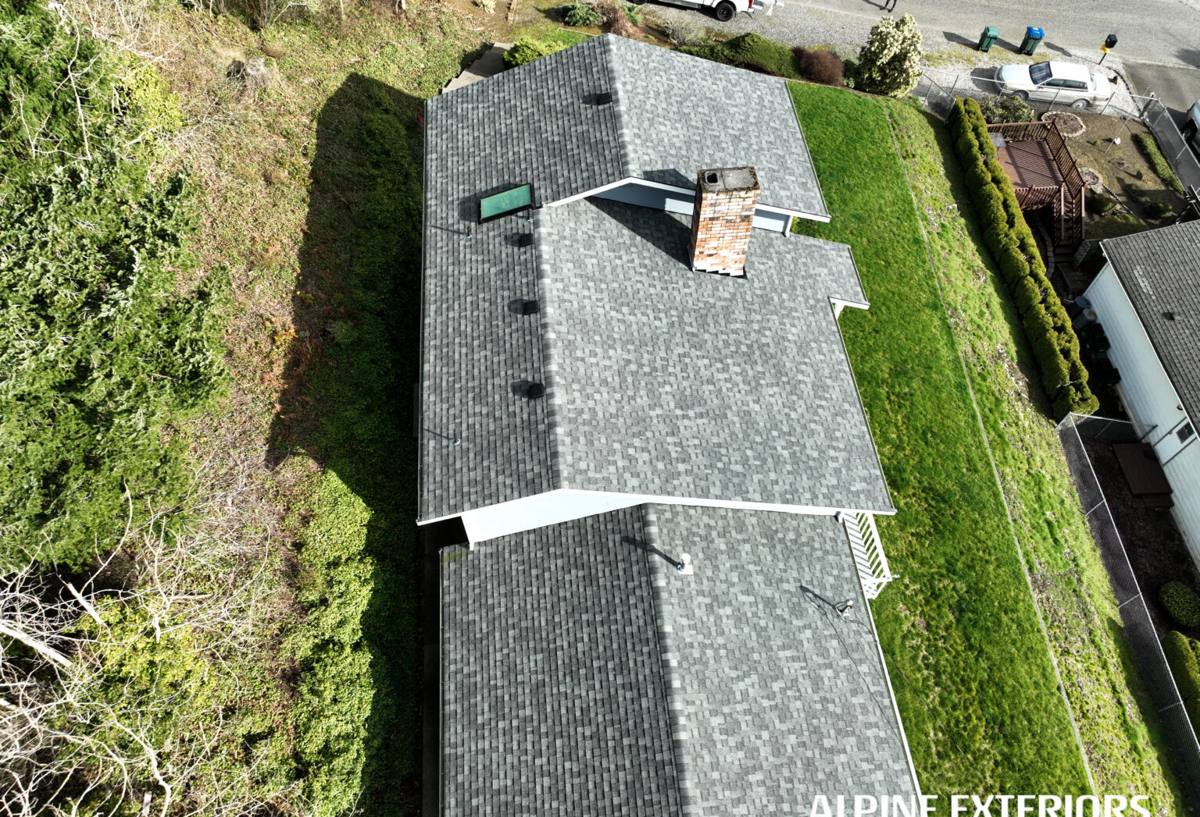
What Storm Damage Actually Looks Like on a Roof Here
Storm damage isn't always a tarp-worthy emergency. Most of what we find after a windstorm falls into a handful of categories, and knowing what to look for from the ground — safely, without getting on a ladder — helps homeowners decide how urgent a call really is.
Wind Damage
Sustained wind and gusts lift shingle tabs and break the sealant strip that holds them flat. Sometimes they reseat on their own after the wind dies down; often they don't, and they sit slightly raised, which is exactly the gap wind-driven rain needs to get underneath. Ridge cap shingles, being the most exposed row on the roof, tend to go first.
Impact Damage
Columbia's tree cover is part of what makes the area appealing, and it's also a source of storm risk. Branches and debris coming down in a windstorm can crack shingles, dent metal flashing, or in worse cases punch through decking. Even small branch strikes can knock loose enough granules to expose the asphalt mat underneath to UV and moisture.
Flashing and Seal Failures
Flashing around chimneys, skylights, vent pipes, and roof-to-wall transitions is sealed with caulking and mechanical laps, not a solid membrane. Wind can work a flashing edge loose over time, and a hard storm is often what finally pulls it far enough to let water in. This is one of the most common sources of a leak that shows up well away from where the actual damage is.
Granule Loss and Mat Exposure
Driving rain and wind together accelerate granule loss on shingles that are already aging. Granules are what protect the asphalt mat from UV breakdown — once they're gone in a patch, that spot ages faster than the rest of the roof and becomes a likely future leak point even if it isn't leaking yet.
Why Salt Air, Driving Rain, and a Long Moss Season Change the Math
A storm-damaged roof in a dry inland climate and a storm-damaged roof in Columbia are not the same repair problem, even if the visible damage looks identical.
Salt Air and Fasteners
Proximity to the water means airborne salt is a constant, low-grade presence, and it accelerates corrosion on exposed nail heads, metal flashing, and gutter hardware. A fastener that would hold reliably for decades further inland can start to weaken years sooner here. When we do storm repair work, we're checking fastener and flashing condition around the damage, not just the damaged shingles themselves, because salt exposure often means nearby hardware is closer to failing too.
Wind-Driven Rain
Rain that comes in sideways behaves differently than rain that falls straight down. It gets pushed up under shingle tabs, into flashing laps, and along ridge lines that would stay dry in a calmer storm. A repair that only addresses the visible tear or lifted shingle, without accounting for how wind-driven rain moves across that section of roof, can look finished and still leak in the next storm.
Moss and Trapped Moisture
Chuckanut's tree cover keeps shaded roof slopes damp for long stretches of the year, and moss takes hold fastest where storm damage has already disturbed the shingle surface — a cracked tab, a bare patch of exposed mat, a lifted edge. Moss doesn't just sit there looking bad; its root structure holds moisture against the shingle and works its way under tabs, which can turn a small storm repair area into a soft, rotting patch of decking if it's left unaddressed for a season or two.
Why a Small Storm Repair Shouldn't Be Ignored
The most common mistake we see isn't a homeowner who ignores obvious damage — it's a homeowner who reasonably assumes minor damage can wait. A few lifted shingles after a windstorm often can wait a short while if there's no active leak. The problem is that "minor" and "actively leaking" aren't the same threshold, and the gap between them can close fast once wind-driven rain and moss get into a disturbed section of roof.
- Hidden moisture entry: Water can travel along the underside of decking for feet before it shows up as a ceiling stain, so by the time you see evidence indoors, the damage is often already established.
- Insulation damage: Wet attic insulation loses most of its effectiveness and can take a long time to dry out on its own, driving up heating costs long after the storm has passed.
- Sheathing rot: Repeated small exposures — not one dramatic leak, but months of a slow drip — are what actually rot roof decking, and rotted decking is a materially bigger repair than the original storm damage.
- Insurance timing: Most homeowner policies have documentation and filing windows tied to the storm event itself. Waiting months to address damage can complicate a claim even when the damage is legitimate.
How We Approach a Storm Damage Repair in Columbia
Storm repair work follows a different sequence than routine roof maintenance, because the priority order is safety first, then stopping active water intrusion, then a proper permanent fix.
1. Immediate Assessment and Temporary Protection
If there's active leaking or exposed decking, the first step is stopping water intrusion — typically a tarp or temporary patch — before anything else. This isn't the repair itself; it's buying time so the permanent fix can be done correctly rather than rushed.
2. A Full Roof Inspection, Not Just the Obvious Spot
We walk the whole roof, not just the section where damage is visible from the ground. Wind and impact damage often has a secondary point of entry nearby that isn't obvious until someone is up there looking at flashing laps, ridge condition, and granule wear directly.
3. Documentation
We photograph and document what we find before any repair work starts. If a homeowner is filing an insurance claim, this record matters — adjusters work from evidence, and clear documentation of storm-specific damage (as opposed to gradual wear) is often the difference in how a claim gets evaluated.
4. Matching the Repair to the Actual Damage
Not every storm-damaged roof needs full replacement, and not every roof can be properly fixed with a spot patch. We look at the extent of the damage, the age and remaining life of the existing roof, and whether the shingle can still be reasonably matched, then give a straight recommendation rather than defaulting to the largest possible scope of work.
5. Correct Reinstallation, Not Just Patching Over
A proper storm repair reinstalls flashing with correct laps, replaces underlayment where it's been compromised, and reseats or replaces shingles with attention to how wind and rain move across that specific roof plane — not just a surface patch over the visible damage.
Repair or Replace? What Actually Determines the Right Call
Homeowners understandably want a straight answer to "do I need a new roof or just a repair," and the honest answer depends on a handful of factors working together, not any single one of them.
| Factor | Leans Toward Repair | Leans Toward Replacement |
|---|---|---|
| Extent of damage | Isolated to one section or slope | Spread across multiple slopes or widespread granule loss |
| Roof age | Roof is well within its expected service life | Roof is already near end of life; storm damage accelerates the decision |
| Shingle match | Matching shingles are available or the patch is on a less visible slope | Discontinued color/line makes a clean patch impossible |
| Underlying decking | Decking is sound once exposed | Rot or soft spots found once shingles are pulled back |
| History of prior repairs | First significant repair on this roof | Multiple past patches suggest a roof that's been failing gradually |
Roof age matters more than most homeowners expect. A well-installed asphalt shingle roof typically has an expected service life in the range of 20 to 30 years depending on the product line and installation quality, and storm damage on a roof already near that mark is often the practical trigger for replacement rather than a series of increasingly patchwork repairs.
Working With Insurance on a Storm Claim
We're contractors, not insurance adjusters, and we won't promise a claim outcome we don't control. What we can do is give homeowners an honest, documented assessment that supports their own conversation with their carrier.
- Take photos and notes at the time of inspection, before any repair work begins, so there's a clear record tied to the storm event.
- Distinguish storm-specific damage from pre-existing wear in our assessment — carriers look closely at this distinction, and an honest assessment holds up better than an inflated one.
- Be available to walk an adjuster through what we found if the homeowner requests it.
- Give a written scope and estimate the homeowner can use in their claim, without pressuring them into signing anything before they've had a chance to review it.
Be cautious of anyone who shows up unsolicited after a storm promising to "handle the insurance company" for you or asking you to sign an assignment of benefits on the spot. A legitimate local contractor is glad to document damage and support your claim — but the decision about your policy and your claim is yours to make, not something to hand off to whoever knocked on the door first.
Choosing a Crew That Already Works Columbia
After any significant windstorm in Whatcom County, it's common to see unfamiliar trucks and door-to-door offers for fast, cheap roof repair. Some of that work is fine. A lot of it isn't, and the problem usually doesn't show up until the following winter, when a rushed patch fails and the crew that did it is nowhere to be found.
A crew that already works this part of the coast has a working understanding of things that don't show up in a generic repair — how far salt air travels inland from the water, which roof orientations around Chuckanut hold moss longest, and how wind-driven rain actually behaves on a given roof pitch. That's the difference between a repair that holds and one that needs to be redone in a year or two.
What to Check Before Hiring Anyone for Storm Repair
- Current Washington State contractor license, verifiable through the state Department of Labor & Industries
- General liability insurance and workers' compensation coverage, provided in writing without hesitation
- A real local address and phone number — not a P.O. box or an out-of-area call center
- A written scope of work and estimate before any deposit changes hands
- No pressure to sign the same day, and no claims of an "insurance deadline" that doesn't actually exist
- Willingness to explain, specifically, how the repair addresses your roof's actual damage — not a generic answer
What to Do in the First 24 to 48 Hours After a Storm
How a homeowner handles the first day or two after storm damage affects both the eventual repair and, often, the insurance outcome.
- Stay off the roof. Storm-damaged shingles and wet surfaces are not safe to inspect on foot, and a fall is a far worse outcome than a delayed repair.
- Photograph visible damage from the ground — missing shingles, debris on the roof, damaged gutters or flashing you can see safely.
- Check attics and ceilings for new staining, drips, or musty odor, which can indicate a leak even before it's visible from outside.
- Call for a professional inspection promptly rather than waiting to see if it "gets worse" — early assessment gives more options and better documentation.
- Avoid signing anything with a contractor who shows up unsolicited before you've had a chance to verify who they are.
If a recent storm has left your Columbia roof with lifted shingles, damaged flashing, or a leak you can't quite place, we're glad to take a look and give you a straight, no-pressure assessment — free of charge — and walk you through exactly what we find and what it would take to fix it right. Use the form below to request an estimate.
```