 Chuckanut Exterior
 Silver Beach's Climate Is Hard on Siding — Here's Why
Silver Beach homes deal with a specific combination of punishment that a lot of siding products simply weren't built for: salt-tinged air moving in off the water, wind-driven rain that hits walls sideways instead of falling straight down, and a moss and algae season that can stretch for most of the year in Whatcom County's cool, damp climate. Any one of these on its own is manageable. Together, over years, they expose every weakness in a siding system — swelling seams, failing caulk joints, moisture trapped behind panels, and paint that gives out years before it should.
This is why siding choice matters more here than it does in a drier, more sheltered part of the state. A product that performs fine in Eastern Washington can fail early in a Whatcom County shoreline neighborhood. Before we talk about installation, it helps to understand what the material itself needs to be able to do.
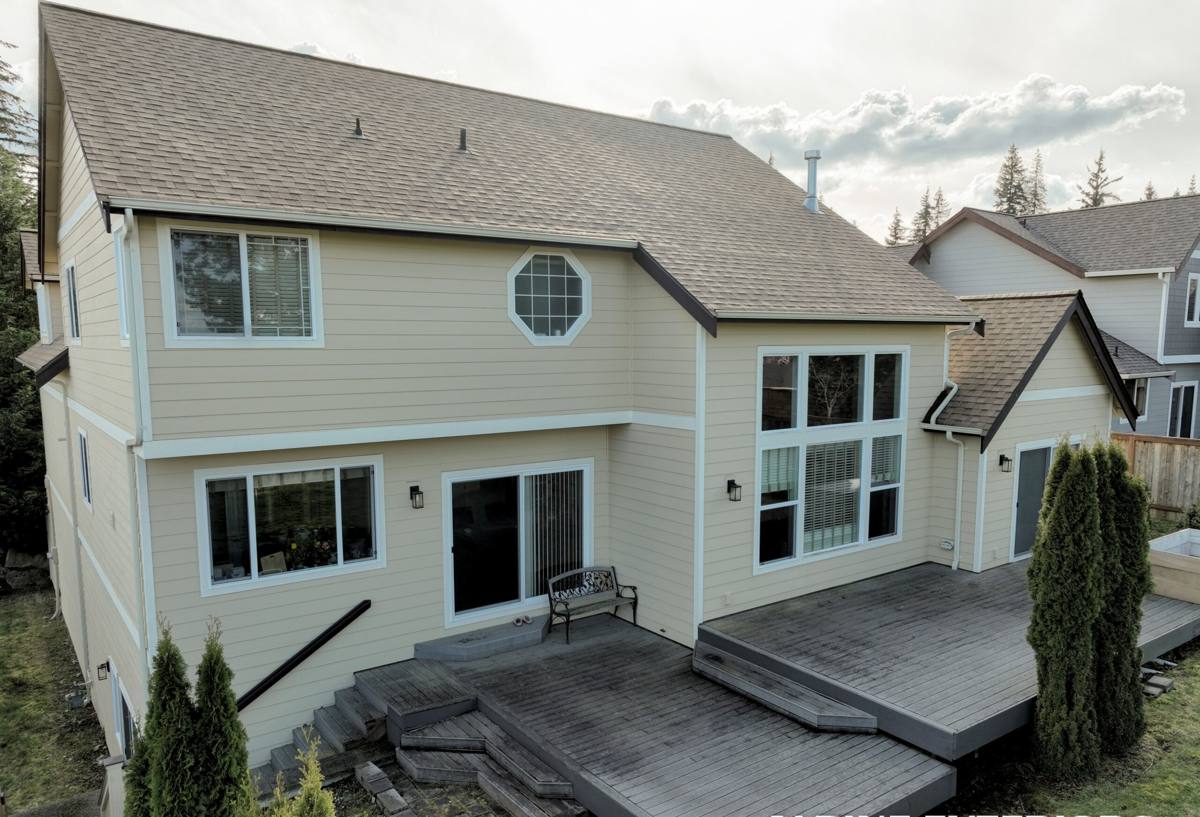
Why We Install Only James Hardie Fiber Cement
We don't install vinyl, LP SmartSide, Cemplank, Allura, primed spruce, or cedar. That's not a marketing line — it's a standard we hold because of what we've seen these products do (or fail to do) in exactly this kind of coastal, high-moisture environment over time.
Vinyl siding is affordable and easy to install, but it's a thin plastic product that expands and contracts with temperature swings, can crack in cold snaps, and offers no real fire resistance. LP SmartSide and similar engineered-wood products use wood strand cores — even with resin treatment, wood-based cores are more vulnerable to swelling and rot if water finds its way behind the panel, which is a real risk in a climate with this much sustained rain. Primed spruce and cedar are natural wood: beautiful, but high-maintenance, and they demand disciplined repainting and caulking schedules that most homeowners can't realistically keep up with in a wet marine climate.
James Hardie fiber cement is made from cement, sand, and cellulose fiber. It doesn't have an organic core to rot, it's non-combustible, and it holds paint and factory finishes far longer than wood-based alternatives because the material itself is dimensionally stable — it doesn't expand and contract the way wood or vinyl does with moisture and temperature changes. Hardie also engineers its HZ product lines by climate zone, and the HZ5 formulation used in the Pacific Northwest is specifically built to resist the freeze-thaw cycling and sustained moisture exposure common to Whatcom County.
ColorPlus Finish vs. Field Paint
Most Hardie products we install come with the ColorPlus factory finish — a baked-on finish applied under controlled conditions, backed by its own finish warranty, that resists fading and holds up better than paint applied on-site after installation. In a climate where moss, algae, and constant dampness stress a paint film, that factory-cured finish is a real advantage over field-painted siding, which is more exposed to weather during the curing window and more likely to need touch-up sooner.
What a Correct Installation Involves
Fiber cement is only as good as the installation behind it. Hardie's own installation instructions are specific for a reason — in a climate like Silver Beach's, skipping a step doesn't just void the warranty, it creates a moisture problem hiding behind new siding that looks fine from the curb.
- Weather-resistive barrier: A code-compliant house wrap or building paper goes on before any siding, lapped correctly to shed water downward.
- Drainage plane / rain screen: In a high-rainfall climate, a small gap behind the siding lets any moisture that does get in drain and dry out instead of sitting against the wall.
- Minimum ground and roof clearances: Hardie specifies clearance from grade, decks, roof lines, and other horizontal surfaces so water can't wick up into the bottom edge of the siding.
- Flashing at every penetration: Windows, doors, hose bibs, light fixtures, and vents all need proper flashing so water is directed out and away from the wall assembly, not into it.
- Sealed and primed cut edges: Every field cut exposes raw fiber cement that needs to be primed and, where required, caulked — factory edges are already sealed, but job-site cuts are not.
- Correct fastening pattern: Proper nail placement, spacing, and blind- or face-nailing per the product and exposure keeps panels secure without cracking the board or restricting the very slight movement the material needs.
Skip any one of these and you can end up with water intrusion at a window head, a rotting band board hidden behind a beautiful new lap siding job, or premature paint failure at panel seams — all things that show up two or three winters later, after the crew that cut corners is long gone.
Our Process on a Silver Beach Job
1. Assessment and Moisture Check
We start by inspecting the existing siding and, where accessible, the sheathing behind it. In a wet climate, it's common to find soft sheathing or old water staining behind aging siding — we flag this before tear-off so there are no surprises mid-project.
2. Tear-Off and Sheathing Repair
We remove the old siding down to the sheathing, replace or repair any damaged sections, and correct any flashing or trim details that weren't done right the first time.
3. Weather Barrier and Drainage Plane
New house wrap goes on correctly lapped, with a drainage gap where the wall assembly calls for one, before a single piece of Hardie siding is hung.
4. Installation to Spec
Panels or planks go up per Hardie's fastening and clearance requirements, with every window, door, and penetration flashed and every field-cut edge sealed.
5. Trim, Caulking, and Touch-Up
Trim boards, corner details, and any ColorPlus touch-up paint are finished last, matched to the factory finish so seams and fastener heads disappear into the color.
6. Final Walkthrough
We walk the finished job with the homeowner, cover basic care, and register the Hardie product warranty.
Choosing the Right Hardie Product for a Silver Beach Home
Hardie makes several distinct product lines, and the right one depends on the home's existing architecture, the look you want, and how much detail work (trim, corners, batten strips) you're willing to take on.
| Product | Look | Best Fit |
|---|---|---|
| HardiePlank lap siding | Traditional horizontal lap, widest range of homes | Most Silver Beach houses, classic and craftsman-style exteriors |
| HardieShingle | Staggered or straight-edge shingle profile | Cottage or Cape Cod-influenced homes wanting texture |
| HardiePanel with battens | Vertical panel with board-and-batten detail | Modern or farmhouse-style exteriors, accent gables |
| HardieTrim | Fiber cement trim boards | Corners, window/door surrounds, fascia — pairs with any of the above |
A lot of Silver Beach homes end up using a primary lap siding with a shingle or board-and-batten accent on a gable or entry feature — it breaks up a large wall plane and gives the house some character without turning the project into a full custom design job.
Keeping Moss and Algae From Winning
Even the best siding needs a little upkeep in a climate this damp. The good news is that Hardie's maintenance needs are modest compared to wood, and none of it is complicated.
- Keep gutters clear so water isn't sheeting down the wall face during heavy rain.
- Trim back shrubs and landscaping so air can move along the wall and siding can dry between storms.
- Rinse siding gently once or twice a year to clear moss and algae buildup before it takes hold — a garden hose and soft brush is usually enough; avoid high-pressure washing directly at seams and caulk lines, which can force water behind the panels.
- Check caulking at trim joints, window edges, and penetrations annually, and re-caulk any cracked or shrunken beads before the wet season sets in.
- Watch north-facing and shaded walls most closely — they dry slowest and are usually the first place moss reappears.
What Factors Drive the Cost
Every Silver Beach home is different, so we won't quote a number without seeing the job, but these are the factors that actually move the price:
| Factor | Why It Matters |
|---|---|
| Home size and number of stories | More wall area and taller walls mean more material, labor, and staging/scaffolding needs |
| Condition of existing sheathing | Rot or moisture damage found during tear-off adds repair scope before new siding can go on |
| Trim and architectural detail | Multiple gables, dormers, or accent materials take more cutting, fitting, and flashing work |
| Product line and profile | Lap siding, shingle profile, and panel-and-batten systems differ in material and labor time |
| Site access | Tight lots, slopes, or limited equipment access can add time to any project |
Broadly, a full siding replacement is a significant home investment, and the range between a straightforward single-story lap job and a detail-heavy multi-story project with extensive trim work can be substantial. The only way to get a real number is a walk of the actual house.
Why Hiring a Crew That Already Works Silver Beach Matters
Siding installation isn't just a product question — it's a local-conditions question. A crew that regularly works Whatcom County's shoreline and near-shoreline neighborhoods already understands the wind-driven rain patterns that push water sideways into wall assemblies, knows how aggressive to be with drainage details given the moss and rainfall here, and is familiar with local permitting and inspection expectations. That local track record shows up in the small decisions — how tight to run a drainage gap, where to add extra flashing, which walls need the most attention — that a crew unfamiliar with this specific climate might not think to make.
It also matters for the warranty. Hardie's transferable warranty depends on correct installation to their published specifications. A contractor who installs Hardie regularly, in this exact climate, is far more likely to get every detail right the first time — which protects both the look of the house and the paperwork behind it.
Get a Free, No-Pressure Estimate
If your Silver Beach home's siding is showing its age — cracked caulk, peeling paint, soft spots, or persistent moss you can't get ahead of — we're happy to take a look and walk you through what James Hardie siding would involve for your specific house, with no pressure and no obligation. Use the form below to request a free estimate.