 Chuckanut Exterior
 Why Sedro-Woolley Homes Need Siding Built for This Climate
Homes around Sedro-Woolley spend most of the year wet. Long stretches of driving rain, heavy fall and winter moisture, and shaded lots where moss and algae take hold on north-facing walls all add up to a tougher environment for exterior materials than most homeowners realize. Wood-based siding products absorb that moisture over time. Once water gets behind or into a wall assembly, it doesn't dry out quickly here — the air stays damp for months at a stretch, especially under tree cover or in low-lying yards near the river valley.
That's the backdrop for every siding decision we make on this side of the state. We install James Hardie fiber cement exclusively, and on a wet-climate job like a typical Sedro-Woolley home, the reasons are practical, not brand loyalty. Hardie's fiber cement doesn't rot, doesn't feed moss the way untreated wood fiber can, and holds a factory finish that doesn't need repainting every few years just to keep water out.
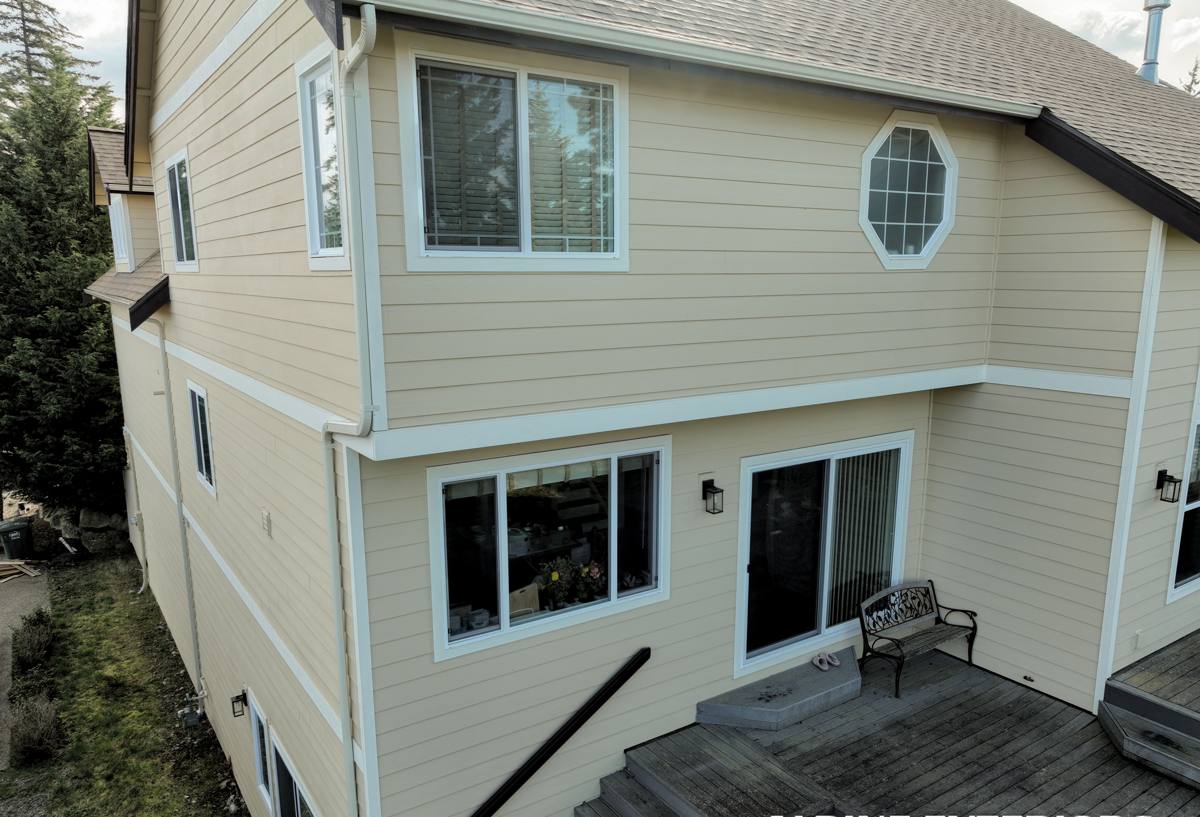
What Local Homes Are Up Against
If you're calling us about siding, it's usually because something's already showing. The patterns we see most often on homes in this area include:
- Soft or delaminating panels on the north and west walls, where sun exposure is lowest and moisture lingers longest
- Green-black staining and moss growth building up along horizontal laps and under eaves with limited overhang
- Caulk joints that have cracked or pulled away, letting wind-driven rain track behind the siding at trim and window edges
- Paint that's chalking or peeling well before the manufacturer's expected repaint interval, usually a sign the substrate underneath is already taking on moisture
None of these are cosmetic-only problems. Once moisture gets past the siding's face, it's working on the sheathing, the framing, and eventually the interior finishes. Catching it at the siding stage is the cheap version of the fix.
Why James Hardie Fits This Climate
Fiber Cement vs. What It Replaces
James Hardie siding is cement, sand, and cellulose fiber — not wood, and not vinyl. That composition matters directly for a place like this:
- It doesn't rot. There's no wood fiber for moisture to break down over time, which matters on shaded walls that rarely fully dry out.
- It resists moss and mildew staining far better than bare or primed wood. The factory-cured surface doesn't have the same porous grain that organic growth anchors into.
- It holds paint — or skips the need for it. ColorPlus factory finish is baked on and warrantied separately from the substrate, so you're not repainting every 5-7 years just to keep the wall protected.
- It's non-combustible. Not a climate factor specifically, but a real advantage anywhere in Washington given regional wildfire seasons.
HZ5 Engineering
James Hardie makes region-specific product lines, and the HZ5 formulation is engineered for the wetter, harsher climate zones — which includes Western Washington. It's not a marketing label; the difference is in the moisture and impact performance of the board itself. We install the HZ5 line here for that reason, not the version built for drier climates.
What a Correct Installation Actually Involves
Fiber cement siding is only as good as the installation behind it. A huge share of the "Hardie problems" homeowners hear about — cracking, moisture intrusion, premature caulk failure — trace back to installation shortcuts, not the product. In a wet climate, those shortcuts fail faster and worse. A correct job includes:
Water Management First
- A weather-resistive barrier installed and lapped correctly behind every panel, not just stapled on as an afterthought
- Proper flashing at every window, door, and roofline intersection — the majority of leaks we find start at these transitions, not in the field of the wall
- Correct minimum clearances between the bottom edge of the siding and the ground, roof lines, decks, and patios, so splash-back and standing water can't wick into the board
Fastening and Joints
- Manufacturer-spec nailing patterns and fastener types — over-driven or under-driven nails are one of the most common causes of early panel failure
- Properly gapped and sealed butt joints, using sealants rated for the movement and moisture exposure Hardie specifies, not general-purpose caulk
- Panels cut and fit to manufacturer tolerances, not forced or overlapped to save time
None of this is exotic. It's James Hardie's published installation standard, followed to the letter. The reason it matters more here than in a drier climate is that any gap in the water management chain gets tested by rain more often, for more months of the year, than almost anywhere else in the country.
Our Process on a Sedro-Woolley Job
- Inspection and diagnosis. We look at what's actually happening on your walls now — moisture readings where relevant, condition of existing sheathing once siding is off, and where water has been getting in.
- Tear-off and sheathing check. We don't side over rot. If sheathing or framing has taken damage, we address it before anything new goes up — covering it over just resets the clock on the same failure.
- Weather barrier and flashing installation. This is the layer nobody sees once the job is done, and it's the layer that determines whether the siding actually keeps water out for the next several decades.
- Hardie panel installation to spec. HZ5 boards, manufacturer nailing pattern, correct clearances, properly sealed joints.
- Trim, caulking, and final detailing. The small stuff — corner boards, J-channel, touch-up — is where a rushed job shows. We don't rush it.
- Walkthrough and cleanup. You should be able to see and understand what was done and why.
Cost Factors on a Typical Job
Every home is different, but the variables that move price on a Sedro-Woolley siding project are fairly consistent. This isn't a quote — it's what to expect the estimate to weigh:
| Factor | Why It Matters |
|---|---|
| Tear-off vs. new construction | Removing old siding and dealing with any hidden sheathing damage adds labor that's hard to estimate until walls are opened up |
| Siding profile (lap, panel, shingle) | HardiePlank lap siding, vertical panel systems, and HardieShingle accent siding all have different material and labor costs |
| Home complexity | Dormers, multiple gables, and cut-up wall lines mean more trim work and more seams to detail correctly |
| ColorPlus vs. field paint | Factory-finished ColorPlus costs more up front but skips a full repaint cycle and carries its own finish warranty |
| Access and site conditions | Tree cover, tight lot lines, and multi-story walls affect scaffolding and staging time |
Why a Crew That Already Works This Area Matters
Siding installation isn't one-size-fits-all across Washington. A crew that mostly works drier inland climates can install Hardie correctly on paper and still miss the details that matter here — clearance heights that assume less standing moisture, caulk choices that assume less sustained dampness, or flashing sequencing that hasn't been stress-tested against a genuinely wet fall and winter. Working Sedro-Woolley and the surrounding area regularly means we're seeing how these installations actually hold up in this climate over years, not just at the final walkthrough.
It also means fewer surprises during the job itself — knowing what condition to expect under existing siding on homes of a certain age, what local permitting and inspection expectations look like, and how to sequence work around the wetter months instead of fighting them.
Maintenance: What Ownership Looks Like After Installation
Correctly installed Hardie siding is low-maintenance, not zero-maintenance. A simple annual routine keeps it performing the way it's designed to:
- Rinse off accumulated grime, pollen, and early moss growth with a garden hose and soft brush — avoid high-pressure washing directly at joints and edges
- Walk the exterior once a year and check caulking at trim, windows, and joints for cracking or separation
- Keep gutters clear and downspouts directed away from the foundation so splash-back doesn't sit against the bottom courses
- Trim back vegetation and tree limbs that keep walls shaded and damp longer than necessary
- Address any impact damage (a stray branch, equipment bump) promptly rather than letting a chip sit exposed
Warranty
James Hardie backs its fiber cement siding with a non-prorated limited warranty, and ColorPlus factory finishes carry their own separate finish warranty covering fading and peeling. Warranty coverage is tied to correct installation per manufacturer specification — another reason installation quality isn't optional, it's what keeps the warranty intact if you ever need it.
If your siding is showing moss staining, soft spots, failing paint, or you're planning ahead for a home in the Sedro-Woolley area, we're happy to take a look and give you a straightforward assessment. Reach out for a free, no-pressure estimate — the form below gets you started.