 Chuckanut Exterior
 Why Roofs Age Faster Around Sedro-Woolley
A roof in this part of Washington doesn't fail the way a roof does in a dry climate. It fails from the outside in, slowly, over years of exposure that most homeowners never see until the damage shows up as a stain on a ceiling. Moist marine air moves inland off the Sound and carries salt with it, which accelerates corrosion on fasteners, flashing, and any exposed metal. Add driving rain that hits roofs sideways during winter storms, not just straight down, and you get water finding its way into laps, valleys, and vent penetrations that would stay dry in a calmer climate. Then there's moss season, which in this area isn't really a season at all — it's most of the year, thanks to shade, humidity, and mild temperatures that never dry a roof out for long.
We work out of Chuckanut in Whatcom County, and Sedro-Woolley is part of our regular service area, not a place we drive to occasionally. That matters because the right roofing decisions here — material choice, ventilation, moss control — are specific to this climate, not generic advice pulled from a manufacturer's national brochure.
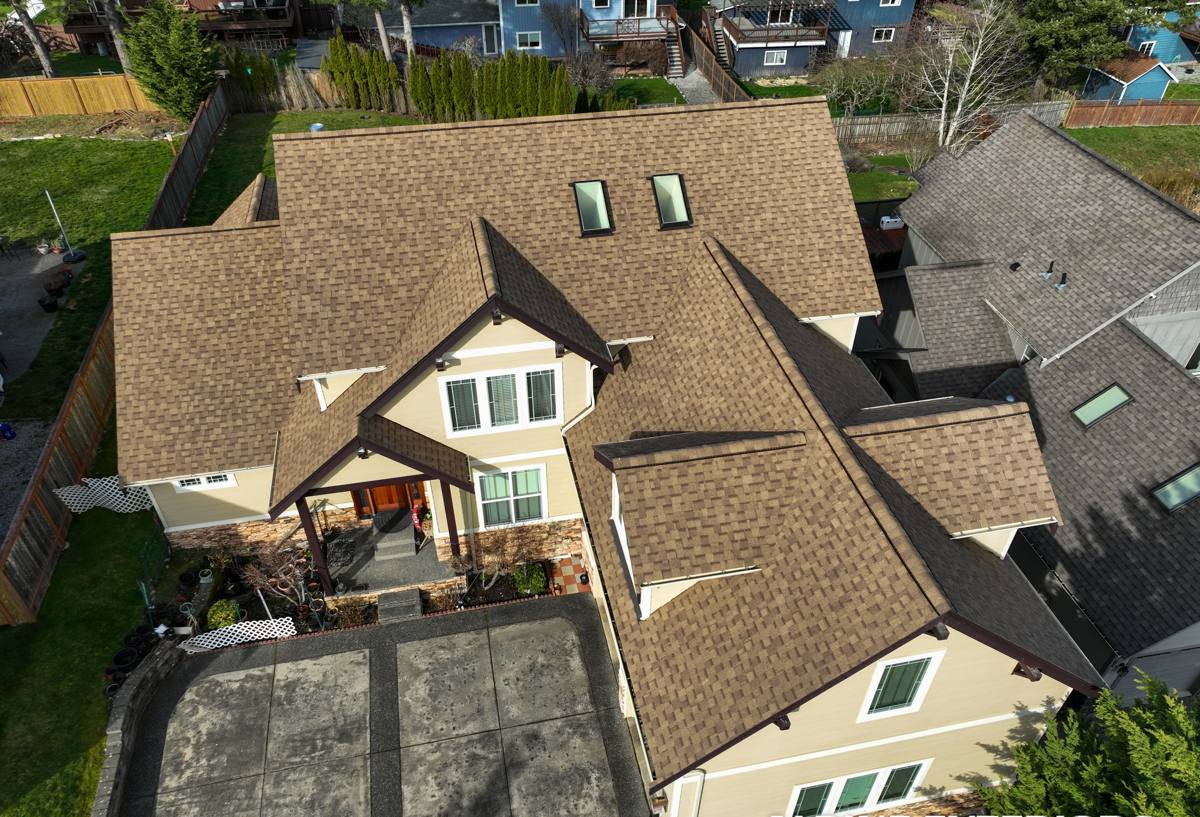
Signs You Need Replacement, Not Another Repair
Every roof eventually crosses a line where patching stops being the honest answer. Repairs make sense when the problem is isolated — a cracked pipe boot, a section of lifted shingles, a chimney flashing leak. Replacement makes sense when the roofing material itself is worn out and repairs would just be chasing new leaks every wet season.
- Shingles are curling, cupping, or losing granules in large patches, not just around one vent
- The roof is original and 20-25+ years old (typical lifespan for standard asphalt shingles in this climate, often shorter than the manufacturer's rated life due to moisture exposure)
- Moss has worked its way under shingle edges and is visibly lifting them, not just growing on the surface
- You've had more than one leak in different spots over the past couple of years
- Daylight, staining, or a spongy feel is visible in the attic decking
- Valleys show wear or granule loss faster than the rest of the field, a common early failure point in heavy-rain climates
If your roof shows one or two of these, a repair may still buy you time. If it shows several at once, replacement is usually the more honest and more economical path — not because we want to sell a bigger job, but because piecemeal repairs on a worn-out roof rarely hold up through another wet winter.
What a Correct Roof Replacement Actually Involves
A roof replacement is not just stripping old shingles and nailing down new ones. In a climate that gets sustained rain and long stretches of dampness, the details underneath the visible surface are what determine whether the roof lasts 10 years or 30.
Tear-Off and Deck Inspection
We remove the old roofing down to the deck rather than layering over it. That's the only way to actually see what's underneath — soft spots, rot, or delamination in the plywood or plank decking that hides under old shingles for years. Any damaged decking gets replaced before anything new goes down. Installing new roofing over a compromised deck just guarantees a shorter lifespan for the new material.
Underlayment and Moisture Protection
This is the layer that protects your home if wind-driven rain ever gets past the shingles, which happens more often here than in drier regions. We use synthetic underlayment as standard, with self-adhered ice-and-water membrane at vulnerable spots — eaves, valleys, and roof-to-wall transitions — where wind-driven rain is most likely to work its way backward under the shingle laps.
Ventilation
Attic ventilation matters as much as the roofing material itself. A poorly ventilated attic traps moisture, which condenses on the underside of the decking and accelerates rot from the inside — independent of how good the shingles are. We check intake at the eaves and exhaust at the ridge and correct the balance where it's insufficient, which is common on older homes that were never updated for current ventilation standards.
Flashing and Transitions
Flashing around chimneys, skylights, dormers, and sidewalls is where most roof leaks actually originate, not in the open field of shingles. We install new flashing rather than reusing old pieces, since bent or corroded flashing — especially with salt air accelerating corrosion on lower-grade metal — is a leak waiting to happen regardless of how new the surrounding shingles are.
Choosing a Roofing Material for This Climate
There's no single "best" roofing material — there's a best fit for your home's structure, your budget, and how much long-term maintenance you're willing to do. Here's how the common options compare for a home in this climate:
| Material | Typical Lifespan | Moss/Moisture Resistance | Maintenance | Relative Cost |
|---|---|---|---|---|
| Architectural asphalt shingle | 20-30 years | Good with algae-resistant granules; needs periodic moss removal | Low to moderate | $ |
| Standing seam metal | 40-50+ years | Excellent — sheds moss and moisture, minimal surface for growth to grip | Low | $$$ |
| Cedar shake (natural) | 20-30 years with upkeep | Poor without regular treatment — absorbs moisture, prone to moss and rot | High | $$$ |
| Synthetic/composite shake | 30-40 years | Good — mimics cedar look without the moisture absorption | Low to moderate | $$ |
We're generally cautious about recommending natural cedar shake for homes in this area, not because it can't look good, but because of what it demands over time: regular treatment, more frequent moss removal, and a moisture-absorption profile that's simply harder to manage under sustained rain and shade. If a homeowner wants that look, synthetic shake products get closer to the appearance with a maintenance schedule that's realistic for this climate.
Our Replacement Process, Start to Finish
- On-site inspection and written estimate — we walk the roof (or use a lift/drone where pitch or access requires it), check the attic, and give you a clear scope and price before any work is scheduled.
- Material selection — we go over the tradeoffs in plain terms so you're choosing based on your home and budget, not a sales script.
- Permitting — we handle the permit process required for your jurisdiction so it's not something you have to chase down yourself.
- Property protection — landscaping, siding, and gutters get covered or protected before tear-off begins.
- Tear-off and deck inspection — old roofing comes off, decking is inspected and repaired as needed.
- Underlayment, flashing, and installation — the layers described above go down in the correct order, not shortcuts.
- Cleanup and magnetic nail sweep — the property is cleared of debris and swept for stray fasteners.
- Final walkthrough — we go over the finished roof with you before calling the job done.
Moss, Algae, and Keeping a New Roof Looking Good
Given how long moss season runs here, a new roof needs a maintenance plan, not just a good installation. A few things make a real difference over the life of the roof:
- Zinc or copper strips installed near the ridge, which release trace metal ions in rainwater that inhibit moss and algae growth down the roof slope
- Algae-resistant shingle products, which most major manufacturers now offer as standard on architectural lines
- Keeping gutters and downspouts clear so water isn't sitting or backing up against roof edges
- Trimming back overhanging branches that keep sections of the roof shaded and damp longer than the rest
- Gentle, low-pressure moss removal on a regular schedule rather than aggressive pressure washing, which can strip granules and shorten shingle life
None of this eliminates moss entirely — that's not realistic in this climate — but it slows regrowth significantly and protects the investment you just made in a new roof.
Why a Crew That Already Works in Sedro-Woolley Matters
Roofing crews that only occasionally work outside their home base tend to learn a region's quirks the hard way, on your roof, during your job. Working this area regularly means we already know how local weather windows behave — when it's realistic to schedule tear-off without betting against an incoming rain system, and how to sequence a job so your home isn't sitting open to the weather longer than necessary. It also means familiarity with the age and construction of housing stock common in this area, which affects everything from deck thickness to how much ventilation correction a given roof typically needs. And if a warranty question comes up two or five years down the road, you're calling a crew that's still working in your area, not chasing down a contractor who moved on to other regions.
Questions to Ask Before You Hire a Roofing Contractor
- Are you licensed and insured in Washington, and can you provide proof?
- Will you tear off down to the deck, or do you offer overlays — and why?
- What underlayment and ice-and-water protection do you use at eaves and valleys?
- How will you address attic ventilation, not just the shingles themselves?
- Is the estimate written and itemized, with materials and scope clearly spelled out?
- What's the manufacturer's warranty versus your workmanship warranty, and what's the difference?
- Do you have references or completed work in this area you can point to?
A contractor who answers these clearly and without hesitation is generally a good sign. Vague answers or pressure to sign quickly are worth paying attention to.
If your roof is showing its age or you just want an honest read on where it stands, we're happy to take a look. We offer free, no-pressure estimates for roof replacement in Sedro-Woolley — use the form below to get started.